
Question 53 marksAsked 2017Easy
(i) Which particles are responsible for current in conductors?
(ii) To which wire of a cable in a power circuit should the metal case of a geyser be connected?
(iii) To which wire should the fuse be connected?
Confirming your payment
Sign up now and get 250 free tokens.
Previous Year Questions · Question 5 of 27
(i) Which particles are responsible for current in conductors?
(ii) To which wire of a cable in a power circuit should the metal case of a geyser be connected?
(iii) To which wire should the fuse be connected?
Solution:
Concept: In a metal conductor some electrons are only loosely held by their atoms (free electrons). When a potential difference is applied, they drift through the metal, and this flow of charge is the current. In earthing, the metal case of an appliance is joined to the earth wire, whose resistance is almost zero. If a fault makes the live wire touch the case, a very large current flows from the live wire through the case to the earth, and the fuse in the live wire blows at once. Only the live wire is at a high potential (220 V); the neutral and the earth are at 0 V. A device that is meant to make an appliance safe (a fuse, an MCB or a switch) must therefore cut it off from the live wire.
Step 1 — Name the particles (part i).
In a metal conductor the free electrons are responsible for the current: under a potential difference they drift from the negative end towards the positive end.
Step 2 — Wire for the metal case (part ii).
The metal case of the geyser is joined to the earth wire. If, because of a fault, the live wire touches the case, a heavy current passes through the earth wire to the ground and the fuse blows, so the person touching the geyser is safe.
Step 3 — Wire for the fuse (part iii).
The fuse is connected in the live wire. When it blows, the geyser is cut off from the live wire and is at 0 V, which is safe. If the fuse were in the neutral wire, the geyser would stop working but would still be joined to the live wire at 220 V, and touching it could give a fatal shock.
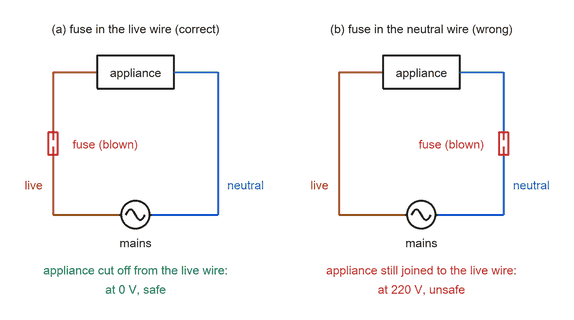
Watch out: A fuse in the NEUTRAL wire still stops the current, but it leaves the appliance at 220 V, which is dangerous.
Therefore, (i) free electrons; (ii) the earth wire; (iii) the live wire.