
Question 12 marksAsked 2016Easy
State the characteristics required in a material to be used as an effective fuse wire.
Confirming your payment
Sign up now and get 250 free tokens.
Previous Year Questions · Question 1 of 27
State the characteristics required in a material to be used as an effective fuse wire.
Solution:
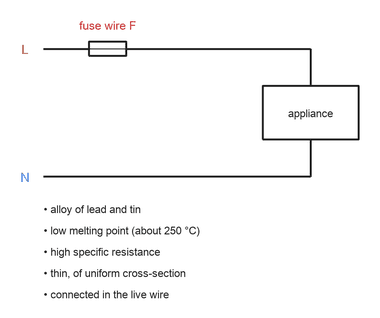
Concept: A fuse is a safety device that works on the heating effect of current. It is a short piece of thin wire of a tin–lead alloy, of high resistance and low melting point (about 250 °C), joined in series in the live wire. When the current goes above its current rating, it heats up, melts and breaks the circuit.
Step 1 — Low melting point.
The material must melt at a low temperature (the tin–lead alloy of fuse wire melts at about 250 °C), so that a small rise in current above the rating heats it enough to melt it at once.
Step 2 — High resistance.
The material must have a high resistance (high specific resistance), so that the excess current produces enough heat (H = I²Rt) to bring it quickly to its melting point.
Step 3 — Other points.
It is a short, thin wire of uniform cross-section, so that it melts at the same current along its whole length; an alloy of lead and tin is used. It is placed in the live wire, so that when it melts the appliance is cut off from the high potential.
Watch out: A good conductor such as copper is a BAD fuse material: it has a low resistance and a high melting point.
Therefore, a fuse wire material must have a low melting point and a high resistance (high specific resistance); a tin–lead alloy is used.