Solution:
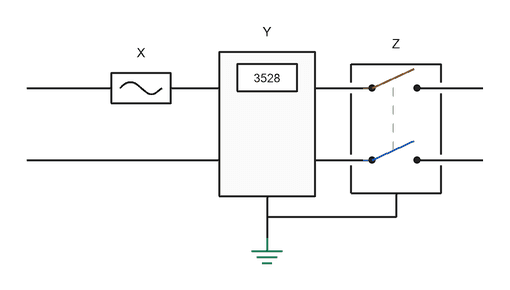
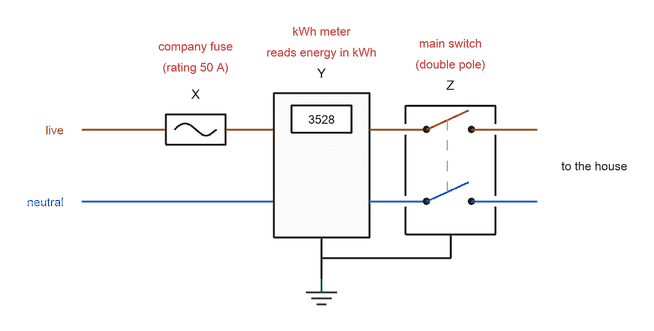
Concept: Where the cable enters a house, it passes in this order through the company (pole) fuse in the live wire, the kWh meter, and then, in the distribution box, the main switch (a double pole switch, in both wires) and the main fuse or MCB (in the live wire only).
Step 1 — Identify the devices.
The supply cable enters the building through the company (pole) fuse X in the live wire, then the kWh meter Y, then the main switch Z, before reaching the distribution box.
Step 2 — Give the rating of X (part a).
X is the company fuse, fitted in the live wire before the meter; its current rating is about 50 A.
Step 3 — Compare Z with home switches (part b).
Z is the main switch, a double pole switch: it breaks both the live and the neutral wires at the same time, so the whole building is cut off from the supply. The switches used for appliances at home are single pole switches: each breaks the live wire alone and controls one appliance.
Step 4 — Give the unit shown by Y (part c).
Y is the kWh meter; it shows the electrical energy consumed, in kilowatt hour (kWh), the 'unit' of electricity.
1 kWh=1000×3600 J=3.6×10⁶ J
Watch out: The meter shows ENERGY (kWh), not power (kW).
Therefore, (a) X, the company fuse, is rated about 50 A; (b) Z is a double pole switch that breaks the live and the neutral together, while home switches are single pole switches in the live wire only; (c) kilowatt hour (kWh).