
Question 33 marksAsked 2016Easy
(i) Name the transformer used in the power transmitting station of a power plant.
(ii) What type of current is transmitted from the power station?
(iii) At what voltage is this current available to our household?
Confirming your payment
Sign up now and get 250 free tokens.
Previous Year Questions · Question 3 of 27
(i) Name the transformer used in the power transmitting station of a power plant.
(ii) What type of current is transmitted from the power station?
(iii) At what voltage is this current available to our household?
Solution:
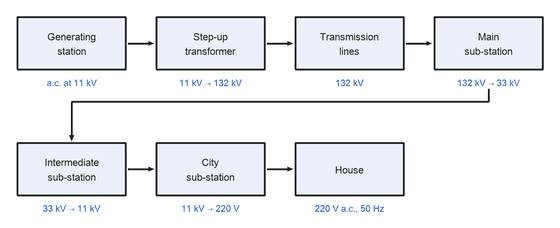
Concept: Electric power is generated as a.c. of frequency 50 Hz at 11 kV. At the grid sub-station a step-up transformer raises it to 132 kV for transmission. It is then stepped down in stages: to 33 kV at the main sub-station (for heavy industry), to 11 kV at the intermediate sub-station (for light industry), and to 220 V at the city sub-station, for the houses.
Step 1 — Name the transformer (part i).
At the power station the voltage is raised from 11 kV to 132 kV before transmission, so the transformer used is a step-up transformer.
Step 2 — Name the type of current (part ii).
Alternating current (a.c.) of frequency 50 Hz is transmitted. Only an alternating voltage can be stepped up or down by a transformer, so power is generated and sent as a.c.
Step 3 — Give the household voltage (part iii).
The voltage is stepped down in stages, from 132 kV to 33 kV, then to 11 kV, and finally to 220 V at the city sub-station. So the current reaches our homes at 220 V a.c., 50 Hz.
Watch out: A STEP-UP transformer is used at the generating end; step-down transformers are used near the consumers.
Therefore, (i) a step-up transformer; (ii) alternating current (a.c.); (iii) 220 V.