
Opening your dashboard
Class 8 Maths Chapter 17: Special Types of Quadrilaterals Solutions
45 textbook questions with step-by-step answers, free to read, for ICSE 2026-27.
Get talked through Ch 17, not just shown the answer
Reading a finished solution is not the same as being able to do it. The AI tutor takes one question at a time and works it with you, in your own words, until you can.
- Ask it out loud, in your own words
- It gives you the next step, not the answer
- Stuck on part (ii)? Start there
45 questions with solutions
1–3 marks · Mixed difficulty
- 11 mark
Question 1
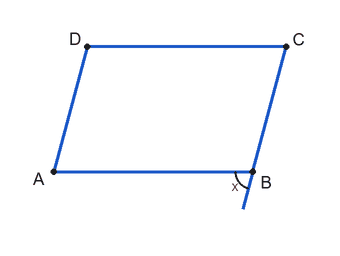
In the given figure ABCD is a parallelogram, angles DAB and ABC are in the ratio 5 : 7, the value of x is :
 Solve with AI
Answer
(A) 105°
(B) 85°
- Correct
(C) 75°
(D) none of these
Answer: (C) 75°
Concept: In a parallelogram, both pairs of opposite sides are parallel. So any two adjacent angles are co-interior angles between parallel lines and add up to 180°, and opposite angles are equal.
Step 1 — Find the angles of the parallelogram.
∠DAB and ∠ABC are adjacent angles of the parallelogram, so they add up to 180°. Sharing 180° in the ratio 5 : 7 gives ∠ABC the larger share of 7 parts out of 12.
Step 2 — Use the straight line at B.
In the figure, x is the angle between BA and side CB produced beyond B. Together with ∠ABC it makes a straight angle (a linear pair), so the two add up to 180°.
Step 3 — Check.
AD ∥ BC with AB as the transversal, so x and ∠DAB are alternate angles. ∠DAB is 5 parts of 12, which is also 75°, as it should be.
Watch out: X lies outside the parallelogram; it is not ∠ABC itself.
Why the other options are wrong:
- (A) 105°: 105° is ∠ABC, the angle inside the parallelogram at B, not the angle x outside it.
- (B) 85°: 85° does not come from the ratio: the two adjacent angles are 75° and 105°.
- (D) none of these: 75° is listed as option (C), so “none of these” is wrong.
Therefore, x = 75°, option (C).
- 21 mark
Question 2
ABCD is a rectangle. To make it a square which of the following condition(s) must be satisfied :
Solve with AIAnswer
(A) AC = BD
- Correct
(B) AC ⊥ BD
(C) Diagonals bisect each other
(D) AB = CD
Answer: (B) AC ⊥ BD
Concept: A square is a quadrilateral with all four sides equal and each angle 90°. It is a special rectangle and a special rhombus, so its diagonals are equal and bisect each other at right angles.
Step 1 — List what every rectangle already has.
Every rectangle has equal diagonals (AC = BD), diagonals that bisect each other, and equal opposite sides (AB = CD). A fact that is true for every rectangle cannot make a rectangle special.
Step 2 — Find the extra condition.
A square is a rectangle whose diagonals also cut each other at right angles (this happens exactly when two adjacent sides are equal). So the condition to add is AC ⊥ BD.
Watch out: Look for a condition that ordinary rectangles do NOT satisfy.
Why the other options are wrong:
- (A): Every rectangle already has equal diagonals, so this does not make it a square.
- (C) Diagonals bisect each other: The diagonals of every parallelogram, and so of every rectangle, bisect each other.
- (D): Opposite sides of every rectangle are equal; a square needs ADJACENT sides equal.
Therefore, the rectangle is a square when AC ⊥ BD, option (B).
- 31 mark
Question 3
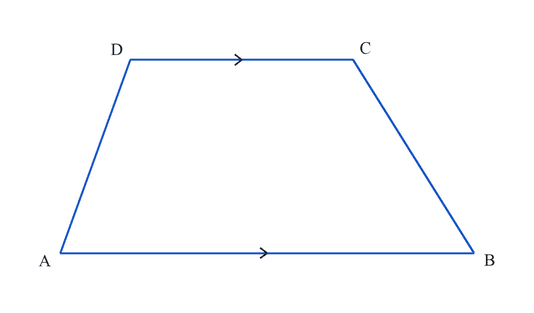
In quadrilateral ABCD, AB//DC, then :
 Solve with AI
Answer
(A) ∠A + ∠B = 180°
(B) ∠A + ∠C = 180°
(C) ∠C + ∠D = 180°
- Correct
(D) ∠A + ∠D = 180°
Answer: (D) ∠A + ∠D = 180°
Concept: A trapezium has one pair of opposite sides parallel. The two angles at the ends of each non-parallel side are co-interior angles, so they add up to 180°.
Step 1 — Spot the transversal.
Sides AB and DC are parallel, and side AD joins them, so AD is a transversal. ∠A (that is ∠DAB) and ∠D (that is ∠ADC) lie between the parallel lines on the same side of AD, so they are co-interior angles.
Step 2 — Use co-interior angles.
Co-interior angles between parallel lines add up to 180°, so ∠A + ∠D = 180°. In the same way, with BC as the transversal, ∠B + ∠C = 180°.
Watch out: The angles that add up to 180° sit at the two ends of a NON-parallel side (AD or BC), not at the ends of a parallel side.
Why the other options are wrong:
- (A): ∠A and ∠B sit at the two ends of the parallel side AB; they add up to 180° only in special cases, such as a parallelogram.
- (B): ∠A and ∠C are opposite angles; a general trapezium gives no reason for them to add up to 180°.
- (C): ∠C and ∠D sit at the two ends of the parallel side DC; they add up to 180° only in special cases.
Therefore, ∠A + ∠D = 180°, option (D).
- 41 mark
Question 4
The diagonals of a quadrilateral are equal and bisect each other. The quadrilateral is a :
Solve with AIAnswer
(A) square
(B) rhombus
(C) parallelogram
- Correct
(D) rectangle
Answer: (D) rectangle
Concept: A parallelogram becomes a rectangle when its diagonals are equal, and a rhombus when its diagonals cut at right angles. With both, it is a square.
Step 1 — Diagonals that bisect each other.
A quadrilateral whose diagonals bisect each other is a parallelogram.
Step 2 — Equal diagonals.
A parallelogram with equal diagonals is a rectangle. (The two triangles on one side are congruent by SSS, so two adjacent angles are equal; since they also add up to 180°, each is 90°.)
Step 3 — Choose the most exact name.
Nothing says the diagonals are perpendicular, so we cannot call it a square or a rhombus. The most exact name the facts prove is a rectangle.
Watch out: Give the most exact name the facts prove, neither a more special one nor a more general one.
Why the other options are wrong:
- (A) square: A square also needs the diagonals to meet at right angles, which is not given.
- (B) rhombus: A rhombus needs perpendicular diagonals; equal diagonals do not make one.
- (C) parallelogram: It is a parallelogram, but that name ignores the equal diagonals; the most exact answer is a rectangle.
Therefore, the quadrilateral is a rectangle, option (D).
- 51 mark
Question 5
A quadrilateral will be a square, if its :
Solve with AIAnswer
(A) each angle is 90°
(B) each angle is 90° and the diagonals are equal
(C) all the sides are equal
- Correct
(D) all the sides are equal and each angle is 90°
Answer: (D) all the sides are equal and each angle is 90°
Concept: A square is a quadrilateral with all four sides equal and each angle 90°. It is a special rectangle and a special rhombus, so its diagonals are equal and bisect each other at right angles.
Step 1 — Recall the definition.
A square needs two things at once: all four sides equal AND each angle 90°.
Step 2 — Test the options.
Only option (D) gives both conditions. Each of the others leaves out one of them.
Watch out: A rectangle's diagonals are always equal, so adding “diagonals equal” to “each angle 90°” gives nothing new.
Why the other options are wrong:
- (A) each angle is 90°: A quadrilateral with each angle 90° is a rectangle; its sides need not all be equal.
- (B): Every rectangle already has equal diagonals, so this still describes any rectangle, such as one 6 cm by 4 cm.
- (C) all the sides are equal: A quadrilateral with all sides equal is a rhombus; its angles need not be 90°.
Therefore, a quadrilateral is a square if all its sides are equal and each angle is 90°, option (D).
- 63 marks
Question 6
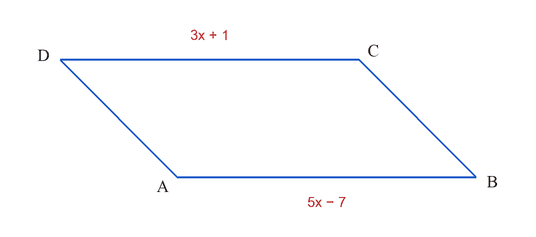
In parallelogram ABCD, ∠A = 3 times ∠B. Find all the angles of the parallelogram. In the same parallelogram, if AB = 5x − 7 and CD = 3x + 1, find the length of CD.
 Solve with AI
Written solution
Solution:
Concept: In a parallelogram, both pairs of opposite sides are parallel. So any two adjacent angles are co-interior angles between parallel lines and add up to 180°, and opposite angles are equal. Opposite sides are also equal.
Step 1 — Use adjacent angles.
∠A and ∠B are adjacent angles of the parallelogram, so they add up to 180°. Let ∠B be b degrees; then ∠A is 3b degrees.
Step 2 — Find all four angles.
So ∠B = 45°, and ∠A is three times as large.
Opposite angles of a parallelogram are equal. So ∠C equals ∠A, giving ∠C = 135°, and ∠D equals ∠B, giving ∠D = 45°.
Step 3 — Use equal opposite sides.
AB and CD are opposite sides of the parallelogram, so they are equal.
Step 4 — Find CD.
Now substitute x = 4 in CD.
As a check, AB gives the same length.
Watch out: Opposite angles are equal; it is the ADJACENT angles ∠A and ∠B that add up to 180°.
Therefore, ∠A = 135°, ∠B = 45°, ∠C = 135°, ∠D = 45° and CD = 13 units.
- 73 marks
Question 7
In parallelogram PQRS, ∠Q = (4x − 5)° and ∠S = (3x + 10)°. Calculate : ∠Q and ∠R.
 Solve with AI
Written solution
Solution:
Concept: In a parallelogram, both pairs of opposite sides are parallel. So any two adjacent angles are co-interior angles between parallel lines and add up to 180°, and opposite angles are equal.
Step 1 — Opposite angles are equal.
In parallelogram PQRS the vertices go round in order, so ∠Q and ∠S are opposite angles and are equal.
Step 2 — Find ∠Q.
Substitute x = 15.
Step 3 — Find ∠R.
∠R is adjacent to ∠Q, so the two add up to 180°.
Watch out: ∠Q and ∠S are opposite, so they are EQUAL, not supplementary.
Therefore, ∠Q = 55° and ∠R = 125°.
- 83 marks
Question 8
In rhombus ABCD :
if ∠A = 74°, find ∠B and ∠C.
 Solve with AI
Written solution
Solution:
Concept: A rhombus is a parallelogram with all four sides equal. Its diagonals bisect each other at right angles, and each diagonal bisects the angles at its two ends. Being a parallelogram, its adjacent angles add up to 180° and its opposite angles are equal.
Step 1 — Find ∠B.
∠A and ∠B are adjacent angles of the rhombus (a parallelogram), so they add up to 180°.
Step 2 — Find ∠C.
∠C is opposite ∠A, and opposite angles of a parallelogram are equal. So ∠C = 74°, the same as ∠A.
Therefore, ∠B = 106° and ∠C = 74°.
- 93 marks
Question 9
In rhombus ABCD :
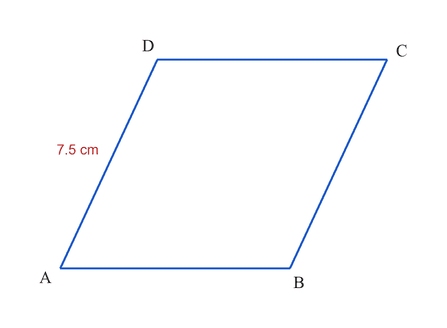
if AD = 7.5 cm, find BC and CD.
 Solve with AI
Written solution
Solution:
Concept: A rhombus is a parallelogram with all four sides equal. Its diagonals bisect each other at right angles, and each diagonal bisects the angles at its two ends.
Step 1 — Recall the property.
All four sides of a rhombus are equal: AB, BC, CD and DA all have the same length.
Step 2 — Apply it.
AD = 7.5 cm, so BC and CD are also 7.5 cm each.
Therefore, BC = 7.5 cm and CD = 7.5 cm.
- 103 marks
Question 10
In square PQRS :
if PQ = 3x − 7 and QR = x + 3, find PS.
 Solve with AI
Written solution
Solution:
Concept: A square is a quadrilateral with all four sides equal and each angle 90°. It is a special rectangle and a special rhombus, so its diagonals are equal and bisect each other at right angles.
Step 1 — Equal sides.
All sides of a square are equal, so PQ = QR.
Step 2 — Find PS.
PS is also a side of the square, so it equals QR.
As a check, PQ gives the same length.
Therefore, PS = 8 units.
- 113 marks
Question 11
In square PQRS :
if PR = 5x and QS = 9x − 8. Find QS.
 Solve with AI
Written solution
Solution:
Concept: A square is a quadrilateral with all four sides equal and each angle 90°. It is a special rectangle and a special rhombus, so its diagonals are equal and bisect each other at right angles.
Step 1 — Equal diagonals.
PR and QS are the two diagonals of the square, and the diagonals of a square are equal.
Step 2 — Find QS.
Substitute x = 2 in QS.
As a check, PR gives the same length.
Therefore, QS = 10 units.
- 123 marks
Question 12
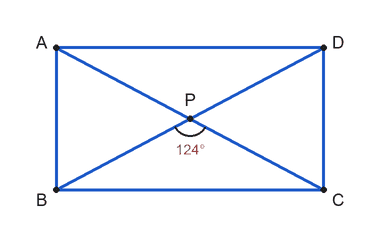
ABCD is a rectangle. If ∠BPC = 124°,
calculate :
(i) ∠BAP (ii) ∠ADP.
 Solve with AI
Written solution
Solution:
Concept: A rectangle is a parallelogram with each angle 90°. Its diagonals are equal and bisect each other.
Step 1 — Equal half-diagonals.
The diagonals of a rectangle are equal and bisect each other, so the four half-diagonals PA, PB, PC and PD are all equal. This makes triangles APB and APD isosceles.
Step 2 — Find ∠APB.
A, P and C lie on the diagonal AC, so ∠APB and ∠BPC form a linear pair and add up to 180°.
Step 3 — Find ∠BAP.
In triangle APB, PA = PB, so the base angles ∠BAP and ∠ABP are equal and share what is left of 180°.
Step 4 — Find ∠ADP.
∠APD and ∠BPC are vertically opposite angles, so ∠APD = 124°. In triangle APD, PA = PD, so ∠PAD = ∠ADP.
Step 5 — Check.
∠BAP + ∠PAD should be the right angle ∠BAD, where ∠PAD is equal to ∠ADP (Step 4).
Watch out: ∠APB and ∠BPC are a linear pair along the diagonal AC; they are not equal.
Therefore, ∠BAP = 62° and ∠ADP = 28°.
- 133 marks
Question 13
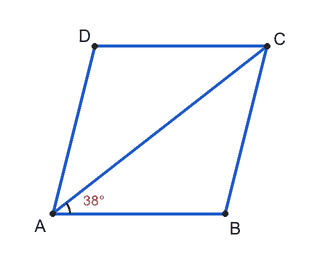
ABCD is a rhombus. If ∠BAC = 38°, find :
(i) ∠ACB
(ii) ∠DAC
(iii) ∠ADC.
 Solve with AI
Written solution
Solution:
Concept: A rhombus is a parallelogram with all four sides equal. Its diagonals bisect each other at right angles, and each diagonal bisects the angles at its two ends.
Step 1 — Find ∠ACB.
In triangle ABC, AB = BC (sides of the rhombus), so the angles opposite them are equal. So ∠ACB = 38°, the same as ∠BAC.
Step 2 — Find ∠DAC.
The diagonal AC bisects ∠A of the rhombus, so ∠DAC = 38°, the same as ∠BAC.
Step 3 — Find ∠ADC.
∠DAB is made of the two halves, and ∠ADC is adjacent to it, so the two add up to 180°.
Therefore, ∠ACB = 38°, ∠DAC = 38° and ∠ADC = 104°.
- 143 marks
Question 14
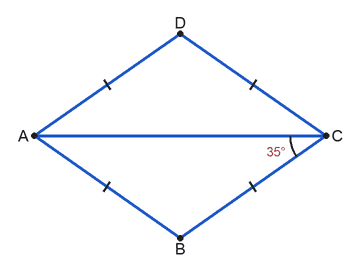
ABCD is a rhombus. If ∠BCA = 35°, find ∠ADC.
 Solve with AI
Written solution
Solution:
Concept: A rhombus is a parallelogram with all four sides equal. Its diagonals bisect each other at right angles, and each diagonal bisects the angles at its two ends.
Step 1 — Find ∠BCD.
The diagonal AC bisects ∠BCD of the rhombus, so ∠BCD is twice ∠BCA.
Step 2 — Find ∠ADC.
∠ADC and ∠BCD are adjacent angles of the rhombus, so they add up to 180°.
Watch out: ∠BCA is only HALF of ∠C; double it before using adjacent angles.
Therefore, ∠ADC = 110°.
- 153 marks
Question 15
PQRS is a parallelogram whose diagonals intersect at M.
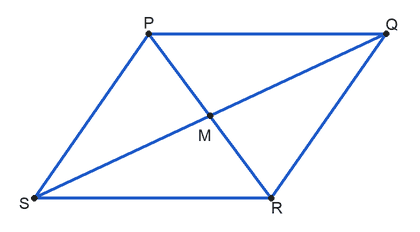
If ∠PMS = 54°, ∠QSR = 25° and ∠SQR = 30°, find :
(i) ∠RPS (ii) ∠PRS (iii) ∠PSR.
Solve with AIWritten solution
Solution:
Concept: In a parallelogram, both pairs of opposite sides are parallel. So any two adjacent angles are co-interior angles between parallel lines and add up to 180°, and opposite angles are equal. Alternate angles between parallel lines are equal.
Step 1 — Read the data.
We use the three given angles as the question intends; the note below explains why they cannot all hold exactly. M is where the diagonals PR and QS meet, so M lies on both of them.
Step 2 — Find ∠PSQ.
PS ∥ QR and QS is a transversal, so ∠PSQ and ∠SQR are alternate angles. So ∠PSQ = 30°; as M lies on SQ, this is also ∠PSM.
Step 3 — Find ∠RPS.
In triangle PMS the three angles add up to 180°, and ∠MPS is the same angle as ∠RPS because M lies on PR.
Step 4 — Find ∠SMR.
P, M and R lie on one line, so ∠PMS and ∠SMR form a linear pair.
Step 5 — Find ∠PRS.
In triangle SMR, ∠MSR = 25° because it is the same angle as ∠QSR (M lies on QS), and ∠MRS is the same angle as ∠PRS.
Step 6 — Find ∠PSR.
∠PSR is made of ∠PSQ and ∠QSR.
Watch out: ∠PSQ is found from ∠SQR (alternate angles, PS ∥ QR), not from ∠QSR.
Note: The three given angles cannot all hold in one parallelogram. ∠QSR = 25° and ∠SQR = 30° already fix the shape of triangle QRS, and then ∠PMS works out to about 78°, not 54°. The answers follow the method the question intends; ∠PSR = 55° uses only the two angles at S and Q.
Therefore, ∠RPS = 96°, ∠PRS = 29° and ∠PSR = 55°.
- 163 marks
Question 16
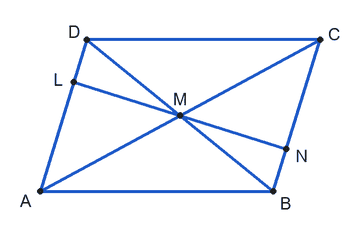
Given : Parallelogram ABCD in which diagonals AC and BD intersect at M.
Prove : M is the mid-point of LN.
 Solve with AI
Written solution
Solution:
Concept: In a parallelogram, opposite sides are equal and parallel, and the diagonals bisect each other (they cut each other into two equal parts).
Step 1 — Choose the triangles.
From the figure, L lies on AD, N lies on BC and the line LN passes through M. To show ML = MN, we prove that triangles AML and CMN are congruent.
Step 2 — Equal sides.
The diagonals of a parallelogram bisect each other, so AM = CM.
Step 3 — Equal angles.
AD ∥ BC and AC is a transversal, so ∠LAM = ∠NCM (alternate angles).
Also ∠AML = ∠CMN, because they are vertically opposite angles at M.
Step 4 — Conclude.
Two angles and the side between them match, so triangle AML ≅ triangle CMN (ASA). Corresponding parts of congruent triangles are equal, so ML = MN.
Watch out: AM = CM comes from the diagonals bisecting each other; it is not given in the question.
Therefore, ML = MN, so M is the mid-point of LN.
- 173 marks
Question 17
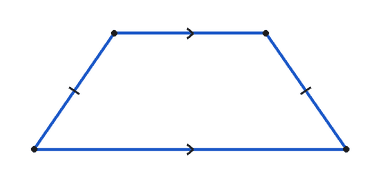
In an isosceles-trapezium, show that the opposite angles are supplementary.
 Solve with AI
Written solution
Solution:
Concept: A trapezium has one pair of opposite sides parallel. The two angles at the ends of each non-parallel side are co-interior angles, so they add up to 180°. In an isosceles trapezium the non-parallel sides are equal and the base angles are equal.
Step 1 — Set up the trapezium.
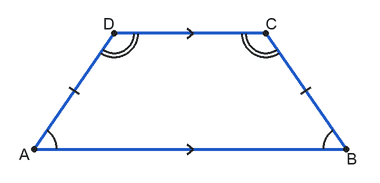
Let ABCD be an isosceles trapezium with AB ∥ DC and AD = BC.
In an isosceles trapezium the base angles are equal: ∠A = ∠B and ∠C = ∠D.
Step 2 — Use the transversal AD.
AB ∥ DC and AD is a transversal, so ∠A and ∠D are co-interior angles: ∠A + ∠D = 180°.
Step 3 — Show ∠A + ∠C = 180°.
Since ∠D = ∠C, we can replace ∠D by ∠C in Step 2, which gives ∠A + ∠C = 180°.
Step 4 — Show ∠B + ∠D = 180°.
With BC as the transversal, ∠B + ∠C = 180°.
Replacing ∠C by ∠D gives ∠B + ∠D = 180°.
Watch out: In an ordinary trapezium the opposite angles need NOT be supplementary; the equal base angles are what make it work.
Therefore, ∠A + ∠C = 180° and ∠B + ∠D = 180°, so the opposite angles of an isosceles trapezium are supplementary.
- 183 marks
Question 18
ABCD is a parallelogram. What kind of quadrilateral is it if :
AC = BD and AC is perpendicular to BD ?
Solve with AIWritten solution
Solution:
Concept: A parallelogram becomes a rectangle when its diagonals are equal, and a rhombus when its diagonals cut at right angles. With both, it is a square.
Step 1 — Equal diagonals.
A parallelogram with equal diagonals is a rectangle.
Step 2 — Perpendicular diagonals.
A parallelogram whose diagonals cut at right angles is a rhombus.
Step 3 — Both together.
A parallelogram that is both a rectangle and a rhombus has each angle 90° and all sides equal, so it is a square.
Therefore, ABCD is a square.
- 193 marks
Question 19
ABCD is a parallelogram. What kind of quadrilateral is it if :
AC is perpendicular to BD but is not equal to it ?
Solve with AIWritten solution
Solution:
Concept: A parallelogram becomes a rectangle when its diagonals are equal, and a rhombus when its diagonals cut at right angles. With both, it is a square.
Step 1 — Perpendicular diagonals.
A parallelogram whose diagonals cut at right angles is a rhombus.
Step 2 — Unequal diagonals.
The diagonals are not equal, so it is not a rectangle, and therefore not a square.
Therefore, ABCD is a rhombus (not a square).
- 203 marks
Question 20
ABCD is a parallelogram. What kind of quadrilateral is it if :
AC = BD but AC is not perpendicular to BD?
Solve with AIWritten solution
Solution:
Concept: A parallelogram becomes a rectangle when its diagonals are equal, and a rhombus when its diagonals cut at right angles. With both, it is a square.
Step 1 — Equal diagonals.
A parallelogram with equal diagonals is a rectangle.
Step 2 — Diagonals not perpendicular.
The diagonals do not cut at right angles, so it is not a rhombus, and therefore not a square.
Therefore, ABCD is a rectangle (not a square).
- 213 marks
Question 21
Prove that the diagonals of a parallelogram bisect each other.
 Solve with AI
Written solution
Solution:
Concept: In a parallelogram, opposite sides are equal and parallel. Alternate angles between parallel lines are equal.
Step 1 — Draw and name.
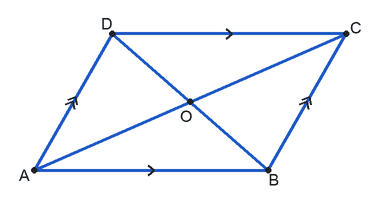
Let the diagonals AC and BD of parallelogram ABCD meet at O. We prove that triangles AOB and COD are congruent.
Step 2 — Equal sides.
AB = CD, because opposite sides of a parallelogram are equal.
Step 3 — Equal angles.
AB ∥ DC with AC as a transversal gives ∠OAB = ∠OCD (alternate angles).
With BD as a transversal it gives ∠OBA = ∠ODC (alternate angles).
Step 4 — Conclude.
Two angles and the side between them match, so triangle AOB ≅ triangle COD (ASA). Corresponding parts are equal, so OA = OC and OB = OD.
Therefore, OA = OC and OB = OD, so the diagonals of a parallelogram bisect each other.
- 223 marks
Question 22
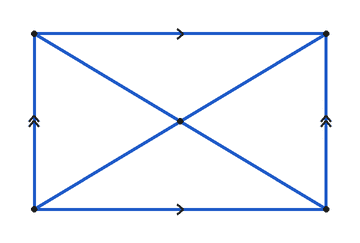
If the diagonals of a parallelogram are of equal lengths, the parallelogram is a rectangle. Prove it.
 Solve with AI
Written solution
Solution:
Concept: In a parallelogram, both pairs of opposite sides are parallel. So any two adjacent angles are co-interior angles between parallel lines and add up to 180°, and opposite angles are equal.
Step 1 — Draw and name.
Let ABCD be a parallelogram with AC = BD. We compare triangles ABC and BAD, which share the side AB.

Step 2 — Three pairs of equal sides.
AB = BA (common side), BC = AD (opposite sides of a parallelogram) and AC = BD (given). So triangle ABC ≅ triangle BAD (SSS), and hence ∠ABC = ∠BAD.
Step 3 — Each angle is 90°.
∠ABC and ∠BAD are adjacent angles of the parallelogram, so they add up to 180°. Two equal angles that add up to 180° are 90° each.
Step 4 — Conclude.
A parallelogram with one angle 90° has all its angles 90° (adjacent angles are 90° and the opposite angle is equal), so it is a rectangle.
Therefore, ABCD is a rectangle.
- 233 marks
Question 23
In parallelogram ABCD, E is the mid-point of AD and F is the mid-point of BC.

Prove that BFDE is a parallelogram.
Solve with AIWritten solution
Solution:
Concept: A quadrilateral is a parallelogram if one pair of its opposite sides is both equal and parallel. In parallelogram ABCD, AD ∥ BC and AD = BC.
Step 1 — Parallel parts.
AD ∥ BC, and ED is part of AD while BF is part of BC, so ED ∥ BF.
Step 2 — Equal parts.
AD = BC (opposite sides of a parallelogram). E and F are mid-points, so ED is half of AD and BF is half of BC; halves of equal lengths are equal, so ED = BF.
Step 3 — Conclude.
In quadrilateral BFDE, the opposite sides ED and BF are both equal and parallel. A quadrilateral with one pair of opposite sides equal and parallel is a parallelogram.
Therefore, BFDE is a parallelogram.
- 241 mark
Question 24
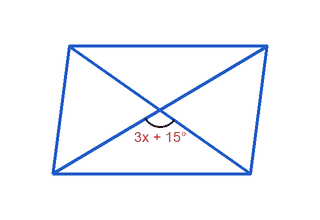
The given figure shows a parallelogram. The value of x for which it will be a rhombus is :
 Solve with AI
Answer
(A) 35°
- Correct
(B) 25°
(C) 15°
(D) 45°
Answer: (B) 25°
Concept: A parallelogram whose diagonals cut each other at right angles is a rhombus.
Step 1 — Condition for a rhombus.
A parallelogram is a rhombus when its diagonals cut at right angles, so the marked angle must be 90°.
Why the other options are wrong:
- (A) 35°: With x = 35° the diagonals meet at 120°, not 90°.
- (C) 15°: With x = 15° the diagonals meet at 60°, not 90°.
- (D) 45°: With x = 45° the diagonals meet at 150°, not 90°.
Therefore, x = 25°, option (B).
- 251 mark
Question 25
A rhombus will be a square, if :
Solve with AIAnswer
(A) its diagonals bisect each other
(B) its diagonals are perpendicular to each other
(C) one of its angles is 60°
- Correct
(D) none of these
Answer: (D) none of these
Concept: A rhombus is a parallelogram with all four sides equal. Its diagonals bisect each other at right angles, and each diagonal bisects the angles at its two ends.
Step 1 — What a square needs.
A rhombus already has all sides equal. It becomes a square when one angle is 90° (or, equally, when its diagonals are equal).
Step 2 — Test the options.
Options (A) and (B) are true for every rhombus, and option (C) gives a 60° angle, not 90°. None of them makes the rhombus a square.
Watch out: A property that every rhombus already has cannot make a rhombus a square.
Why the other options are wrong:
- (A) its diagonals bisect each other: The diagonals of every rhombus bisect each other, so this does not make it a square.
- (B): The diagonals of every rhombus are perpendicular, so this does not make it a square.
- (C) one of its angles is 60°: A rhombus with a 60° angle has angles 60°, 120°, 60° and 120°, so it is not a square.
Therefore, none of the given conditions makes the rhombus a square, option (D).
- 261 mark
Question 26
The diagonals of a quadrilateral, bisect each other at right-angle. The quadrilateral is a :
Solve with AIAnswer
(A) trapezium
(B) square
- Correct
(C) rhombus
(D) parallelogram
Answer: (C) rhombus
Concept: A parallelogram becomes a rectangle when its diagonals are equal, and a rhombus when its diagonals cut at right angles. With both, it is a square.
Step 1 — Diagonals that bisect each other.
A quadrilateral whose diagonals bisect each other is a parallelogram.
Step 2 — At right angles.
A parallelogram whose diagonals cut at right angles is a rhombus. Nothing says the diagonals are equal, so we cannot call it a square.
Watch out: Give the most exact name the facts prove.
Why the other options are wrong:
- (A) trapezium: The diagonals of a trapezium do not in general bisect each other.
- (B) square: A square also needs equal diagonals, which is not given.
- (D) parallelogram: It is a parallelogram, but the right angle between the diagonals makes it a rhombus, the more exact name.
Therefore, the quadrilateral is a rhombus, option (C).
- 271 mark
Question 27
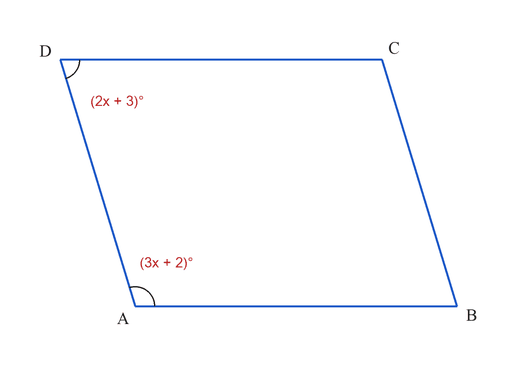
In a parallelogram ABCD; ∠A = (3x + 2)° and ∠D = (2x + 3)°; the value of x is :
 Solve with AI
Answer
(A) 37
- Correct
(B) 35
(C) 30
(D) 40
Answer: (B) 35
Concept: In a parallelogram, both pairs of opposite sides are parallel. So any two adjacent angles are co-interior angles between parallel lines and add up to 180°, and opposite angles are equal.
Step 1 — Adjacent angles.
∠A and ∠D are adjacent angles of parallelogram ABCD, so they add up to 180°.
Step 2 — Check.
With x = 35, ∠A = 107° and ∠D = 73°, which add up to 180°.
Watch out: ∠A and ∠D are adjacent (not opposite), so they are supplementary, not equal.
Why the other options are wrong:
- (A) 37: With x = 37 the two angles add up to 190°, not 180°.
- (C) 30: With x = 30 the two angles add up to 155°, not 180°.
- (D) 40: With x = 40 the two angles add up to 205°, not 180°.
Therefore, x = 35, option (B).
- 281 mark
Question 28
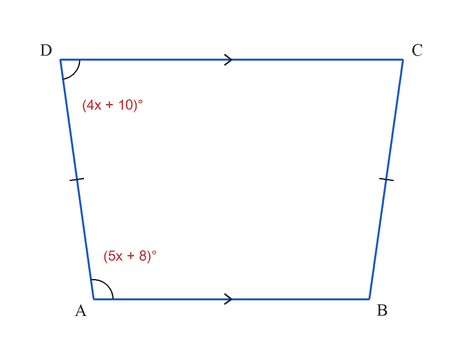
In a trapezium ABCD, AB//DC and AD = BC. If ∠A = (5x + 8)° and ∠D = (4x + 10)°; the measure of angle B is
 Solve with AI
Answer
- Correct
(A) 98°
(B) 82°
(C) 96°
(D) none of these
Answer: (A) 98°
Concept: A trapezium has one pair of opposite sides parallel. The two angles at the ends of each non-parallel side are co-interior angles, so they add up to 180°. In an isosceles trapezium the base angles are equal.
Step 1 — Co-interior angles.
AB ∥ DC and AD is a transversal, so ∠A + ∠D = 180°.
Step 2 — Find ∠A.
Substitute x = 18.
Step 3 — Find ∠B.
AD = BC, so ABCD is an isosceles trapezium, and its base angles on AB are equal. So ∠B = 98°, the same as ∠A.
Watch out: ∠A and ∠D are supplementary (co-interior), while ∠A and ∠B are equal (base angles).
Why the other options are wrong:
- (B) 82°: 82° is ∠D (and ∠C), the angles at the other parallel side, not ∠B.
- (C) 96°: With x = 18, ∠A = 98°, and ∠B equals ∠A, so ∠B cannot be 96°.
- (D) none of these: 98° is listed as option (A), so “none of these” is wrong.
Therefore, ∠B = 98°, option (A).
- 291 mark
Question 29
Statement 1 : In order to prove that a given parallelogram is a rectangle, we must prove that (a) any angle of it is 90° or (b) its diagonals are equal.
Statement 2 : A kite is an arrowhead in which two pairs of adjacent sides are equal.
Which of the following options is correct?
Solve with AIAnswer
- Correct
(A) Both the statements are true.
(B) Both the statements are false.
(C) Statement 1 is true, and statement 2 is false.
(D) Statement 1 is false, and statement 2 is true.
Answer: (A) Both the statements are true.
Concept: To prove a parallelogram is a rectangle, it is enough to show one angle is 90° or that its diagonals are equal. A kite is a quadrilateral with two pairs of equal adjacent sides.
Step 1 — Judge Statement 1.
A parallelogram with one angle of 90° has all its angles 90°, and a parallelogram with equal diagonals is a rectangle. So proving either (a) or (b) is enough. Statement 1 is true.
Step 2 — Judge Statement 2.
The chapter defines a kite as a quadrilateral in which two pairs of adjacent sides are equal. Statement 2 gives exactly this property and calls the kite an arrowhead, meaning its arrow-like shape. Statement 2 is taken as true.
Note: In strict geometry an arrowhead (also called a dart) is the concave kite, which has one angle greater than 180°. Read that way, an ordinary kite is not an arrowhead, Statement 2 would be false and the answer would be (C). Here “arrowhead” is used loosely for the kite shape, so both statements are taken as true.
Why the other options are wrong:
- (B): Statement 1 is true, so “both false” is wrong.
- (C): This would be the answer only if “arrowhead” is read strictly as the concave kite (see the note).
- (D): Statement 1 is true, not false.
Therefore, both statements are true, option (A).
- 301 mark
Question 30
Assertion (A) : In a parallelogram, the bisectors of any two pair of adjacent angles meet at a right angle.

Reason (R) : In a parallelogram, opposite angles are equal.
Solve with AIAnswer
(A) Both A and R are correct, and R is the correct explanation for A.
- Correct
(B) Both A and R are correct, and R is not the correct explanation for A.
(C) A is true, but R is false.
(D) A is false, but R is true.
Answer: (B) Both A and R are correct, and R is not the correct explanation for A.
Concept: In a parallelogram, both pairs of opposite sides are parallel. So any two adjacent angles are co-interior angles between parallel lines and add up to 180°, and opposite angles are equal.
Step 1 — Judge the Assertion.
Let two adjacent angles of the parallelogram be a° and b°, so a + b = 180. Their bisectors and the side between them form a triangle whose two base angles are half of a and half of b. The third angle, where the bisectors meet, is what is left of 180°.
So the bisectors meet at a right angle: A is true.
Step 2 — Judge the Reason.
Opposite angles of a parallelogram are equal: R is true.
Step 3 — Does R explain A?
Step 1 used the fact that ADJACENT angles add up to 180°. Equal opposite angles play no part, so R does not explain A.
Why the other options are wrong:
- (A): R is true, but A follows from adjacent angles adding up to 180°, not from opposite angles being equal.
- (C): R is true: opposite angles of a parallelogram are equal.
- (D): A is true, as Step 1 shows.
Therefore, both A and R are true, but R is not the correct explanation of A, option (B).
- 311 mark
Question 31
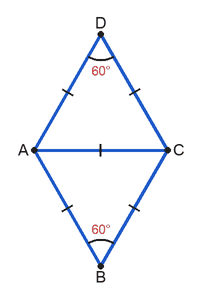
Assertion (A) : One of the diagonals of a rhombus is equal to one of its sides. The angles of a rhombus are 60°, 120°, 60°, 120°.
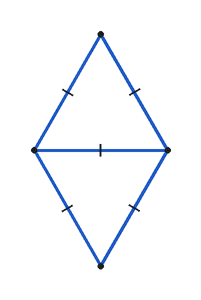
Reason (R) : All sides of a rhombus are equal.
Solve with AIAnswer
(A) Both A and R are correct, and R is the correct explanation for A.
- Correct
(B) Both A and R are correct, and R is not the correct explanation for A.
(C) A is true, but R is false.
(D) A is false, but R is true.
Answer: (B) Both A and R are correct, and R is not the correct explanation for A.
Concept: A rhombus is a parallelogram with all four sides equal. Its diagonals bisect each other at right angles, and each diagonal bisects the angles at its two ends.
Step 1 — Judge the Assertion.
Let rhombus ABCD have diagonal AC equal to a side. Then the sides AB, BC and AC of triangle ABC are all equal, so the triangle is equilateral and ∠ABC = 60°.
The opposite angle ∠ADC is also 60°, and each of the other two angles is 180° − 60° = 120°. So the angles are 60°, 120°, 60° and 120°: A is true.
Step 2 — Judge the Reason.
All sides of a rhombus are equal: R is true.
Step 3 — Does R explain A?
Every rhombus has equal sides, yet most rhombuses do not have angles of 60° and 120°. A depends on the extra fact that a diagonal equals a side, so R is not taken as the explanation of A.
Note: Step 1 does use R (AB = BC), so some readers treat R as part of the explanation; the key keeps (B) because R by itself does not lead to A.
Why the other options are wrong:
- (A): R alone is true of every rhombus, but most rhombuses do not have angles 60° and 120°; A rests on the diagonal being equal to a side.
- (C): R is true: all sides of a rhombus are equal.
- (D): A is true, as Step 1 shows.
Therefore, both A and R are true, but R is not the correct explanation of A, option (B).
- 321 mark
Question 32
Assertion (A) : If one angle of a parallelogram measures 90°, the parallelogram is a rectangle.
Reason (R) : If each interior angle of a parallelogram is 90°, then all sides of it are equal.
Solve with AIAnswer
(A) Both A and R are correct, and R is the correct explanation for A.
(B) Both A and R are correct, and R is not the correct explanation for A.
- Correct
(C) A is true, but R is false.
(D) A is false, but R is true.
Answer: (C) A is true, but R is false.
Concept: A rectangle is a parallelogram with each angle 90°. Its diagonals are equal and bisect each other.
Step 1 — Judge the Assertion.
If one angle of a parallelogram is 90°, its adjacent angles are 180° − 90° = 90° and its opposite angle is also 90°, so it is a rectangle. A is true.
Step 2 — Judge the Reason.
A rectangle 6 cm long and 4 cm wide has every angle 90°, but its sides are not all equal. So R is false.
Watch out: Each angle 90° makes a rectangle; equal sides are needed as well for a square.
Why the other options are wrong:
- (A): R is false, so it cannot be a correct explanation.
- (B): R is false, so “both correct” is wrong.
- (D): A is true and R is false, the reverse of this option.
Therefore, A is true but R is false, option (C).
- 331 mark
Question 33
Assertion (A) : The adjacent angles of a parallelogram are in the ratio 2:3. The remaining angles are 78° and 102°.
Reason (R) : Opposite angles of a parallelogram are equal.
Solve with AIAnswer
(A) Both A and R are correct, and R is the correct explanation for A.
(B) Both A and R are correct, and R is not the correct explanation for A.
(C) A is true, but R is false.
- Correct
(D) A is false, but R is true.
Answer: (D) A is false, but R is true.
Concept: In a parallelogram, both pairs of opposite sides are parallel. So any two adjacent angles are co-interior angles between parallel lines and add up to 180°, and opposite angles are equal.
Step 1 — Find the adjacent angles.
Adjacent angles of a parallelogram add up to 180°, so share 180° in the ratio 2 : 3.
Step 2 — Judge the Assertion.
The remaining two angles are opposite these, so they are also 72° and 108°, not 78° and 102°. A is false.
Step 3 — Judge the Reason.
Opposite angles of a parallelogram are equal: R is true.
Why the other options are wrong:
- (A): A is false, so this cannot be right.
- (B): A is false, so this cannot be right.
- (C): A is false and R is true, the reverse of this option.
Therefore, A is false but R is true, option (D).
- 343 marks
Question 34
The adjacent sides of a parallelogram are in the ratio 5 : 4. If the perimeter of the parallelogram is 108 cm, find the length of its sides.
Solve with AIWritten solution
Solution:
Concept: In a parallelogram, opposite sides are equal and parallel, and the diagonals bisect each other (they cut each other into two equal parts).
Step 1 — Name the sides.
Let the adjacent sides be 5k cm and 4k cm. Opposite sides of a parallelogram are equal, so the perimeter is twice the sum of two adjacent sides.
Step 2 — Find the sides.
Multiply each ratio part by k = 6.
Step 3 — Check.
The perimeter must come back to 108 cm.
Watch out: The perimeter has FOUR sides, so use 2(5k + 4k), not 5k + 4k.
Therefore, the sides are 30 cm, 24 cm, 30 cm and 24 cm.
- 353 marks
Question 35
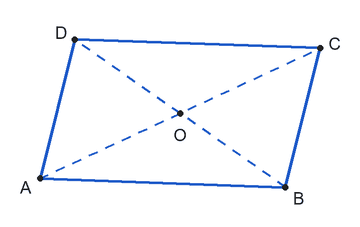
In the given figure, ABCD is a parallelogram. If OA = 6 cm and AC − BD = 2 cm; find the length of BD.
 Solve with AI
Written solution
Solution:
Concept: In a parallelogram, opposite sides are equal and parallel, and the diagonals bisect each other (they cut each other into two equal parts).
Step 1 — Find AC.
The diagonals of a parallelogram bisect each other, so O is the mid-point of AC and AC is twice OA.
Step 2 — Find BD.
AC is 2 cm longer than BD, so BD is 2 cm less than AC.
Watch out: OA is only half of AC; double it first.
Therefore, BD = 10 cm.
- 363 marks
Question 36
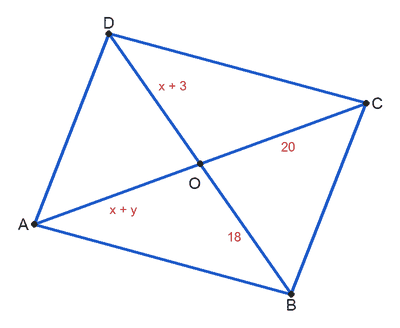
The diagonals of a parallelogram ABCD intersect each other at point O. If OA = x + y, OC = 20, OD = x + 3 and OB = 18; find the values of x and y.
 Solve with AI
Written solution
Solution:
Concept: In a parallelogram, opposite sides are equal and parallel, and the diagonals bisect each other (they cut each other into two equal parts).
Step 1 — Use OB = OD.
The diagonals bisect each other, so OB = OD.
Step 2 — Use OA = OC.
Also OA = OC.
Watch out: Pair each half with its own partner: OA with OC and OB with OD.
Therefore, x = 15 and y = 5.
- 373 marks
Question 37
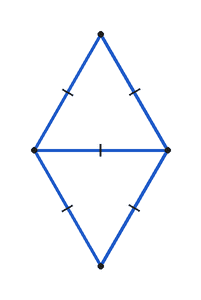
One of the diagonals of a rhombus and its sides are equal. Find the angles of the rhombus.
 Solve with AI
Written solution
Solution:
Concept: A rhombus is a parallelogram with all four sides equal. Its diagonals bisect each other at right angles, and each diagonal bisects the angles at its two ends.
Step 1 — Find an equilateral triangle.
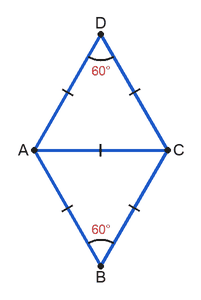
Let rhombus ABCD have diagonal AC equal to its sides. Then the three sides AB, BC and AC of triangle ABC are all equal.
So triangle ABC is equilateral, and each of its angles is 60°; in particular ∠B = 60°.
Step 2 — Find the other angles.
∠D is opposite ∠B, so ∠D = 60°. ∠A is adjacent to ∠B, so it is what is left of 180°, and ∠C = ∠A.
Therefore, the angles of the rhombus are 60°, 120°, 60° and 120°.
- 383 marks
Question 38
In a parallelogram ABCD, E is the mid-point of side AB and CE bisects angle BCD.

Prove that :
(i) AE = AD
(ii) DE bisects ∠ADC and
(iii) Angle DEC is a right angle.
Solve with AIWritten solution
Solution:
Concept: In a parallelogram, both pairs of opposite sides are parallel. So any two adjacent angles are co-interior angles between parallel lines and add up to 180°, and opposite angles are equal. Alternate angles between parallel lines are equal, and in a triangle the sides opposite equal angles are equal.
Step 1 — Show BE = BC.
AB ∥ DC with CE as a transversal, so ∠BEC = ∠ECD (alternate angles).
CE bisects ∠BCD, so ∠ECD = ∠ECB.
Hence ∠BEC = ∠BCE, and in triangle BEC the sides opposite these equal angles are equal: BE = BC.
Step 2 — Prove (i) AE = AD.
E is the mid-point of AB, so AE = BE.
Step 1 gave BE = BC, and opposite sides of the parallelogram give BC = AD.
Each of these lengths equals the next, so AE = AD.
Step 3 — Prove (ii) DE bisects ∠ADC.
In triangle AED, AE = AD, so the angles opposite them are equal: ∠AED = ∠ADE.
AB ∥ DC with DE as a transversal gives ∠AED = ∠EDC (alternate angles).
So ∠ADE = ∠EDC, and DE bisects ∠ADC.
Step 4 — Prove (iii) ∠DEC = 90°.
DE and CE are bisectors, so ∠EDC is half of ∠D and ∠ECD is half of ∠C. ∠D and ∠C are adjacent angles of the parallelogram, so they add up to 180°.
The angles of triangle DEC add up to 180°.
Therefore, AE = AD, DE bisects ∠ADC and ∠DEC = 90°.
- 393 marks
Question 39
In the diagram given below, the bisectors of interior angles of the parallelogram PQRS enclose a quadrilateral ABCD.
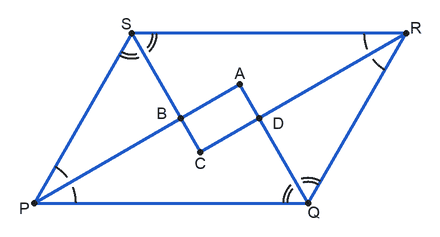
Show that :
(i) ∠PSB + ∠SPB = 90°
(ii) ∠PBS = 90°
(iii) ∠ABC = 90°
(iv) ∠ADC = 90°
(v) ∠A = 90°
(vi) ABCD is a rectangle
Solve with AIWritten solution
Solution:
Concept: Adjacent angles of a parallelogram add up to 180°, so the halves of any two adjacent angles add up to 90°. The angles of a triangle add up to 180°, and vertically opposite angles are equal.
Step 1 — Prove (i).
SB lies along the bisector of ∠S and PB along the bisector of ∠P, so ∠PSB is half of ∠S and ∠SPB is half of ∠P. ∠S and ∠P are adjacent angles of the parallelogram, so they add up to 180°.
Step 2 — Prove (ii).
The angles of triangle PBS add up to 180°.
Step 3 — Prove (iii).
A lies on PB produced and C lies on SB produced, so ∠ABC and ∠PBS are vertically opposite angles: ∠ABC = 90°.
Step 4 — Prove (iv).
In the same way, Q and R are adjacent angles, so ∠DQR + ∠DRQ = 90° (half of 180°), and so ∠QDR = 90° in triangle QDR.
A lies on QD produced and C on RD produced, so ∠ADC and ∠QDR are vertically opposite angles. Hence ∠ADC is also 90°.
Step 5 — Prove (v).
In triangle APQ, ∠APQ is half of ∠P and ∠AQP is half of ∠Q, and ∠P + ∠Q = 180°.
So ∠APQ + ∠AQP = 90°, and the third angle ∠PAQ is 90°. This is the angle A of ABCD, so ∠A = 90°.
Step 6 — Prove (vi).
ABCD has four angles of 90° (Steps 3, 4 and 5 give three of them, and the four add up to 360°, so the fourth is 360° − 270° = 90°). A quadrilateral with every angle 90° is a rectangle.
Therefore, ∠PSB + ∠SPB = 90° and ∠PBS = 90°; the angles ABC, ADC and A are each 90°, so ABCD is a rectangle.
- 403 marks
Question 40
In a parallelogram ABCD, X and Y are mid-points of opposite sides AB and DC respectively.
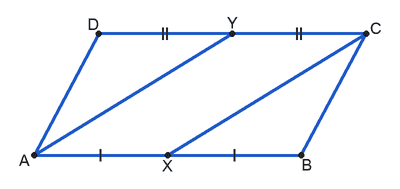
Prove that :
(i) AX = YC.
(ii) AX is parallel to YC
(iii) AXCY is a parallelogram.
Solve with AIWritten solution
Solution:
Concept: A quadrilateral is a parallelogram if one pair of its opposite sides is both equal and parallel. In parallelogram ABCD, AB ∥ DC and AB = DC.
Step 1 — Prove (i) AX = YC.
AB = DC (opposite sides of a parallelogram). X and Y are their mid-points, so AX is half of AB and YC is half of DC. Halves of equal lengths are equal, so AX = YC.
Step 2 — Prove (ii) AX ∥ YC.
AX lies along AB and YC lies along DC, and AB ∥ DC. So AX ∥ YC.
Step 3 — Prove (iii).
In quadrilateral AXCY, the opposite sides AX and YC are both equal and parallel, so AXCY is a parallelogram.
Therefore, AX = YC, AX ∥ YC and AXCY is a parallelogram.
- 413 marks
Question 41
The given figure shows a parallelogram ABCD. Points M and N lie in diagonal BD such that DM = BN.
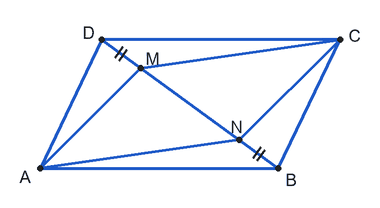
Prove that :
(i) ΔDMC ≅ ΔBNA and so CM = AN.
(ii) ΔAMD ≅ ΔCNB and so AM = CN.
(iii) ANCM is a parallelogram.
Solve with AIWritten solution
Solution:
Concept: In a parallelogram, opposite sides are equal and parallel. A quadrilateral whose opposite sides are equal in pairs is a parallelogram.
Step 1 — Prove (i).
In triangles DMC and BNA: DC = BA (opposite sides of the parallelogram); ∠MDC = ∠NBA (alternate angles, DC ∥ AB with BD as a transversal); and DM = BN (given). Two sides and the angle between them match, so triangle DMC ≅ triangle BNA (SAS), and CM = AN (corresponding parts).
Step 2 — Prove (ii).
In triangles AMD and CNB: AD = CB (opposite sides); ∠ADM = ∠CBN (alternate angles, AD ∥ BC with BD as a transversal); and DM = BN (given). So triangle AMD ≅ triangle CNB (SAS), and AM = CN.
Step 3 — Prove (iii).
In quadrilateral ANCM, AN equals CM (Step 1) and AM equals CN (Step 2). Both pairs of opposite sides are equal, so ANCM is a parallelogram.
Watch out: In SAS the equal angle must lie BETWEEN the two pairs of equal sides.
Therefore, ΔDMC ≅ ΔBNA, ΔAMD ≅ ΔCNB, and ANCM is a parallelogram.
- 423 marks
Question 42
The given figure shows a rhombus ABCD in which angle BCD = 80°. Find angles x and y.
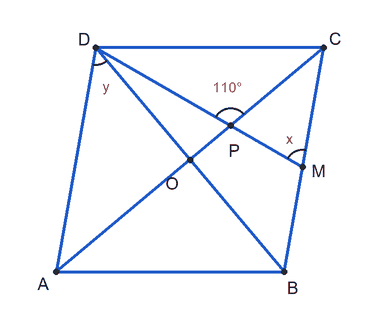 Solve with AI
Written solution
Solution:
Concept: A rhombus is a parallelogram with all four sides equal. Its diagonals bisect each other at right angles, and each diagonal bisects the angles at its two ends.
Step 1 — Find y.
∠ADC is adjacent to ∠BCD, so the two add up to 180°.
The diagonal DB bisects ∠ADC, and y is the half ∠ADO.
Step 2 — Find ∠PCM.
The diagonal AC bisects ∠BCD, so ∠PCM = ∠ACB is half of 80°.
Step 3 — Find ∠CPM.
D, P and M lie on one line, so ∠DPC (the 110° angle) and ∠CPM form a linear pair.
Step 4 — Find x.
The angles of triangle PMC add up to 180°, and x is the angle at M.
Watch out: The 110° angle is ∠DPC; the angle inside triangle PMC at P is its supplement, 70°.
Therefore, x = 70° and y = 50°.
- 433 marks
Question 43
Use the information given in the following diagram to find the values of x, y and z.
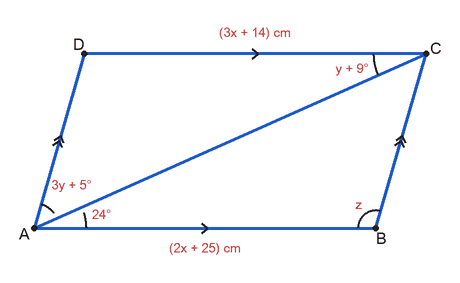 Solve with AI
Written solution
Solution:
Concept: In a parallelogram, both pairs of opposite sides are parallel. So any two adjacent angles are co-interior angles between parallel lines and add up to 180°, and opposite angles are equal. Alternate angles between parallel lines are equal.
Step 1 — Find x.
Both pairs of opposite sides are marked parallel, so ABCD is a parallelogram and its opposite sides DC and AB are equal.
Step 2 — Find y.
AB ∥ DC with AC as a transversal, so ∠ACD = ∠CAB (alternate angles).
Step 3 — Find ∠DAB.
∠DAB is made of ∠DAC = (3y + 5)° and ∠CAB = 24°.
Step 4 — Find z.
The angle z is ∠ABC, which is adjacent to ∠DAB, so the two add up to 180°.
Watch out: Y is the number in (y + 9)°, so y = 15, while the angle ∠ACD itself is 24°.
Therefore, x = 11, y = 15 and z = 106°.
- 443 marks
Question 44
The following figure is a rectangle in which x : y = 3 : 7; find the values of x and y.
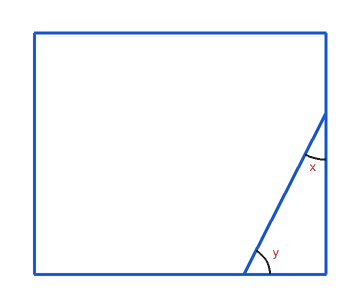 Solve with AI
Written solution
Solution:
Concept: A rectangle is a parallelogram with each angle 90°. Its diagonals are equal and bisect each other. The angles of a triangle add up to 180°.
Step 1 — Use the right-angled corner.
The segment cuts off a triangle at a corner of the rectangle, and that corner angle is 90°. The other two angles of this triangle are x and y, so their sum is what is left of 180°.
Step 2 — Share 90° in the ratio 3 : 7.
Let x = 3k and y = 7k.
Step 3 — Find x and y.
Multiply each ratio part by 9.
Therefore, x = 27° and y = 63°.
- 453 marks
Question 45
In the given figure, AB // EC, AB = AC and AE bisects ∠DAC. Prove that :
(i) ∠EAC = ∠ACB
(ii) ABCE is a parallelogram.
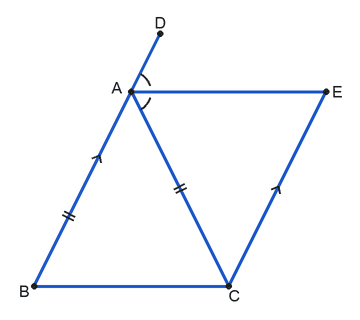 Solve with AI
Written solution
Solution:
Concept: An exterior angle of a triangle equals the sum of its two interior opposite angles. If two lines make equal alternate angles with a transversal, the lines are parallel.
Step 1 — Use the exterior angle.
∠DAC is an exterior angle of triangle ABC (BA is produced to D), so it equals the sum of the two interior opposite angles: ∠DAC = ∠ABC + ∠ACB.
Step 2 — Use AB = AC.
In triangle ABC, AB = AC, so the angles opposite them are equal: ∠ABC = ∠ACB.
Hence ∠DAC = 2∠ACB.
Step 3 — Prove (i).
AE bisects ∠DAC, so ∠EAC is half of ∠DAC, which is half of 2∠ACB. So ∠EAC = ∠ACB.
Step 4 — Prove (ii).
∠EAC and ∠ACB are alternate angles made by the transversal AC with the lines AE and BC. They are equal, so AE ∥ BC. Also AB ∥ EC (given). Both pairs of opposite sides of ABCE are parallel, so ABCE is a parallelogram.
Therefore, ∠EAC = ∠ACB, and ABCE is a parallelogram.
What Class 8 Maths Ch 17 covers
The sections of the chapter, in the order the book takes them. Every question above comes from one of these.
- 01Quadrilateral
- 02Trapezium
- 03Parallelogram
- 04Rectangle
- 05Rhombus
- 06Square
More ways to study this chapter
The same chapter asked three other ways. Practise it, revise it, and see what the board has set on Ch 17 before.
Class 8 Maths Ch 17 questions students ask
How many questions are there in Class 8 Maths Ch 17?
45 questions. Every one is solved step by step on this page.
Are these Class 8 Maths solutions free?
Yes. Every question and its full working is free to read, with no account needed.
Can I download the Class 8 Maths Ch 17 solutions as a PDF?
There is no PDF to download. Every solution is on this page instead, which means it is searchable, always the current syllabus, and readable on a phone. Use your browser's print option if you want it on paper.