
Question 223 marksEasy
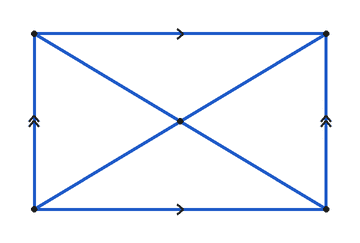
If the diagonals of a parallelogram are of equal lengths, the parallelogram is a rectangle. Prove it.
Confirming your payment
Sign up now and get 250 free tokens.
Special Types of Quadrilaterals · Question 22 of 45
If the diagonals of a parallelogram are of equal lengths, the parallelogram is a rectangle. Prove it.
Solution:
Concept: In a parallelogram, both pairs of opposite sides are parallel. So any two adjacent angles are co-interior angles between parallel lines and add up to 180°, and opposite angles are equal.
Step 1 — Draw and name.
Let ABCD be a parallelogram with AC = BD. We compare triangles ABC and BAD, which share the side AB.

Step 2 — Three pairs of equal sides.
AB = BA (common side), BC = AD (opposite sides of a parallelogram) and AC = BD (given). So triangle ABC ≅ triangle BAD (SSS), and hence ∠ABC = ∠BAD.
Step 3 — Each angle is 90°.
∠ABC and ∠BAD are adjacent angles of the parallelogram, so they add up to 180°. Two equal angles that add up to 180° are 90° each.
Step 4 — Conclude.
A parallelogram with one angle 90° has all its angles 90° (adjacent angles are 90° and the opposite angle is equal), so it is a rectangle.
Therefore, ABCD is a rectangle.