
Question 311 markMCQEasy
Assertion (A) : One of the diagonals of a rhombus is equal to one of its sides. The angles of a rhombus are 60°, 120°, 60°, 120°.
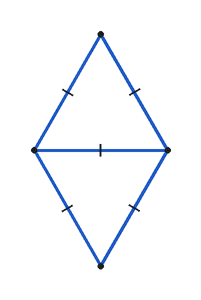
Reason (R) : All sides of a rhombus are equal.
Confirming your payment
Sign up now and get 250 free tokens.
Special Types of Quadrilaterals · Question 31 of 45
Assertion (A) : One of the diagonals of a rhombus is equal to one of its sides. The angles of a rhombus are 60°, 120°, 60°, 120°.
Reason (R) : All sides of a rhombus are equal.
(A) Both A and R are correct, and R is the correct explanation for A.
(B) Both A and R are correct, and R is not the correct explanation for A.
(C) A is true, but R is false.
(D) A is false, but R is true.
Answer: (B) Both A and R are correct, and R is not the correct explanation for A.
Concept: A rhombus is a parallelogram with all four sides equal. Its diagonals bisect each other at right angles, and each diagonal bisects the angles at its two ends.
Step 1 — Judge the Assertion.
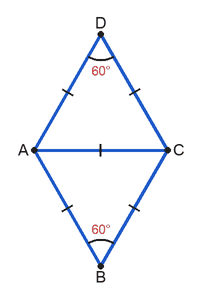
Let rhombus ABCD have diagonal AC equal to a side. Then the sides AB, BC and AC of triangle ABC are all equal, so the triangle is equilateral and ∠ABC = 60°.
The opposite angle ∠ADC is also 60°, and each of the other two angles is 180° − 60° = 120°. So the angles are 60°, 120°, 60° and 120°: A is true.
Step 2 — Judge the Reason.
All sides of a rhombus are equal: R is true.
Step 3 — Does R explain A?
Every rhombus has equal sides, yet most rhombuses do not have angles of 60° and 120°. A depends on the extra fact that a diagonal equals a side, so R is not taken as the explanation of A.
Note: Step 1 does use R (AB = BC), so some readers treat R as part of the explanation; the key keeps (B) because R by itself does not lead to A.
Why the other options are wrong:
Therefore, both A and R are true, but R is not the correct explanation of A, option (B).