
Opening your dashboard
Class 8 Maths Chapter 17 Special Types of Quadrilaterals: Practice Questions
40 questions on Chapter 17, each worked through on its own page with the AI tutor. Class 8 Maths, ICSE 2026-27.
40 questions
1–5 marks · Mixed difficulty
- 11 mark
Question 1
Bloom's level: Remember
The diagonals of quadrilateral PQRS are :
- 21 mark
Question 2
Bloom's level: Remember
ABCD is a kite in which AB = AD and CB = CD. Which of the following is always true?
- 31 mark
Question 3
Bloom's level: Remember
A parallelogram in which a pair of adjacent sides are equal is called a :
- 41 mark
Question 4
Bloom's level: Understand
Which of the following is true for every trapezium, parallelogram, rectangle, rhombus, square and kite?
- 51 mark
Question 5
Bloom's level: Apply
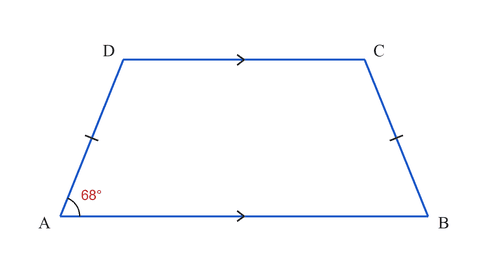
ABCD is an isosceles trapezium with AB ∥ DC and AD = BC. If ∠A = 68°, then ∠C is :
- 61 mark
Question 6
Bloom's level: Apply
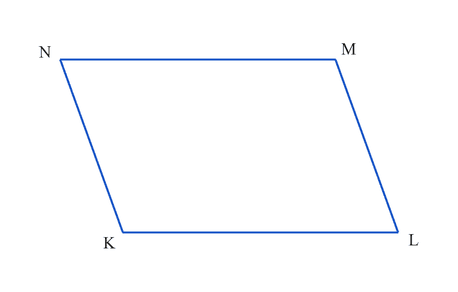
In parallelogram KLMN, ∠K is 40° more than ∠L. Then ∠M equals :
- 71 mark
Question 7
Bloom's level: Apply
The diagonals AC and BD of rectangle ABCD meet at O.
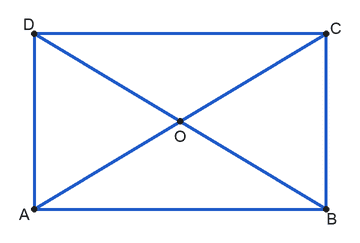
If AC = (2x + 4) cm and BD = (5x − 8) cm, then OB is :
- 81 mark
Question 8
Bloom's level: Analyse
Which property is true for every square but not for every rhombus?
- 91 mark
Question 9
Bloom's level: Understand
Which of the following quadrilaterals is not always a parallelogram?
- 101 mark
Question 10
Bloom's level: Understand
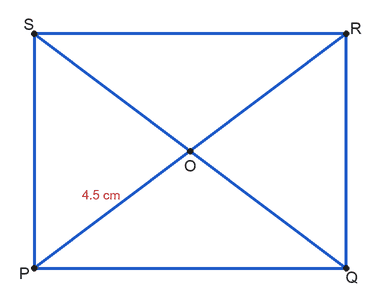
Assertion (A) : The diagonals of rectangle PQRS meet at O. If OP = 4.5 cm, then QS = 9 cm.
Reason (R) : The opposite sides of a rectangle are parallel.
- 111 mark
Question 11
Bloom's level: Evaluate
Assertion (A) : Every kite is a rhombus.
Reason (R) : A rhombus has two pairs of equal adjacent sides.
- 121 mark
Question 12
Bloom's level: Analyse
Assertion (A) : In trapezium ABCD with AB ∥ DC, ∠A = 65° and ∠B = 80°. Then ∠D = 115° and ∠C = 100°.
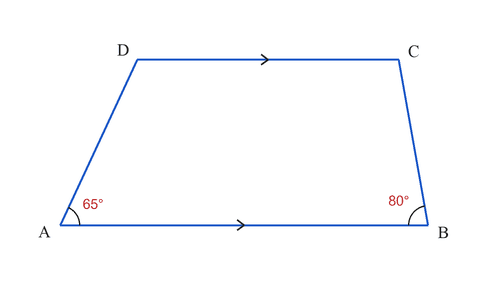
Reason (R) : When two parallel lines are cut by a transversal, the co-interior angles add up to 180°.
- 131 mark
Question 13
Bloom's level: Remember
Name the quadrilateral that has all the properties of a parallelogram, a rectangle and a rhombus.
- 142 marks
Question 14
Bloom's level: Apply
The angles of a quadrilateral are in the ratio 2 : 3 : 4 : 6. Find each angle.
- 152 marks
Question 15
Bloom's level: Apply
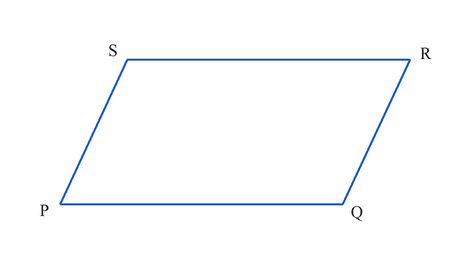
The perimeter of parallelogram PQRS is 50 cm and side PQ is 7 cm longer than side QR. Find PQ and QR.
- 162 marks
Question 16
Bloom's level: Apply
A floor tile is shaped like a rhombus whose diagonals measure 16 cm and 12 cm.
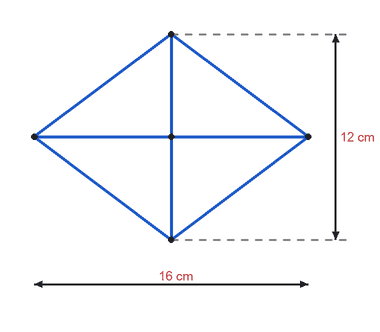
Calculate the length of a side of the tile and its perimeter.
- 172 marks
Question 17
Bloom's level: Understand
In kite PQRS, PQ = PS and RQ = RS. If ∠PQR = 100°, find ∠PSR. Explain why ∠QPS and ∠QRS need not be equal.
- 182 marks
Question 18
Bloom's level: Apply
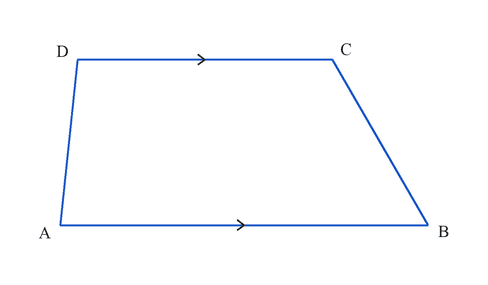
In trapezium ABCD, AB ∥ DC, ∠A : ∠D = 7 : 8 and ∠C = 2∠B. Find all four angles.
- 192 marks
Question 19
Bloom's level: Apply
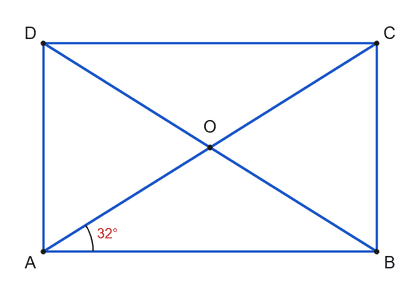
The diagonals of rectangle ABCD cross at O, and diagonal AC makes an angle of 32° with side AB, as shown. Calculate (i) the angle AOD between the diagonals (ii) ∠ODC.
- 202 marks
Question 20
Bloom's level: Understand
Arrange square, quadrilateral, parallelogram, rhombus in order from the most general to the most special. Give one reason for each step.
- 212 marks
Question 21
Bloom's level: Evaluate
Check each claim and say whether it is correct. Give a reason.
(a) Riya: “In quadrilateral ABCD, ∠A = 70°, ∠B = 110°, ∠C = 70° and ∠D = 110°. So ABCD must be a parallelogram.”
(b) Aman: “In quadrilateral ABCD, AB = DC and AD ∥ BC. So ABCD must be a parallelogram.”
- 222 marks
Question 22
Bloom's level: Analyse
In rhombus PQRS of side 9 cm, ∠PQR is twice ∠QPS.
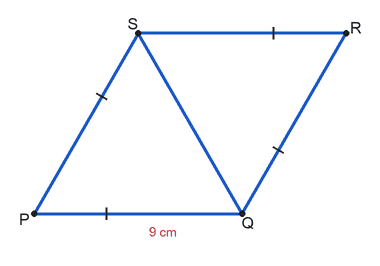
Find ∠QPS and the length of diagonal QS.
- 233 marks
Question 23
Bloom's level: Apply
In the given figure, ABCD is a parallelogram with AB = 11 cm and AD = 7 cm. The bisector of ∠DAB meets DC at E.
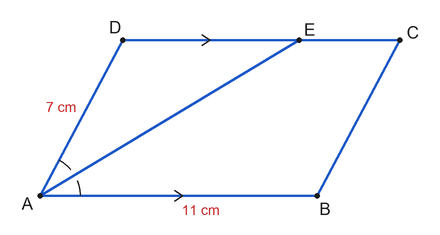
(a) Show that △ADE is isosceles.
(b) Find the lengths of DE and EC.
- 244 marks
Question 24
Bloom's level: Analyse
In the given figure, ABCD is a kite with AB = AD and CB = CD. Its diagonals meet at O. ∠BAD = 70° and ∠BCD = 50°.
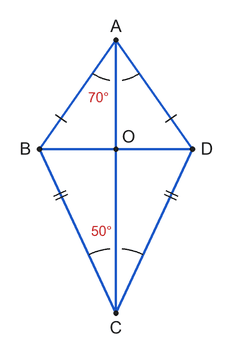
Find (i) ∠ABC (ii) ∠OAB (iii) ∠ABO (iv) ∠OBC.
- 255 marks
Question 25
Bloom's level: Evaluate
Case study: A carpenter makes wooden window frames. Each frame should be a rectangle 90 cm wide and 120 cm tall. To check a frame quickly, he measures its two diagonals.
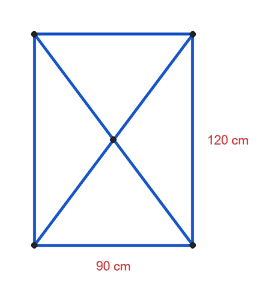
(a) What should each diagonal measure if the frame is a perfect rectangle?
(b) A second frame has opposite sides 90 cm and 120 cm, but its diagonals measure 144 cm and 155.8 cm. Is it a rectangle? Justify.
(c) A third frame has all four sides 75 cm and diagonals of 90 cm and 120 cm. His helper says, "All sides are equal, so it is a square." Is the helper right? Justify, and check that the measurements fit together.
- 265 marks
Question 26
Bloom's level: Analyse
Case study: A flower bed ABCD is in the shape of an isosceles trapezium, as shown. AB ∥ DC, AB = 14 m, DC = 8 m and AD = BC = 5 m. DM and CN are drawn perpendicular to AB.

(a) Name two pairs of equal angles of the bed, and state why ∠A + ∠D = 180°.
(b) A fence is put all around the bed at ₹45 per metre. Find the cost of fencing.
(c) Show that AM = NB = 3 m, and hence find the width DM of the bed.
- 274 marks
Question 27
Bloom's level: Create
(a) Design a decision chart that uses only facts about the diagonals to sort a quadrilateral into one of: not a parallelogram, parallelogram (only), rectangle, rhombus, square. Write it as a sequence of yes/no questions.
(b) Use your chart to name each quadrilateral:
- Quadrilateral 1: diagonals 10 cm and 10 cm, bisect each other, meet at 90°.
- Quadrilateral 2: diagonals 8 cm and 12 cm, bisect each other, meet at 70°.
- 285 marks
Question 28
Bloom's level: Create
Case study: Sameer is making paper kites on frames of two thin sticks fixed at right angles. The cross-stick is 24 cm long and the upright stick is fixed through the middle of the cross-stick. String joins the four stick ends.

(a) In his first design the upright stick is 21 cm long and crosses the cross-stick 5 cm from its top end. Find the lengths of the four sides, and explain why the shape is a kite.
(b) Design a frame with the same 24 cm cross-stick that gives a rhombus of side 15 cm. How long must the upright stick be, and where should the sticks cross?
(c) Design a frame with the 24 cm cross-stick that gives a square. State the length of the upright stick and find the side of the square, correct to 2 decimal places.
- 293 marks
Question 29
Bloom's level: Understand
Copy and complete the table with ✓ (always true) or ✗ (not always true). Then use it to explain why a square is both a rectangle and a rhombus.
Property of the diagonals Parallelogram Rectangle Rhombus Square Bisect each other Are equal Are perpendicular - 303 marks
Question 30
Bloom's level: Understand
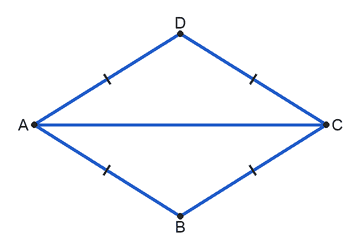
ABCD is a rhombus. Using congruent triangles, explain why the diagonal AC bisects both ∠A and ∠C. Hence, if ∠BAD = 64°, find ∠BCA.
- 311 mark
Question 31
The four angles of a quadrilateral are , , and . The largest of them measures :
- 321 mark
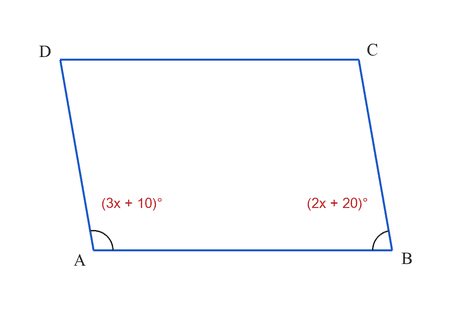
Question 32
In a parallelogram , and . The measure of is :
- 331 mark
Question 33
is a rhombus with .
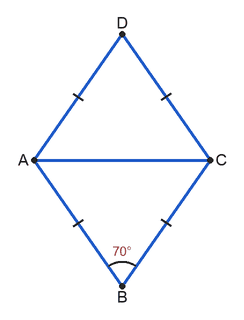
The measure of is :
- 342 marks
Question 34
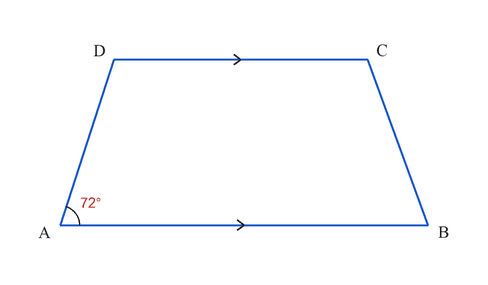
In the trapezium , , , and is more than . Find , and .
- 352 marks
Question 35
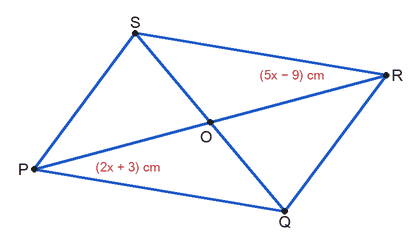
The diagonals and of a parallelogram meet at . If cm and cm, find and the length of the diagonal .
- 362 marks
Question 36
The diagonals of a rectangle meet at , and .
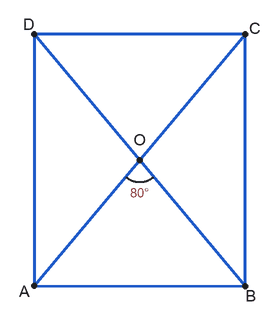
Find (a) and (b) .
- 372 marks
Question 37
In a square , the diagonals and meet at , and cm.
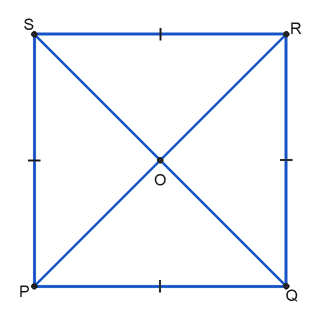
Find , , and , giving a reason for each.
- 384 marks
Question 38
In the figure, is a rhombus in which . The diagonals and meet at .
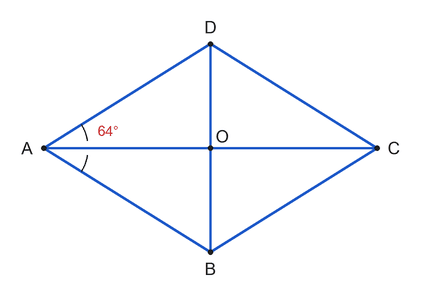
(a) Find .
(b) Find .
(c) Find , and state the measure of .
- 393 marks
Question 39
is a kite with and . The diagonals meet at , and .
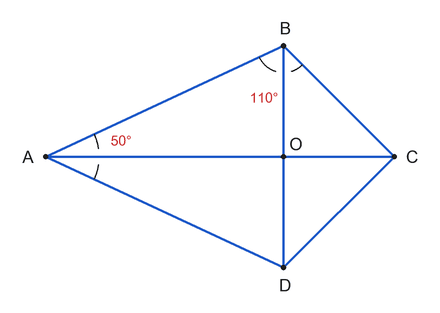
(a) Write and give a reason.
(b) Find .
(c) Find and .
- 403 marks
Question 40
In a parallelogram , cm, cm, cm and cm.

(a) Find the value of .
(b) Find the value of .
(c) Find the perimeter of the parallelogram.