
Question 173 marksEasy
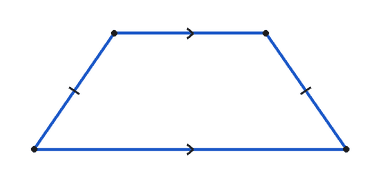
In an isosceles-trapezium, show that the opposite angles are supplementary.
Confirming your payment
Sign up now and get 250 free tokens.
Special Types of Quadrilaterals · Question 17 of 45
In an isosceles-trapezium, show that the opposite angles are supplementary.
Solution:
Concept: A trapezium has one pair of opposite sides parallel. The two angles at the ends of each non-parallel side are co-interior angles, so they add up to 180°. In an isosceles trapezium the non-parallel sides are equal and the base angles are equal.
Step 1 — Set up the trapezium.
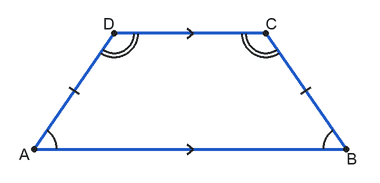
Let ABCD be an isosceles trapezium with AB ∥ DC and AD = BC.
In an isosceles trapezium the base angles are equal: ∠A = ∠B and ∠C = ∠D.
Step 2 — Use the transversal AD.
AB ∥ DC and AD is a transversal, so ∠A and ∠D are co-interior angles: ∠A + ∠D = 180°.
Step 3 — Show ∠A + ∠C = 180°.
Since ∠D = ∠C, we can replace ∠D by ∠C in Step 2, which gives ∠A + ∠C = 180°.
Step 4 — Show ∠B + ∠D = 180°.
With BC as the transversal, ∠B + ∠C = 180°.
Replacing ∠C by ∠D gives ∠B + ∠D = 180°.
Watch out: In an ordinary trapezium the opposite angles need NOT be supplementary; the equal base angles are what make it work.
Therefore, ∠A + ∠C = 180° and ∠B + ∠D = 180°, so the opposite angles of an isosceles trapezium are supplementary.