
Question 123 marksEasy
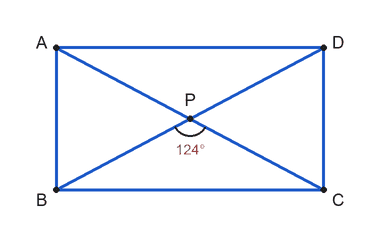
ABCD is a rectangle. If ∠BPC = 124°,
calculate :
(i) ∠BAP (ii) ∠ADP.
Confirming your payment
Sign up now and get 250 free tokens.
Special Types of Quadrilaterals · Question 12 of 45
ABCD is a rectangle. If ∠BPC = 124°,
calculate :
(i) ∠BAP (ii) ∠ADP.
Solution:
Concept: A rectangle is a parallelogram with each angle 90°. Its diagonals are equal and bisect each other.
Step 1 — Equal half-diagonals.
The diagonals of a rectangle are equal and bisect each other, so the four half-diagonals PA, PB, PC and PD are all equal. This makes triangles APB and APD isosceles.
Step 2 — Find ∠APB.
A, P and C lie on the diagonal AC, so ∠APB and ∠BPC form a linear pair and add up to 180°.
Step 3 — Find ∠BAP.
In triangle APB, PA = PB, so the base angles ∠BAP and ∠ABP are equal and share what is left of 180°.
Step 4 — Find ∠ADP.
∠APD and ∠BPC are vertically opposite angles, so ∠APD = 124°. In triangle APD, PA = PD, so ∠PAD = ∠ADP.
Step 5 — Check.
∠BAP + ∠PAD should be the right angle ∠BAD, where ∠PAD is equal to ∠ADP (Step 4).
Watch out: ∠APB and ∠BPC are a linear pair along the diagonal AC; they are not equal.
Therefore, ∠BAP = 62° and ∠ADP = 28°.