
Question 413 marksMedium
The given figure shows a parallelogram ABCD. Points M and N lie in diagonal BD such that DM = BN.
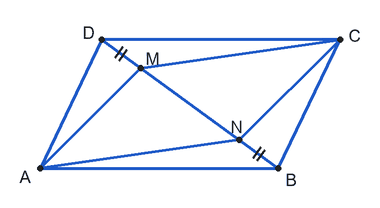
Prove that :
(i) ΔDMC ≅ ΔBNA and so CM = AN.
(ii) ΔAMD ≅ ΔCNB and so AM = CN.
(iii) ANCM is a parallelogram.
Confirming your payment
Sign up now and get 250 free tokens.
Special Types of Quadrilaterals · Question 41 of 45
The given figure shows a parallelogram ABCD. Points M and N lie in diagonal BD such that DM = BN.
Prove that :
(i) ΔDMC ≅ ΔBNA and so CM = AN.
(ii) ΔAMD ≅ ΔCNB and so AM = CN.
(iii) ANCM is a parallelogram.
Solution:
Concept: In a parallelogram, opposite sides are equal and parallel. A quadrilateral whose opposite sides are equal in pairs is a parallelogram.
Step 1 — Prove (i).
In triangles DMC and BNA: DC = BA (opposite sides of the parallelogram); ∠MDC = ∠NBA (alternate angles, DC ∥ AB with BD as a transversal); and DM = BN (given). Two sides and the angle between them match, so triangle DMC ≅ triangle BNA (SAS), and CM = AN (corresponding parts).
Step 2 — Prove (ii).
In triangles AMD and CNB: AD = CB (opposite sides); ∠ADM = ∠CBN (alternate angles, AD ∥ BC with BD as a transversal); and DM = BN (given). So triangle AMD ≅ triangle CNB (SAS), and AM = CN.
Step 3 — Prove (iii).
In quadrilateral ANCM, AN equals CM (Step 1) and AM equals CN (Step 2). Both pairs of opposite sides are equal, so ANCM is a parallelogram.
Watch out: In SAS the equal angle must lie BETWEEN the two pairs of equal sides.
Therefore, ΔDMC ≅ ΔBNA, ΔAMD ≅ ΔCNB, and ANCM is a parallelogram.