
Question 153 marksMedium
PQRS is a parallelogram whose diagonals intersect at M.
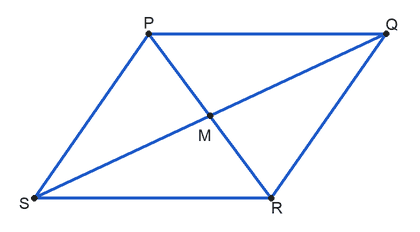
If ∠PMS = 54°, ∠QSR = 25° and ∠SQR = 30°, find :
(i) ∠RPS (ii) ∠PRS (iii) ∠PSR.
Confirming your payment
Sign up now and get 250 free tokens.
Special Types of Quadrilaterals · Question 15 of 45
PQRS is a parallelogram whose diagonals intersect at M.
If ∠PMS = 54°, ∠QSR = 25° and ∠SQR = 30°, find :
(i) ∠RPS (ii) ∠PRS (iii) ∠PSR.
Solution:
Concept: In a parallelogram, both pairs of opposite sides are parallel. So any two adjacent angles are co-interior angles between parallel lines and add up to 180°, and opposite angles are equal. Alternate angles between parallel lines are equal.
Step 1 — Read the data.
We use the three given angles as the question intends; the note below explains why they cannot all hold exactly. M is where the diagonals PR and QS meet, so M lies on both of them.
Step 2 — Find ∠PSQ.
PS ∥ QR and QS is a transversal, so ∠PSQ and ∠SQR are alternate angles. So ∠PSQ = 30°; as M lies on SQ, this is also ∠PSM.
Step 3 — Find ∠RPS.
In triangle PMS the three angles add up to 180°, and ∠MPS is the same angle as ∠RPS because M lies on PR.
Step 4 — Find ∠SMR.
P, M and R lie on one line, so ∠PMS and ∠SMR form a linear pair.
Step 5 — Find ∠PRS.
In triangle SMR, ∠MSR = 25° because it is the same angle as ∠QSR (M lies on QS), and ∠MRS is the same angle as ∠PRS.
Step 6 — Find ∠PSR.
∠PSR is made of ∠PSQ and ∠QSR.
Watch out: ∠PSQ is found from ∠SQR (alternate angles, PS ∥ QR), not from ∠QSR.
Note: The three given angles cannot all hold in one parallelogram. ∠QSR = 25° and ∠SQR = 30° already fix the shape of triangle QRS, and then ∠PMS works out to about 78°, not 54°. The answers follow the method the question intends; ∠PSR = 55° uses only the two angles at S and Q.
Therefore, ∠RPS = 96°, ∠PRS = 29° and ∠PSR = 55°.