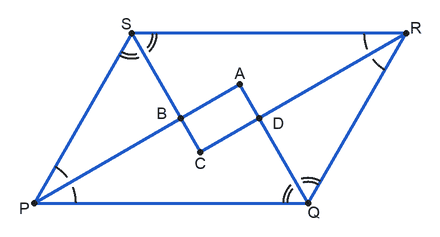
Solution:
Concept: Adjacent angles of a parallelogram add up to 180°, so the halves of any two adjacent angles add up to 90°. The angles of a triangle add up to 180°, and vertically opposite angles are equal.
Step 1 — Prove (i).
SB lies along the bisector of ∠S and PB along the bisector of ∠P, so ∠PSB is half of ∠S and ∠SPB is half of ∠P. ∠S and ∠P are adjacent angles of the parallelogram, so they add up to 180°.
∠PSB+∠SPB=21×180∘=90∘
Step 2 — Prove (ii).
The angles of triangle PBS add up to 180°.
∠PBS=180∘−90∘=90∘
Step 3 — Prove (iii).
A lies on PB produced and C lies on SB produced, so ∠ABC and ∠PBS are vertically opposite angles: ∠ABC = 90°.
Step 4 — Prove (iv).
In the same way, Q and R are adjacent angles, so ∠DQR + ∠DRQ = 90° (half of 180°), and so ∠QDR = 90° in triangle QDR.
A lies on QD produced and C on RD produced, so ∠ADC and ∠QDR are vertically opposite angles. Hence ∠ADC is also 90°.
Step 5 — Prove (v).
In triangle APQ, ∠APQ is half of ∠P and ∠AQP is half of ∠Q, and ∠P + ∠Q = 180°.
So ∠APQ + ∠AQP = 90°, and the third angle ∠PAQ is 90°. This is the angle A of ABCD, so ∠A = 90°.
Step 6 — Prove (vi).
ABCD has four angles of 90° (Steps 3, 4 and 5 give three of them, and the four add up to 360°, so the fourth is 360° − 270° = 90°). A quadrilateral with every angle 90° is a rectangle.
Therefore, ∠PSB + ∠SPB = 90° and ∠PBS = 90°; the angles ABC, ADC and A are each 90°, so ABCD is a rectangle.