
Question 453 marksMedium
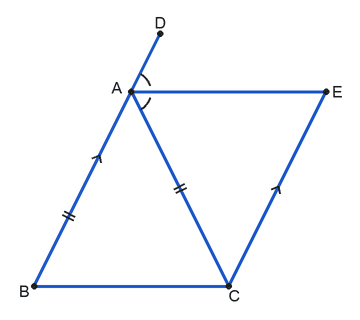
In the given figure, AB // EC, AB = AC and AE bisects ∠DAC. Prove that :
(i) ∠EAC = ∠ACB
(ii) ABCE is a parallelogram.
Confirming your payment
Sign up now and get 250 free tokens.
Special Types of Quadrilaterals · Question 45 of 45
In the given figure, AB // EC, AB = AC and AE bisects ∠DAC. Prove that :
(i) ∠EAC = ∠ACB
(ii) ABCE is a parallelogram.
Solution:
Concept: An exterior angle of a triangle equals the sum of its two interior opposite angles. If two lines make equal alternate angles with a transversal, the lines are parallel.
Step 1 — Use the exterior angle.
∠DAC is an exterior angle of triangle ABC (BA is produced to D), so it equals the sum of the two interior opposite angles: ∠DAC = ∠ABC + ∠ACB.
Step 2 — Use AB = AC.
In triangle ABC, AB = AC, so the angles opposite them are equal: ∠ABC = ∠ACB.
Hence ∠DAC = 2∠ACB.
Step 3 — Prove (i).
AE bisects ∠DAC, so ∠EAC is half of ∠DAC, which is half of 2∠ACB. So ∠EAC = ∠ACB.
Step 4 — Prove (ii).
∠EAC and ∠ACB are alternate angles made by the transversal AC with the lines AE and BC. They are equal, so AE ∥ BC. Also AB ∥ EC (given). Both pairs of opposite sides of ABCE are parallel, so ABCE is a parallelogram.
Therefore, ∠EAC = ∠ACB, and ABCE is a parallelogram.