
Question 433 marksEasy
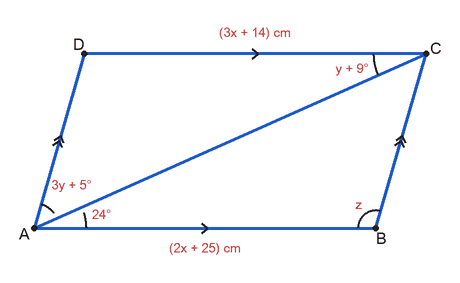
Use the information given in the following diagram to find the values of x, y and z.
Confirming your payment
Sign up now and get 250 free tokens.
Special Types of Quadrilaterals · Question 43 of 45
Use the information given in the following diagram to find the values of x, y and z.
Solution:
Concept: In a parallelogram, both pairs of opposite sides are parallel. So any two adjacent angles are co-interior angles between parallel lines and add up to 180°, and opposite angles are equal. Alternate angles between parallel lines are equal.
Step 1 — Find x.
Both pairs of opposite sides are marked parallel, so ABCD is a parallelogram and its opposite sides DC and AB are equal.
Step 2 — Find y.
AB ∥ DC with AC as a transversal, so ∠ACD = ∠CAB (alternate angles).
Step 3 — Find ∠DAB.
∠DAB is made of ∠DAC = (3y + 5)° and ∠CAB = 24°.
Step 4 — Find z.
The angle z is ∠ABC, which is adjacent to ∠DAB, so the two add up to 180°.
Watch out: Y is the number in (y + 9)°, so y = 15, while the angle ∠ACD itself is 24°.
Therefore, x = 11, y = 15 and z = 106°.