
Opening your dashboard
Class 8 Maths Chapter 17 Special Types of Quadrilaterals: Competency-Based Questions (CBQ)
40 questions on Chapter 17, each worked through on its own page with the AI tutor. Class 8 Maths, ICSE 2026-27.
40 questions
1–5 marks · Mixed difficulty
- 11 mark
Question 1
Competency: Understanding
A folding gate is made of four equal steel strips hinged at their ends to form a quadrilateral. When the gate is pulled open or pushed shut, the shape of the quadrilateral changes.
Which statement stays true in every position of the gate?
- 21 mark
Question 2
Competency: Application
The side panel of a slanting bookshelf is a parallelogram ABCD. The carpenter measures ∠A = 52°.

At what angle must he cut the corner B?
- 31 mark
Question 3
Competency: Analysis
A factory cuts four quadrilateral tiles. The angles of each tile, taken in order ∠A, ∠B, ∠C, ∠D, are given below.
Tile ∠A ∠B ∠C ∠D 1 70° 110° 70° 110° 2 90° 90° 90° 90° 3 85° 100° 95° 80° 4 80° 100° 110° 70° Which tile is a trapezium but not a parallelogram?
- 41 mark
Question 4
Competency: Application
Tara makes a paper kite in the shape of the quadrilateral called a kite. She pastes a ribbon all along its border and uses exactly 70 cm of ribbon.
Each of the two shorter sides is 14 cm long. How long is each of the longer sides?
- 51 mark
Question 5
Competency: Evaluation
Aman joins two straws of the same length so that they cross each other at right angles. He joins the four ends with thread and says, "The thread always makes a square."
Which is the best judgement of Aman's claim?
- 61 mark
Question 6
Competency: Understanding
Assertion (A) : A rectangular door is 2 m high and 1 m wide. Two strings stretched along its diagonals cross each other at right angles.
Reason (R) : The diagonals of a rectangle are equal and bisect each other.
- 72 marks
Question 7
Competency: Application
A rectangular park ABCD is 40 m long and 30 m wide. Two straight paths run along its diagonals and meet at a fountain O, as shown.
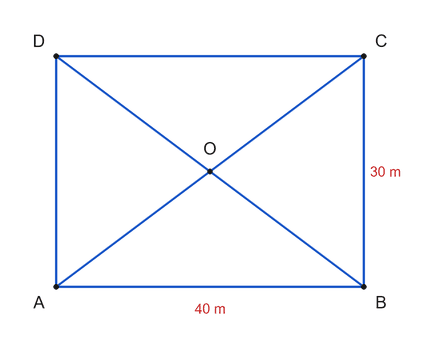
Rohan walks from corner A to the fountain and then from the fountain to corner B. How much farther does he walk than a person who goes straight from A to B along the side?
- 82 marks
Question 8
Competency: Evaluation
Sana measures the four angles of a plot of land that has four straight sides. She writes: 95°, 85°, 110° and 80°.
Her teacher looks only at the four numbers and says, "At least one reading is wrong."
How does the teacher know? If the first three readings are correct, what should the fourth angle be?
- 92 marks
Question 9
Competency: Application
A square handkerchief ABCD is folded once along its diagonal AC. It is then folded again along the line joining B to the mid-point O of AC.

Write the three angles of the small triangle AOB seen after the second fold. Give a reason for each.
- 102 marks
Question 10
Competency: Analysis
Meena has four sticks: two are 10 cm long and two are 6 cm long. She joins all four end to end to make a quadrilateral.
Name the special quadrilateral she gets when
(a) the two equal sticks are placed opposite each other,
(b) the two equal sticks are placed next to each other.
Give a reason in each case.
- 113 marks
Question 11
Competency: Analysis
For a rangoli frame, Kavya ties two thin sticks AC = 18 cm and BD = 24 cm together at their mid-points O. She then runs a thread through the four ends A, B, C and D. She measures the thread from A to B and finds it to be 15 cm.
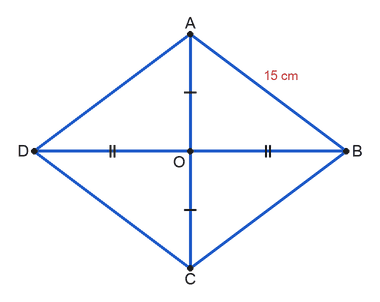
(a) Why must ABCD be a parallelogram?
(b) Use the three lengths in triangle AOB to show that ABCD is a rhombus.
(c) Find the total length of thread used.
- 123 marks
Question 12
Competency: Creativity
Frame a real-life word problem about a parallelogram in which the student has to find all four angles, and the answer is 70°, 110°, 70° and 110°.
Do not give any of these four angles directly in your problem. Then solve your own problem.
- 133 marks
Question 13
Competency: Analysis & Evaluation
A carpenter makes a wooden frame with four sides. He measures its two diagonals and finds that both are 130 cm. He says, "The diagonals are equal, so my frame is surely a rectangle."
(a) Is the carpenter's reasoning correct?
(b) Name one quadrilateral that has equal diagonals but is not a rectangle.
(c) What one more check on the diagonals would make him sure that the frame is a rectangle? Give the reason.
- 144 marks
Question 14
Competency: Application & Analysis
Case study — A flower bed in a garden
A rectangular garden ABCD is 16 m long and 12 m wide. P, Q, R and S are the mid-points of its sides AB, BC, CD and DA. The gardener joins them to mark a flower bed PQRS, as shown.

(a) Find the length of PQ.
(b) Show that the flower bed PQRS is a rhombus. Find the cost of fencing it at ₹ 150 per metre.
(c) The gardener says, "All four sides of the bed are equal, so it is a square." Find the lengths of the diagonals PR and QS, and decide whether he is right.
- 155 marks
Question 15
Competency: Analysis & Evaluation
Case study — The car jack
A car jack has four equal steel arms, each 25 cm long, hinged to form a quadrilateral ABCD. A screw runs along the horizontal diagonal BD. Turning the screw pulls B and D closer, and the top A rises above the base C. The height of the jack is the diagonal AC.
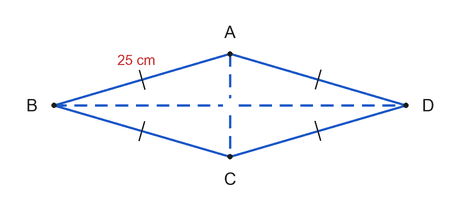
(a) What special quadrilateral is ABCD in every position? What can you say about the angle between AC and BD?
(b) Find the height AC of the jack when BD = 48 cm.
(c) The screw is turned until BD = 30 cm. By how much has the top of the jack risen? A mechanic says, "At some position the jack is a square." Is he right? Justify.
- 161 mark
Question 16
Competency: Application
A surveyor records the corners of a four-sided plot ABCD. He notes that ∠A + ∠C = 200° and that ∠B is 40° more than ∠D.
What is the measure of ∠B?
- 171 mark
Question 17
Competency: Application
A park ABCD is in the shape of a parallelogram. The straight path along the side AB is continued beyond B to a gate E. The angle between this path BE and the side BC is ∠CBE = 68°.
What is the measure of ∠ADC, the corner of the park opposite B?
- 181 mark
Question 18
Competency: Analysis
In a parallelogram ABCD, which is neither a rectangle nor a rhombus, the diagonals AC and BD are drawn and meet at O. The sides and the two diagonals now form eight triangles: AOB, BOC, COD, DOA, ABC, BCD, CDA and DAB.
How many pairs of congruent triangles are there among these eight triangles?
- 191 mark
Question 19
Competency: Analysis
In rectangle ABCD, the diagonals AC and BD meet at O, and ∠AOB is twice ∠BOC. The diagonal AC is 16 cm long.
What is the length of the shorter side of the rectangle?
- 201 mark
Question 20
Competency: Analysis
Two identical isosceles triangular pieces of cloth, ABC and ADC, are stitched together along their common base AC to make the quadrilateral piece ABCD shown. In each triangle the two equal sides are the sides other than AC, and each base angle is 35°.
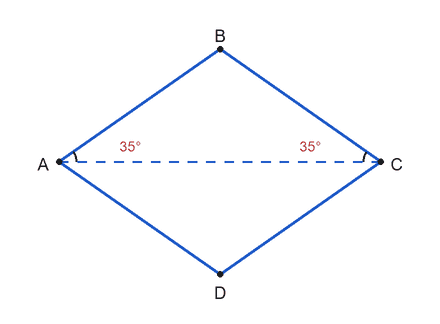
Which of the following describes ABCD correctly?
- 211 mark
Question 21
Competency: Analysis
Assertion (A) : A quadrilateral can have all four of its angles obtuse.
Reason (R) : The sum of the four angles of a quadrilateral is 360°.
- 221 mark
Question 22
Competency: Evaluation
Assertion (A) : A four-sided frame whose two diagonals cross at their mid-points must be a parallelogram.
Reason (R) : The opposite sides of a parallelogram are equal.
- 231 mark
Question 23
Competency: Understanding
A kite has two pairs of equal adjacent sides. A parallelogram has both pairs of opposite sides parallel.
Which of the following quadrilaterals is always both a kite and a parallelogram?
- 241 mark
Question 24
Competency: Evaluation
A mason has marked out a four-sided flower bed PQRS with pegs and string. Four helpers each suggest a test to be sure that PQRS is a rectangle.
Which test is enough on its own?
- 251 mark
Question 25
Competency: Analysis
A square tile ABCD has a triangular pattern ABE painted inside it, where ABE is an equilateral triangle on the side AB, as shown. The painter then joins D to E.
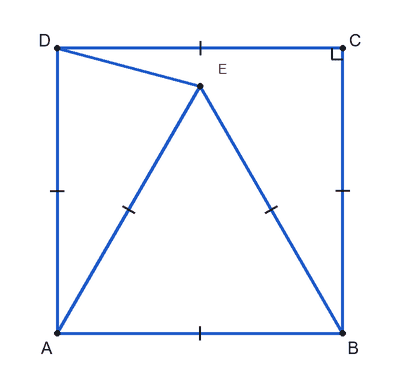
What is the measure of ∠ADE?
- 262 marks
Question 26
Competency: Evaluation
(Hypothetical data.) In kite ABCD, AB = AD and CB = CD. The diagonals meet at O. Sunil measures AO = 6 cm and OC = 15 cm. He says, "The diagonals of a kite bisect each other, so a kite is a parallelogram."
Use his own measurements to show that his statement is wrong. Which diagonal does bisect the other?
- 272 marks
Question 27
Competency: Application
The cross-section of a flower stand is an isosceles trapezium ABCD in which AB ∥ DC and AD = BC. Its angles are ∠A = (3x + 5)° and ∠B = (5x − 35)°.
Find the value of and the measure of ∠D.
- 282 marks
Question 28
Competency: Application
(Hypothetical data.) Meera cuts a parallelogram-shaped sheet of coloured paper ABCD along the diagonal AC into two triangles. The three sides of each triangle add up to 36 cm, and AC = 12 cm.
Find the perimeter of the original sheet.
- 292 marks
Question 29
Competency: Understanding
A photo-frame maker measures three corners of a four-sided frame and finds that each of them is a right angle.
(a) What is the measure of the fourth angle?
(b) Must the frame be a square? Give a reason.
- 302 marks
Question 30
Competency: Application
A jeweller makes a rhombus-shaped pendant PQRS in which ∠P : ∠Q = 1 : 5.
Find (a) ∠QRP and (b) ∠PQS.
- 312 marks
Question 31
Competency: Analysis
A square plot ABCD has a pole at a point E on the diagonal BD, placed so that BE = BC.
Find (a) ∠BEC and (b) ∠ECD.
- 323 marks
Question 32
Competency: Application
A shop sells identical rhombus-shaped floor tiles. Each tile has angles of 60° and 120°. A tiler wants to fit tiles around one point so that there is no gap and no overlap.
(a) How many tiles meet at the point if all of them use their 60° corners?
(b) How many tiles meet at the point if all of them use their 120° corners?
(c) Do four tiles fit exactly around the point if two use their 60° corners and two use their 120° corners? Give a reason.
- 333 marks
Question 33
Competency: Analysis
Rohit has two identical triangular tiles. Each tile is a right-angled isosceles triangle with its two equal sides 10 cm long, as shown.

He joins the two tiles edge to edge, without overlapping, to make a four-sided shape.
(a) He puts the two longest sides together. Name the shape and give its side and its angles.
(b) He now puts two 10 cm sides together, turning the second tile half a turn so that the right angles of the two tiles are at opposite ends of the joined side. Name the shape and give all its angles.
(c) Is the shape in part (b) a rectangle? Give a reason using its angles.
- 343 marks
Question 34
Competency: Analysis
The side face of a wooden wedge is the quadrilateral ABCD shown, in which AB ∥ DC, ∠A = ∠D = 90° and ∠B = 60°. A line CE is drawn from C parallel to DA to meet AB at E.
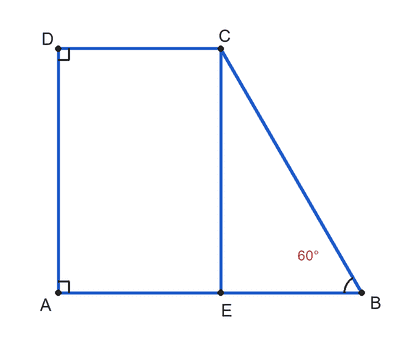
(a) Find ∠C.
(b) Show that AECD is a rectangle.
(c) Find ∠ECB.
- 353 marks
Question 35
Competency: Creativity
Aarav has a rectangular sheet of cardboard ABCD, 24 cm long and 18 cm wide, as shown.
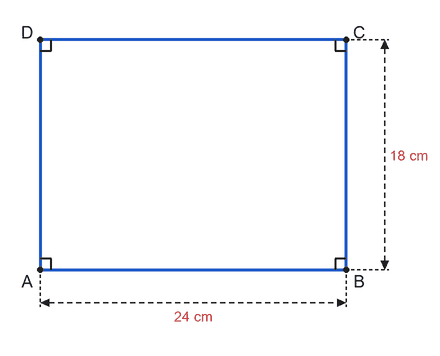
He wants to cut it along one straight line into two pieces.
(a) Show how to make one cut so that one piece is a square and the other piece is a rectangle. Give the size of each piece.
(b) Design a different straight cut so that the two pieces are identical trapeziums. Say where the cut starts and where it ends.
(c) For your cut in part (b), explain why each piece is a trapezium.
- 363 marks
Question 36
Competency: Analysis & Evaluation
(Hypothetical data.) A student's rough sketch of a parallelogram PQRS shows PQ = 6 cm, QR = 10 cm and the diagonal PR = 17 cm.
(a) Use triangle PQR to show that such a parallelogram cannot exist.
(b) The student changes PR to a whole number of centimetres. What is the greatest whole number that PR can be?
(c) What is the smallest whole number that PR can be?
- 375 marks
Question 37
Competency: Application & Analysis
Case study: (Hypothetical data.) A rectangular signboard stands upright on level ground. Its lower edge PQ is 120 cm long and the board is 90 cm tall. The sun's rays are parallel, so the shadows of parallel edges are parallel. The upper corners of the board cast their shadows at S (from the corner above P) and R (from the corner above Q). The shadow of the board on the ground is the quadrilateral PQRS shown. The shadow of each 90 cm vertical edge is 150 cm long, and ∠SPQ = 55°.
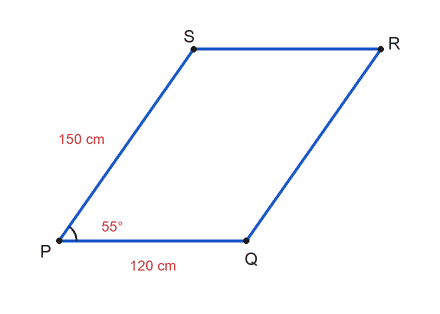
(a) Explain why the shadow PQRS is a parallelogram.
(b) Find ∠PQR, ∠QRS and ∠RSP.
(c) Later in the day the shadow of each vertical edge is 90 cm long and ∠SPQ becomes 90°. Name the shape of the shadow now and find its perimeter.
- 384 marks
Question 38
Competency: Analysis
Case study: A kite-shaped signboard ABCD hangs at a school fair. Its sides are AB = AD and CB = CD, and a wire runs along each diagonal, the wires meeting at O. The angle ∠BAD is 64° and the wire BD is 18 cm long.
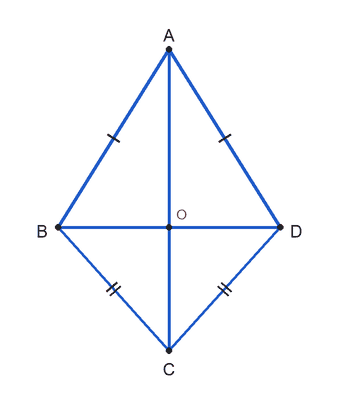
(a) Show that triangle ABC is congruent to triangle ADC.
(b) Hence show that the wire AC bisects ∠BAD, and find ∠BAC.
(c) Show that AC is perpendicular to BD and that O is the mid-point of BD. Hence find BO and ∠ABO.
- 394 marks
Question 39
Competency: Application & Analysis
Case study: Meera has a rectangular sheet of paper ABCD, 20 cm long and 12 cm wide. She cuts off the largest possible square from one end, then keeps cutting off the largest possible square from what is left, until nothing is left.
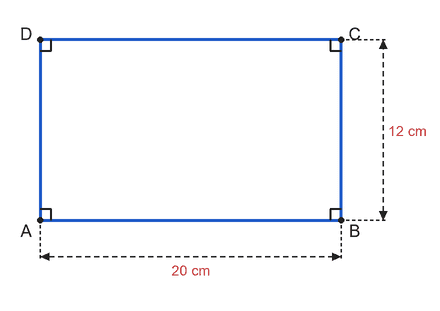
(a) What are the measurements of the piece left after the first cut? Why is the piece that is cut off a square and not just a rectangle?
(b) Write the sizes of all the squares Meera gets from this sheet.
(c) Meera starts again with a sheet that is 12 cm wide and 30 cm long, and cuts it in the same way. Without drawing, write the sizes of all the squares she will get.
- 405 marks
Question 40
Competency: Analysis & Evaluation
Case study: (Hypothetical data.) In a science club, Zoya makes a hinged frame ABCD from four wooden strips joined at the corners by hinges. Opposite strips are equal, with AB = CD = 12 cm and BC = AD = 8 cm, so the frame is always a parallelogram. She holds the frame in four positions and measures its angles with a protractor.
Position ∠A ∠B ∠C ∠D 1 50° 130° 50° 130° 2 75° 105° 75° 105° 3 100° 80° 90° 80° 4 115° (a) Complete the row for position 4.
(b) One reading in position 3 is wrong. Find it and give the correct value, with a reason.
(c) Zoya says, "If I keep pushing the frame until ∠A = 90°, the frame becomes a rhombus." Is she right? Name the shape the frame becomes and say what is true about its diagonals.