
Opening your dashboard
Class 12 Physics Chapter 4: Capacitors and Dielectrics Solutions
118 textbook questions with step-by-step answers, free to read, for ISC 2026-27.
Get talked through Ch 4, not just shown the answer
Reading a finished solution is not the same as being able to do it. The AI tutor takes one question at a time and works it with you, in your own words, until you can.
- Ask it out loud, in your own words
- It gives you the next step, not the answer
- Stuck on part (ii)? Start there
118 questions with solutions
1–5 marks · Mixed difficulty
The first 26 solutions are on this page. This chapter is a long one, so the rest open on their own page to keep this one quick to load.
- 11 mark
Question 1
The capacity of a capacitor does not depend upon
Solve with AIAnswer
(A) charge
(B) voltage
(C) nature of the material
- Correct
(D) all of these
Answer: (D) all of these
Key idea: The capacitance of a capacitor is fixed by its geometry (size, shape and separation of the plates) and by the dielectric between the plates.
Step 1 — Check the dependence on charge and voltage.
Capacitance is the ratio . If the charge is doubled, the voltage also doubles, so the ratio stays the same. depends on neither the charge nor the voltage.
Step 2 — Check the dependence on the material.
The formula contains no property of the metal of which the plates are made. Read as the material of the plates, does not depend on it either.
Step 3 — Choose the option.
None of the three listed quantities changes the capacitance, so "all of these" is the answer.
Why the other options are wrong:
- (A) is wrong: It is true that is independent of the charge, but it is also independent of the voltage, so this option alone is incomplete.
- (B) is wrong: It is true that is independent of the voltage, but it is also independent of the charge, so this option alone is incomplete.
- (C) is wrong: Read as the material of the plates it is true, but it leaves out charge and voltage. (If it meant the dielectric between the plates, does depend on it.)
Note: the book's printed answer is "nature of the material"; the correct choice is "all of these", because is certainly independent of the charge and the voltage, so the material alone cannot be the answer.
Therefore, the capacity does not depend on the charge, the voltage or the material of the plates: option (D).
- 21 mark
Question 2
The capacity of a parallel plate capacitor is when the distance between the plates is 6 cm. If the distance between the plates is reduced to 2 cm, then the capacity of this parallel plate capacitor will be
Solve with AIAnswer
(A)
(B)
- Correct
(C)
(D)
Answer: (C)
Key idea: For a parallel plate capacitor , so with the area fixed, .
Step 1 — Write the ratio of the capacitances.
The area does not change, so the capacitances are in the inverse ratio of the separations.
Step 2 — Find the new capacitance.
We multiply by .
Why the other options are wrong:
- (A) is wrong: The capacitance would stay only if the separation stayed the same.
- (B) is wrong: Doubling the capacitance would need the separation to be halved, but it becomes one third.
- (D) is wrong: Multiplying by 4 would need the separation to fall to a quarter, but the ratio of separations is 3.
Therefore, the new capacity is : option (C).
- 31 mark
Question 3
A parallel plate capacitor is charged to a potential difference . After disconnecting the battery, the distance between the plates of the capacitor is increased using an insulating handle. As a result, the potential difference between the capacitor plates
Solve with AIAnswer
- Correct
(A) increases
(B) decreases
(C) becomes zero
(D) does not change
Answer: (A) increases
Key idea: Once the battery is disconnected, the charge on the plates cannot change.
The p.d. is then , so it changes in the opposite way to .
Step 1 — See how the capacitance changes.
Increasing the separation decreases the capacitance, because .
Step 2 — See how the p.d. changes.
Putting this into shows the p.d. directly.
With , and fixed, increases in proportion to .
Why the other options are wrong:
- (B) is wrong: The p.d. would fall only if rose, that is, if the plates were brought closer together.
- (C) is wrong: The plates keep their charges and , so the p.d. between them cannot become zero.
- (D) is wrong: The p.d. stays fixed only while the battery is connected; here it has been disconnected.
Therefore, the potential difference between the plates increases: option (A).
- 41 mark
Question 4
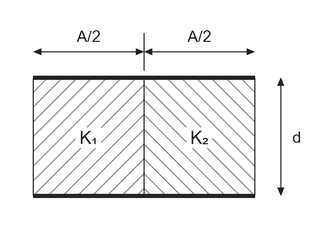
Two materials of dielectric constant and are filled between two parallel plates as shown in the figure. The capacity of the capacitor is
 Solve with AI
Answer
- Correct
(A)
(B)
(C)
(D)
Answer: (A)
Key idea: When two dielectrics lie side by side, each filling the whole gap over part of the plate area, both parts have the same p.d. across them. They act as two capacitors in parallel, and their capacitances add.
Step 1 — Write the capacitance of each half.
Each dielectric fills the full gap over half the plate area, .
Step 2 — Add the two halves in parallel.
We add and and take out the common factor.
Why the other options are wrong:
- (B) is wrong: It makes smaller as and grow, but adding dielectric always increases the capacitance.
- (C) is wrong: It is half the value for two layers stacked one above the other, so it fits neither arrangement.
- (D) is wrong: It is the result for two layers, each of thickness over the full area, stacked in series; here the dielectrics are side by side, which is a parallel connection.
Therefore, the capacity is : option (A).
- 51 mark
Question 5
When a dielectric material is introduced between the plates of a charged air capacitor, then electric field between the plates
Solve with AIAnswer
(A) increases
- Correct
(B) decreases
(C) remains constant
(D) becomes zero
Answer: (B) decreases
Key idea: A dielectric in an electric field is polarised. The bound charges induced on its faces set up a field opposite to the applied field, so the net field inside is smaller.
Step 1 — See what the induced charges do.
The face of the dielectric next to the positive plate gets a negative induced charge, and the face next to the negative plate a positive one. Their field points opposite to the original field .
Step 2 — Write the net field.
The net field is the original field reduced by the dielectric constant , which is greater than 1.
So the field between the plates decreases.
Why the other options are wrong:
- (A) is wrong: The induced field opposes , so it cannot add to it.
- (C) is wrong: The field would stay the same only for , that is, for air or vacuum.
- (D) is wrong: The field becomes zero only inside a conductor (where is effectively infinite), not inside a dielectric.
Therefore, the electric field between the plates decreases: option (B).
- 61 mark
Question 6
If the distance between the plates of a parallel plate capacitor is halved and dielectric constant is doubled, then its capacity increases by
Solve with AIAnswer
(A) 2 times
(B) 8 times
(C) 16 times
- Correct
(D) 4 times
Answer: (D) 4 times
Key idea: For a parallel plate capacitor , so with the area fixed, .
Step 1 — Write the ratio of the capacitances.
Both changes enter the ratio: the dielectric constant goes up by a factor of 2, and halving also raises by a factor of 2.
Step 2 — Put in the factors.
We multiply the two factors.
Why the other options are wrong:
- (A) is wrong: It accounts for only one of the two changes.
- (B) is wrong: It would need a third factor of 2, for example multiplied by 4 instead of 2.
- (C) is wrong: It squares the factor 4, but depends on only to the first power.
Therefore, the capacity increases 4 times: option (D).
- 71 mark
Question 7
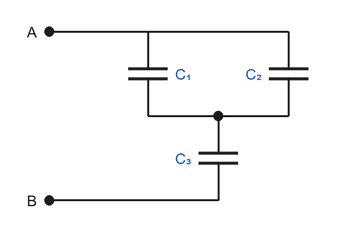
In the network shown in the given figure, , and . What is the resultant capacitance between the points A and B?
 Solve with AI
Answer
(A)
(B)
- Correct
(C)
(D)
Answer: (C)
Key idea: Capacitors joined between the same two points are in parallel (capacitances add); capacitors joined one after the other with nothing branching between them are in series (reciprocals add).
Step 1 — Identify the parallel pair.
In the figure, and are both connected between the wire from and the junction above , so they are in parallel.
Step 2 — Combine the pair with C₃ in series.
The combination and the capacitor follow one after the other between and , so they are in series.
This is about .
Why the other options are wrong:
- (A) is wrong: It is and in series (), which leaves out altogether.
- (B) is wrong: It is less than , the value with all three in series, and no way of joining three capacitors between and can give less than that.
- (D) is wrong: It comes from putting in parallel with and then in series with (), which is not how the figure joins them.
Therefore, the resultant capacitance between A and B is about : option (C).
- 81 mark
Question 8
To obtain capacity from three capacitors each, they will be arranged
Solve with AIAnswer
(A) all three in series
(B) all three in parallel
- Correct
(C) two capacitors in series and the third in parallel with the combination of the first two
(D) two capacitors in parallel and the third in series with the combination of the two
Answer: (C) two capacitors in series and the third in parallel with the combination of the first two
Key idea: Two equal capacitors in series give half the capacitance of one; capacitors in parallel add.
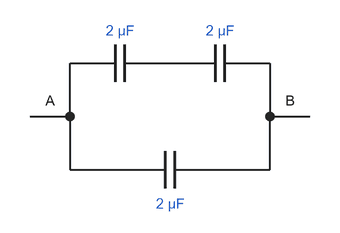
Step 1 — Join two of the capacitors in series.
Two capacitors in series give the product over the sum.
Step 2 — Put the third capacitor in parallel with this pair.
The third capacitor is joined across the same two points as the series pair, as shown below, so the capacitances add.
Why the other options are wrong:
- (A) is wrong: Joining every capacitor in series lowers the capacitance to only .
- (B) is wrong: Joining every capacitor in parallel adds the capacitances to , twice the target.
- (D) is wrong: Two in parallel give , and this in series with gives only .
Therefore, two capacitors are joined in series and the third in parallel with them: option (C).
- 91 mark
Question 9
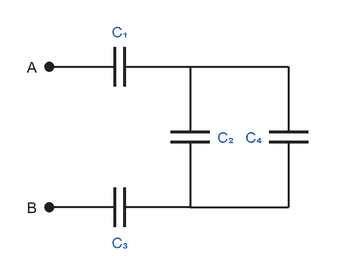
The effective capacitance between points A and B in the given circuit is (capacitance of each capacitor is )
 Solve with AI
Answer
(A)
(B)
(C)
- Correct
(D)
Answer: (D)
Key idea: Capacitors connected across the same two wires are in parallel (capacitances add); capacitors following one another in a single path are in series (reciprocals add).
Step 1 — Identify the parallel pair.
In the figure, and both join the upper wire to the lower wire, so they are in parallel.
Step 2 — Combine the chain in series.
Going from to , the charge passes through , then the pair , then , one after the other. So these three are in series.
Step 3 — Invert the result.
Taking the reciprocal gives the effective capacitance.
Why the other options are wrong:
- (A) is wrong: A series chain is smaller than its smallest member, and this chain contains capacitors, so it cannot reach .
- (B) is wrong: It would need all four capacitors in parallel, which is not the circuit drawn.
- (C) is wrong: It is also larger than , which a series chain containing a capacitor can never be.
Therefore, the effective capacitance between A and B is : option (D).
- 101 mark
Question 10
If capacitors each of capacitance are connected in series with a battery of volt, then energy stored in all the capacitors will be
Solve with AIAnswer
(A)
(B)
(C)
- Correct
(D)
Answer: (D)
Key idea: A chain of equal capacitors in series have an equivalent capacitance of , and the whole battery voltage is across the combination.
Step 1 — Find the equivalent capacitance.
Adding equal reciprocals gives , so the series value is .
Step 2 — Find the energy stored.
We use for the whole combination.
Why the other options are wrong:
- (A) is wrong: It is twice the energy that capacitors in parallel would store, each with across it.
- (B) is wrong: It follows from neither the series nor the parallel rule.
- (C) is wrong: It is the energy for capacitors in parallel, not in series.
Therefore, the energy stored in all the capacitors is : option (D).
- 111 mark
Question 11
A capacitor is charged by 100 V and then its plates are connected by a conducting wire. The heat produced is
Solve with AIAnswer
(A) 0.001 J
- Correct
(B) 0.01 J
(C) 0.1 J
(D) 1 J
Answer: (B) 0.01 J
Key idea: When the plates of a charged capacitor are joined by a wire, the capacitor discharges completely. All the energy stored in it is turned into heat in the wire.
Step 1 — Write the data in SI units.
The capacitance is ().
The charging potential difference is .
Step 2 — Find the stored energy.
We put the values into the energy formula.
Step 3 — Relate the energy to the heat produced.
The wire carries the charge from one plate to the other until both plates are neutral, so the whole stored energy appears as heat.
Why the other options are wrong:
- (A) is wrong: A heat of 0.001 J would need to be ten times smaller; this comes from slipping one power of ten when writing as F.
- (C) is wrong: A heat of 0.1 J is ten times too large; it comes from writing as F.
- (D) is wrong: A heat of 1 J is a hundred times too large; it would need a capacitance of at 100 V.
Therefore, the heat produced is 0.01 J: option (B).
- 121 mark
Question 12
A capacitor is charged to store an energy of . The charging battery is disconnected. An identical capacitor is now connected in parallel with the capacitor. The energy stored in each of the capacitors is
Solve with AIAnswer
(A)
(B)
- Correct
(C)
(D)
Answer: (C)
Key idea: With the battery disconnected, the charge on the capacitor cannot change in total. When an identical uncharged capacitor is joined in parallel, the charge is shared equally because both capacitors end at the same potential.
Step 1 — Write the initial energy.
Let the capacitance be and the charge be . The energy stored at the start is given in terms of the charge, since the charge is the quantity that is conserved.
Step 2 — Find the charge on each capacitor after sharing.
The two capacitors are identical and are at the same potential, so each carries half of the total charge.
Step 3 — Find the energy in each capacitor.
We put the new charge into the energy formula for one capacitor.
The total energy of the pair is . The other half of the original energy is lost as heat (and radiation) in the connecting wires while the charge flows.
Why the other options are wrong:
- (A) is wrong: With no battery connected, nothing supplies energy, so the energy can never rise above ; is impossible.
- (B) is wrong: Each capacitor would store only if each still held the full charge , which would need twice the original charge.
- (D) is wrong: The value is the total energy of the two capacitors together, not the energy in each one.
Therefore, the energy stored in each capacitor is : option (C).
- 131 mark
Question 13
Two capacitors A and B are connected in series with a battery as shown in the figure. When the switch S is closed and two capacitors get charged fully, then
 Solve with AI
Answer
(A) Potential difference across the plates of A is 4 V and across the plates of B is 6 V
- Correct
(B) Potential difference across the plates of A is 6 V and across the plates of B is 4 V
(C) The ratio of electric energies stored in A and B is 2 : 3
(D) The ratio of charges on A and B is 3 : 2
Answer: (B) Potential difference across the plates of A is 6 V and across the plates of B is 4 V
Key idea: Capacitors in series carry the same charge . The battery voltage is shared between them, and the smaller capacitor takes the larger share because .
Step 1 — Read the data from the figure.
Capacitor A is and capacitor B is . The battery gives 10 V across the series pair once S is closed.
Step 2 — Find the equivalent capacitance.
For two capacitors in series, the equivalent capacitance is the product divided by the sum.
Step 3 — Find the charge on each capacitor.
The charge drawn from the battery is the same on A and on B.
Step 4 — Find the potential difference across each capacitor.
We divide the common charge by each capacitance.
As a check, the two voltages add up to the battery's 10 V.
Why the other options are wrong:
- (A) is wrong: It swaps the two voltages; it gives the larger share to the larger capacitor, but with equal gives the larger share to the smaller one.
- (C) is wrong: With equal charges, , so the energies are in the inverse ratio of the capacitances: , not .
- (D) is wrong: Capacitors in series carry equal charges, so the ratio of charges is , not .
Therefore, the p.d. across A is 6 V and across B is 4 V: option (B).
- 141 mark
Question 14
A capacitor is charged to a potential difference of 50 V and is connected to another uncharged capacitor in parallel. Now the common potential difference becomes 20 V. The capacitance of the second capacitor is
Solve with AIAnswer
- Correct
(A)
(B)
(C)
(D)
Answer: (A)
Key idea: When a charged capacitor is joined in parallel with an uncharged one, charge flows until both are at the same (common) potential. The total charge does not change.
Step 1 — Find the charge on the first capacitor.
The capacitor is charged to 50 V, so its charge is .
Step 2 — Use charge conservation at the common potential.
The same 500 μC now sits on the two capacitors in parallel, whose total capacitance is , at 20 V.
Step 3 — Solve for the second capacitance.
We multiply both sides by and divide by 20.
Why the other options are wrong:
- (B) is wrong: With the total capacitance is , so the common potential would be V, not 20 V.
- (C) is wrong: With the total is , giving a common potential of about 16.7 V, not 20 V.
- (D) is wrong: With an identical capacitor the charge splits equally and the common potential would be 25 V, not 20 V.
Therefore, the capacitance of the second capacitor is : option (A).
- 151 mark
Question 15
Three capacitors, each of capacitance are connected in series. Their equivalent capacitance is . The same three capacitors are now connected in parallel. Their equivalent capacitance becomes . The ratio of to is
Solve with AIAnswer
- Correct
(A) 9 : 1
(B) 1 : 9
(C) 3 : 1
(D) 1 : 3
Answer: (A) 9 : 1
Key idea: In series the reciprocals of the capacitances add; in parallel the capacitances themselves add.
Step 1 — Find the series value.
Three equal capacitors in series give three equal reciprocals.
Step 2 — Find the parallel value.
In parallel the three capacitances simply add.
Step 3 — Take the ratio.
We divide the parallel value by the series value.
Why the other options are wrong:
- (B) is wrong: is the ratio , the inverse of the ratio asked for.
- (C) is wrong: is the ratio (parallel value to one capacitor), not .
- (D) is wrong: is the ratio (series value to one capacitor), not .
Therefore, the ratio of to is 9 : 1: option (A).
- 161 mark
Question 16
Three capacitors , and are connected to a 50 V battery as shown in the figure. The equivalent capacitance of the circuit between points A and B and the charge on are
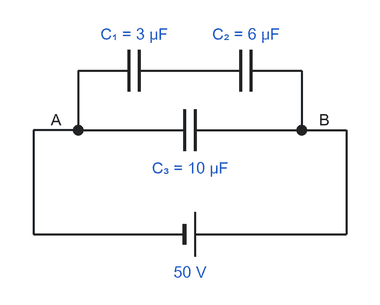 Solve with AI
Answer
(A) ,
(B) ,
- Correct
(C) ,
(D) ,
Answer: (C) ,
Key idea: Reduce the network step by step. In the figure and are in series in the upper branch, and that branch is in parallel with between A and B, which are joined directly to the 50 V battery.
Step 1 — Combine and in series.
The capacitors and are joined end to end with no other connection between them, so they are in series.
Step 2 — Add in parallel.
The series branch and both connect A to B, so they are in parallel and their capacitances add.
Step 3 — Find the charge on .
The whole 50 V acts across the series branch, and carries the same charge as the series branch (and as ).
Why the other options are wrong:
- (A) is wrong: Its capacitance is right, but is V, which wrongly puts the whole 50 V across alone; in fact has only V across it.
- (B) is wrong: About (close to the 4.75 printed) comes from wrongly putting and in parallel (9 μF) and then that in series with ; its charge value is also the right one for , but the pair is wrong.
- (D) is wrong: It pairs the wrong equivalent capacitance of about with the wrong charge , so both of its values come from the slips above.
Therefore, the equivalent capacitance between A and B is and the charge on is : option (C).
- 171 mark
Question 17
Name the physical quantity whose S.I. unit is coulomb .
Solve with AIWritten solution
Solution:
Key idea: The unit of a quantity defined as a ratio is the ratio of the units. Capacitance is defined as charge per unit potential difference.
Step 1 — Write the units of the ratio.
Charge is measured in coulomb (C) and potential difference in volt (V), so the ratio has the unit coulomb per volt, .
Step 2 — Name the quantity.
The quantity is capacitance, and is given the name farad (F).
Therefore, coulomb volt⁻¹ is the S.I. unit of electrical capacitance (1 C V⁻¹ = 1 farad).
- 181 mark
Question 18
What is meant by capacitance? Give its S.I. unit.
Solve with AIWritten solution
Solution:
Key idea: A conductor or capacitor stores charge, and the charge it holds rises in proportion to its potential. The constant of proportionality is its capacitance.
Step 1 — State the definition.
Capacitance of a conductor is the ratio of the charge given to it to the rise in its potential. For a capacitor, it is the ratio of the charge on either plate to the potential difference between the plates.
It measures how much charge the conductor or capacitor can store for each volt of potential difference.
Step 2 — Give the S.I. unit.
Charge is in coulomb and potential difference in volt, so the unit is coulomb per volt, called the farad.
Therefore, capacitance is the charge stored per unit potential difference, , and its S.I. unit is the farad (F).
- 191 mark
Question 19
Why is a parallel plate capacitor named so?
Solve with AIWritten solution
Solution:
Key idea: Capacitors are usually named after the shape of their plates (parallel plate, spherical, cylindrical).
Step 1 — Describe its plates.
This capacitor is made of two flat (plane) metal plates placed facing each other at a small, constant distance apart, with air or a dielectric between them.
Step 2 — Connect the shape to the name.
Because the two plates are plane and parallel to each other, the capacitor is called a parallel plate capacitor.
Therefore, it is named so because its two metal plates are plane and parallel to each other.
- 201 mark
Question 20
In what form is the energy stored in a charged capacitor?
Solve with AIWritten solution
Solution:
Key idea: Work has to be done to move charge on to a capacitor against the field already set up between its plates. This work is stored, not lost.
Step 1 — Say where the work goes.
The work done by the charging source in separating and on the two plates is stored as electrostatic potential energy.
Step 2 — Say where the energy is located.
This energy is located in the electric field between the plates. Each unit volume of that field holds an energy density given below, where is the field strength.
Therefore, the energy of a charged capacitor is stored as electrostatic potential energy in the electric field between its plates.
- 211 mark
Question 21
What is dielectric?
Solve with AIWritten solution
Solution:
Key idea: Materials are grouped by whether their charges can move freely: conductors have free charges, dielectrics do not.
Step 1 — State the definition.
A dielectric is an insulating material, such as glass, mica, paper or wax, that has no free charges to carry a current.
Step 2 — Say how it behaves in a field.
When a dielectric is placed in an electric field, its molecules develop or line up electric dipoles. This is called polarisation, and it reduces the field inside the material.
Therefore, a dielectric is an insulator that does not conduct but gets polarised in an electric field, for example glass, mica or paper.
- 221 mark
Question 22
What is dielectric strength?
Solve with AIWritten solution
Solution:
Key idea: A strong enough field can pull electrons out of the molecules of an insulator, so it starts to conduct. This is called dielectric breakdown.
Step 1 — State the definition.
Dielectric strength is the maximum electric field that a dielectric can withstand without breaking down, that is, without losing its insulating property and starting to conduct.
Step 2 — Give its unit and an example.
It is measured in volt per metre (). For dry air at normal pressure it is about ; above this field a spark passes.
Therefore, dielectric strength is the largest electric field a dielectric can stand without breakdown (about for air).
- 231 mark
Question 23
Define dielectric constant in terms of the capacitance of a capacitor.
Solve with AIWritten solution
Solution:
Key idea: Filling the gap of a capacitor with a dielectric raises its capacitance. The factor by which it rises is a property of the dielectric.
Step 1 — Name the two capacitances.
Let be the capacitance with vacuum (or air) between the plates. Let be the capacitance when the dielectric completely fills the space between the plates.
Step 2 — Define the dielectric constant.
The dielectric constant of the medium is the ratio of these two capacitances.
It has no unit, and for every dielectric.
Therefore, the dielectric constant is the ratio of the capacitance with the medium completely filling the gap to the capacitance with vacuum between the plates, .
- 241 mark
Question 24
What happens to the capacitance of a capacitor when (i) the charge is doubled and (ii) the potential difference across it is doubled?
Solve with AIWritten solution
Solution:
Key idea: Capacitance depends only on the size and shape of the plates, their separation and the medium between them. It does not depend on the charge or the voltage.
Step 1 — Look at part (i), charge doubled.
If the charge on the same capacitor is doubled, the potential difference also doubles, so the ratio stays the same.
Step 2 — Look at part (ii), p.d. doubled.
If the potential difference is doubled, the capacitor takes twice the charge, so again the ratio does not change.
Therefore, (i) the capacitance does not change and (ii) the capacitance does not change.
- 251 mark
Question 25
On inserting a dielectric between the plates of a capacitor, its capacitance is observed to increase 5 times. What is the relative permittivity of the dielectric?
Solve with AIWritten solution
Solution:
Key idea: The relative permittivity (dielectric constant) of a dielectric is the factor by which it multiplies the capacitance when it fills the gap.
Step 1 — Write the given change.
The capacitance with the dielectric is 5 times the capacitance without it.
Step 2 — Find the relative permittivity.
We put this into the definition.
Therefore, the relative permittivity of the dielectric is 5.
- 261 mark
Question 26
After charging a parallel plate capacitor by a battery, the battery is removed. Now a dielectric slab is inserted between the plates. What will be the effect on (i) charge, (ii) capacitance, (iii) potential difference and (iv) electric field of the capacitor?
Solve with AIWritten solution
Solution:
Key idea: Once the battery is removed, the plates are isolated, so the charge on them cannot change. Let the slab (dielectric constant ) fill the gap, and let , , be the values before it is inserted.
Step 1 — Part (i), charge.
There is no path for charge to leave or reach the isolated plates.
Step 2 — Part (ii), capacitance.
A dielectric filling the gap multiplies the capacitance by .
Step 3 — Part (iii), potential difference.
We divide the unchanged charge by the new capacitance.
Step 4 — Part (iv), electric field.
The plate separation is unchanged and the field is , so the field falls in the same ratio as the p.d. The polarised slab sets up an opposing field inside it.
Therefore, (i) the charge stays the same, (ii) the capacitance increases times, (iii) the p.d. decreases times and (iv) the electric field decreases times.
- 271 mark
Question 27
Two spheres of copper of the same radii, one hollow and the other solid are charged to the same potential. On which sphere there is more charge?
- 281 mark
Question 28
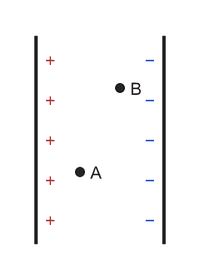
Two protons A and B are placed between the two parallel plates having a potential difference as shown in the figure. Will these protons experience equal or unequal force?
- 291 mark
Question 29
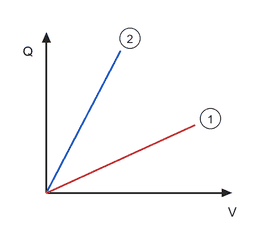
Q–V graph of two parallel plate capacitors is shown in the figure. Which capacitor has greater capacitance?
- 301 mark
Question 30
Give the dimensional formula of capacitance.
- 311 mark
Question 31
What is the net charge on a capacitor?
- 321 mark
Question 32
If the plates of a charged capacitor be suddenly connected to a wire, what will happen?
- 331 mark
Question 33
An uncharged insulated conductor A is brought near a charged insulated conductor B. What happens to the charge, potential and capacity of B?
- 341 mark
Question 34
For a given potential difference, does a capacitor store more or less charge with a dielectric than it does without a dielectric?
- 351 mark
Question 35
The distance between the plates of a parallel plate capacitor is . A metal plate of thickness is placed between the plates. What will be its effect on the capacitance of the system?
- 361 mark
Question 36
Why is it not possible to make a spherical conductor of capacity one farad?
- 371 mark
Question 37
Is it possible to place a parallel plate capacitor of one farad capacity in your house?
- 381 mark
Question 38
Which of the following is a dielectric?
(i) Silicon, (ii) carbon and (iii) mica
- 391 mark
Question 39
The dielectric constant of water is high (80). Why?
- 401 mark
Question 40
Why is the electric potential of Earth taken to be zero?
- 411 mark
Question 41
There are plates in a variable air capacitor each of area and the distance between two successive plates m. What is its capacitance?
- 421 mark
Question 42
What is the effect of temperature on the dielectric constant of a dielectric?
- 431 mark
Question 43
A capacitor has no charge. Is its capacitance zero?
- 442 marks
Question 44
How are the following quantities of an isolated charged parallel plate capacitor affected, when the separation between its plates is doubled?
(i) Capacitance (ii) Stored energy
- 452 marks
Question 45
On inserting a dielectric between the plates of a capacitor, its capacity is found to increase 5 times. What is the relative permittivity of the dielectric?
- 462 marks
Question 46
Define (i) capacitance and (ii) capacity.
- 472 marks
Question 47
Give the principle of working of a capacitor.
- 482 marks
Question 48
The plates of a parallel plate capacitor are connected to a battery. If the connecting wires are removed from the battery, what will happen to the charge on the plates? If the wires are removed and connected to each other, what will happen?
- 492 marks
Question 49
Three capacitors are connected in series. The combination is connected to a battery. Which quantity has the same value for all the capacitors?
- 502 marks
Question 50
The charge on a capacitor plate is doubled. What happens to the energy?
- 512 marks
Question 51
Draw a graph connecting charge and potential difference of a capacitor. Use the graph to obtain an expression for the energy stored in a capacitor.
- 522 marks
Question 52
Define energy density. Write down an expression for it.
- 532 marks
Question 53
Distinguish between polar and non-polar molecules.
- 542 marks
Question 54
Is water molecule polar or non-polar? Why?
- 552 marks
Question 55
The atmospheric electric field on Earth is as high as . Why do we not get an electric shock as we move on the surface of the Earth?
- 562 marks
Question 56
Three capacitors each of capacitance are connected in series. Their equivalent capacitance is . The same three capacitors are now connected in parallel. Their equivalent capacitance becomes . Find the ratio .
- 572 marks
Question 57
Obtain an expression for equivalent capacitance when three capacitors having capacitance , and are connected in series.
- 582 marks
Question 58
Three capacitors , and are connected to a 100 V battery as shown in the figure.
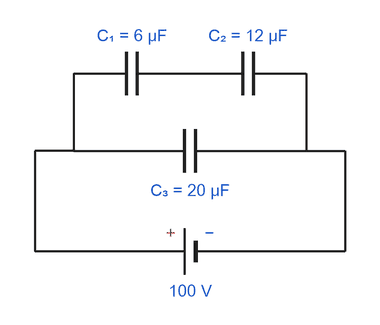
Calculate
(i) charge on each plate of capacitor
(ii) electrostatic potential energy stored in capacitor
- 592 marks
Question 59
You are provided with capacitors. Show with the help of a diagram how you will arrange minimum numbers of them to get a resultant capacitance of .
- 602 marks
Question 60
A parallel plate capacitor is charged by a battery which is then disconnected. A dielectric slab is then inserted to fill the space between the plates. Explain the changes, if any, that occur in the values of (i) charge on the plates, (ii) capacitance, (iii) p.d. between the plates, (iv) electric field between the plates and (v) energy stored in the capacitor.
- 613 marks
Question 61
Distinguish between conductors and insulators. Give examples. Explain free charges and bound charges in a conductor.
- 623 marks
Question 62
What is dielectric? Write down the expression for the capacitance of a parallel plate capacitor with air as dielectric and a given medium as dielectric. Hence define dielectric constant.
- 633 marks
Question 63
Explain the principle of working of a capacitor. Derive an expression for the capacitance of a spherical conductor.
- 643 marks
Question 64
Name the factors affecting the capacitance of a parallel plate capacitor. Derive an expression for the force of attraction between the plates of a charged capacitor.
- 653 marks
Question 65
Distinguish between polar and non-polar molecules with examples. Explain electric polarisation. What is dielectric strength?
- 665 marks
Question 66
(i) Derive an expression for the capacitance of a parallel plate capacitor with a dielectric.
(ii) Discuss the factors affecting the capacitance of a parallel plate capacitor.
(iii) Obtain an expression for the capacitance of a parallel plate capacitor, partly filled with a slab of dielectric constant .
- 675 marks
Question 67
(i) Derive an expression for energy stored in a charge condenser.
(ii) A parallel plate condenser having plates of area and separation , is charged to a potential with a battery. The battery is disconnected and a dielectric slab of thickness is then introduced between the plates of the condenser. Calculate the change in the potential difference, capacitance, charge and stored energy of the condenser. What happens to the difference of stored energy with and without the dielectric?
- 685 marks
Question 68
A number of capacitors are connected (i) in series and (ii) in parallel. Derive an expression for the effective capacitance in each case.
- 695 marks
Question 69
(i) Derive an expression for the energy stored in a capacitor.
(ii) What is the total energy stored in a number of capacitors when they are connected in (a) series and (b) parallel?
(iii) Will there be any loss of energy when two charged capacitors are connected together?
- 705 marks
Question 70
(i) What is electric polarisation?
(ii) What is the effect of introducing a dielectric on the capacitance of a parallel plate capacitor?
(iii) What is the effect of dielectric on
(a) electric field in between the plates?
(b) potential difference between the plates?
(c) energy stored in the capacitor?
- 713 marks
Question 71
The results of charging a capacitor are shown in the tabular column.
Charge (C) 7.5 30 60 75 90 Potential difference (V) 1.0 4.0 8.0 10.0 12.0 Draw a graph of charge stored on the -axis and potential difference on the -axis. From the graph, find the capacitance of the capacitor.
- 723 marks
Question 72
A capacitor is charged to a potential of V and then disconnected from the power supply.
(i) What is the charge on each plate of the capacitor?
(ii) What is the energy stored in the capacitor?
- 733 marks
Question 73
In a camera flash, a capacitor of capacity is used. The capacitor is charged using a battery of V and it takes about s to charge the capacitor fully. What is the energy stored in the capacitor? If the capacitor is discharged in one millisecond, what is the power of the flash obtained?
- 743 marks
Question 74
You are given four capacitors, each with a voltage rating of V. How will you connect them such that these four capacitors are equivalent to a single capacitor of capacitance but with a voltage rating of V.
- 753 marks
Question 75
The radius of the circular plates of a parallel plate capacitor is cm and are separated by a distance of mm. The capacitor is connected to a potential difference of V. Calculate the magnitude of charge on each plate.
- 763 marks
Question 76
A capacitor can be used to measure small time intervals. In an experiment to measure an interval, the charging current flowing through a capacitor of capacitance is mA. During this interval, the plates are raised to a potential difference of mV. Calculate the time interval.
Hint: .
- 773 marks
Question 77
The electric intensity at a point distant m from the centre of an isolated charged spherical conductor is N/C. If the diameter of the sphere is m, calculate
(i) its surface charge density and
(ii) its capacitance
- 784 marks
Question 78
The given figure shows four capacitors each with voltage rating of V. Out of the following quantities, which one has the same value for all the three networks, (i) the effective capacitance, (ii) the voltage rating and (iii) the maximum energy the system can store? Calculate its value.
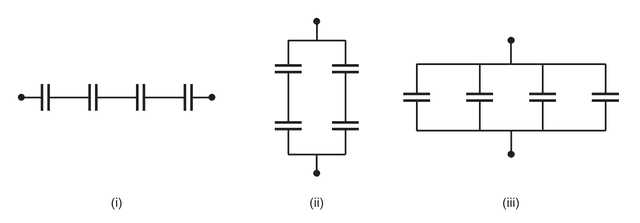
- 793 marks
Question 79
A spherical conductor of diameter m is charged to a potential of kV. What is its capacity?
- 803 marks
Question 80
A capacitor with a capacity of is connected to a battery of V. Find the charge on it and its energy.
- 813 marks
Question 81
Two capacitors have a capacity when connected in parallel and when connected in series. Calculate the capacities.
- 823 marks
Question 82
Three capacitors, each of capacity , are connected in series and are also connected in series with three capacitors of , and , which are grouped together in parallel. Calculate the combined capacity.
- 833 marks
Question 83
Calculate the capacity of a parallel plate condenser of two plates, each of area . The plates are separated by air and the distance between them is mm. What will be the total energy stored if the p.d. of V is applied to this condenser?
- 843 marks
Question 84
If pF and pF, calculate the equivalent capacitance between points and of the given network.

- 853 marks
Question 85
Seven capacitors, each of capacitance , are to be connected in a configuration to obtain an effective capacitance of . How can this be done?
- 863 marks
Question 86
A pF capacitor is charged by a V battery. How much electrostatic energy is stored by the capacitor?
- 873 marks
Question 87
The capacity of a parallel plate capacitor with a dielectric () is . Find the capacity of the capacitor with air as dielectric.
- 883 marks
Question 88
The capacitance of a parallel plate capacitor is pF. If the plate area is , calculate the plate separation.
- 893 marks
Question 89
The capacitors used for maintaining current in computer memories when the computer is switched off have dimensions of mm. The capacity of a capacitor is F. Calculate the energy density of the capacitor when it is charged upto V.
- 903 marks
Question 90
The capacitance of a parallel plate capacitor without any dielectric is . A dielectric of dielectric constant and thickness is placed between the plates, where is the distance between the plates. Calculate the new capacitance.
- 913 marks
Question 91
What is the equivalent capacitance between the points and of the given network? Given , and .

- 923 marks
Question 92
The capacitance of a parallel plate capacitor with air as the dielectric is pF. What will be the capacitance if the distance between the plates is reduced by half and the space between them is filled with a substance of dielectric constant ?
- 933 marks
Question 93
Two isolated metallic solid spheres of radii and are charged such that both of these have the same charge density . The spheres are located far away from each other, and connected by a thin conducting wire. Find the new charge density on the bigger sphere.
- 943 marks
Question 94
A capacitor of withstands a maximum voltage of kilovolt while another capacitor of withstands a maximum voltage of kilovolt. If the two capacitors are connected in series, calculate the maximum voltage the system can withstand.
- 953 marks
Question 95
A parallel plate capacitor with air between the plates has a capacitance of . The capacitor is divided into two halves and filled with two media having dielectric constants and as shown in the figure. Calculate the capacitance of the system.

- 963 marks
Question 96
A capacitor is fully charged across a V battery. It is then disconnected from the battery and connected to an uncharged capacitor. If the voltage across the capacitor becomes V, then find the capacitance of the uncharged capacitor.
- 973 marks
Question 97
A capacitor of , charged to V is connected to another capacitor of , charged to V. What is the total energy of the combination?
- 983 marks
Question 98
The capacitance of a spherical capacitor is . If the spacing between the spheres is mm, then find the radius of the outer sphere.
- 993 marks
Question 99
Two capacitors of capacitance pF and pF are connected in series and a p.d. of V is applied across the combination. They are then disconnected and reconnected in parallel. Calculate the p.d. across the combination.
- 1003 marks
Question 100
A condenser of capacity is charged to a certain potential. The electrostatic energy stored in it is . If it is connected to another uncharged condenser of capacity in parallel, then find the energy dissipated in the process.
- 1013 marks
Question 101
In the given circuit, calculate the potential difference across the capacitor.

- 1023 marks
Question 102
A battery of V is connected to a capacitor of capacity F. The battery is now removed and this capacitor is connected to a second uncharged capacitor. If the charge distributes equally on these two capacitors, find the total energy stored in the two capacitors. Further compare this energy with the initial energy stored in the first capacitor.
- 1033 marks
Question 103
The plates of a parallel plate capacitor are charged upto V. A mm thick plate is inserted between the plates, then to maintain the same potential difference, the distance between the capacitor plates is increased by mm. What is the dielectric constant of the plate?
- 1043 marks
Question 104
A parallel plate capacitor has the following ratings (i) voltage V, (ii) dielectric constant and (iii) dielectric strength V/m. Considering that for safety, the electric field should not exceed of the dielectric strength, find
(i) the distance between the plates and
(ii) the area of each plate for a capacity of pF.
- 1053 marks
Question 105
Twelve capacitors of capacitance each, are connected to form a cube. What is the equivalent capacitance between the diagonally opposite corners?
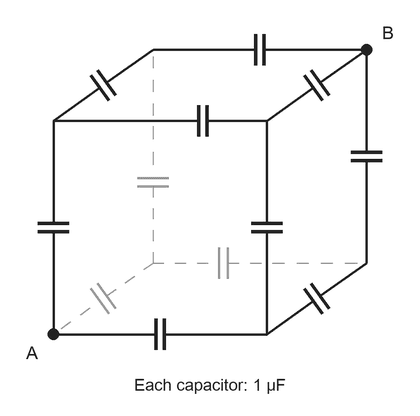
- 1063 marks
Question 106
A parallel plate capacitor of circular section and radius cm has its plates mm apart. The plates are separated by a medium of dielectric constant . If the potential difference between the plates is V, calculate the force of attraction between the plates.
- 1073 marks
Question 107
A capacitor charged from a V d.c. supply is found to have a charge of . What is the capacitance of the capacitor and how much energy is stored in it?
- 1083 marks
Question 108
A variable capacitor is kept connected to a V battery. If the capacitance of the capacitor is changed from to , what is the change in the energy? What happens to the energy?
- 1093 marks
Question 109
Two capacitors of capacitance and arranged in series are connected in parallel with a third capacitor . The arrangement is connected to a V battery. Calculate the total energy stored in capacitors.
- 1103 marks
Question 110
A battery of V is connected to a capacitor of capacity F. The battery is now removed and this capacitor is connected to a second uncharged capacitor. If the charge distributes equally on these two capacitors, find the total energy stored in the two capacitors. Further compare this energy with the initial energy stored in the first capacitor.
- 1113 marks
Question 111
spherical droplets of radius mm each carrying C of charge each are combined to form a bigger drop. Find the capacitance of the bigger drop.
- 1124 marks
Question 112
The equivalent capacitance of the combination between and shown in the figure is .
(i) Calculate the capacitance of the capacitor .
(ii) Calculate charge on each capacitor if a V battery is connected across and .
(iii) What will be the potential drop across each capacitor?

- 1133 marks
Question 113
Three capacitors of each are connected in series. This combination is connected in series to another combination of three capacitors of each in parallel. Find the total capacitance.
- 1143 marks
Question 114
Calculate the equivalent capacitance between the points and in the combination shown in the figure. , , , .
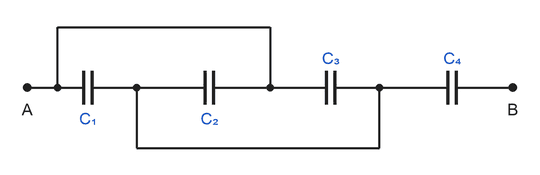
- 1153 marks
Question 115
A capacitor is connected in parallel to capacitor and this combination is joined to a V d.c. source. Calculate the charge taken from the source and the charge on each capacitor.
- 1163 marks
Question 116
Two capacitors of capacitances and arranged in series are connected in parallel with a third capacitor . The arrangement is connected to a V battery. Calculate the total energy stored in capacitors.
- 1174 marks
Question 117
Two parallel plate capacitors and have the same area of plates and same separation between them. has air between the plates and contains a dielectric medium of .
(i) Calculate capacitance of and if equivalent capacitance of the combination is .
(ii) What is the ratio of electrostatic energy stored in and ?

- 1184 marks
Question 118
A capacitor is charged by a V d.c. supply and then connected across an uncharged capacitor. Calculate (i) the final potential difference across the combination and (ii) initial and final energies. How will you account for the difference in energies?
What Class 12 Physics Ch 4 covers
The sections of the chapter, in the order the book takes them. Every question above comes from one of these.
- 01Conductors, Free Charges and Bound Charges
- 02Capacitance and Principle of a Capacitor
- 03Capacitance of an Isolated Sphere and a Parallel Plate Capacitor
- 04Combination of Capacitors
- 05Energy Stored in a Capacitor
- 06Sharing of Charges and Loss of Energy
- 07Dielectrics and Polarisation
More ways to study this chapter
The same chapter asked three other ways. Practise it, revise it, and see what the board has set on Ch 4 before.
- Competency-Based Questions (CBQ)Case study questions: a situation, and the part of the chapter that answers it.41questionsOpen
- Previous Year QuestionsQuestions that have actually appeared in board papers, each tagged with its year.10questionsOpen
- Practice QuestionsExtra questions per chapter, for when one attempt at a method is not enough.138questionsOpen
Ch 4 in past ISC papers
The same chapter as the board has actually asked it. These are worded differently from the textbook exercise, which is the point of reading them.
- 13 marks
Board paper question 1
Four capacitors, , , and are connected as shown in Figure 3 below. Calculate equivalent capacitance of the circuit between points X and Y.
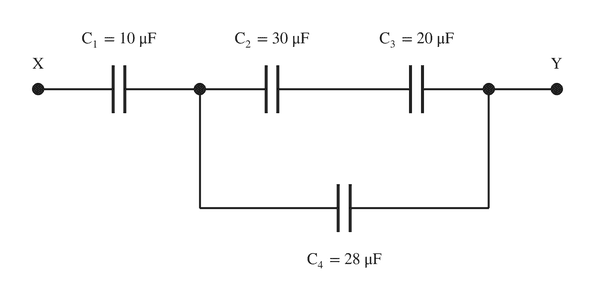 Solve with AI
Written solution
Solution:
Key idea: For capacitors in series, ; in parallel, . We reduce the network step by step, starting from the innermost group.
Step 1 — Combine and (series).
The capacitors and sit one after the other on the top line with no branch between them, so they are in series.
Step 2 — Combine with (parallel).
Capacitor is connected between the same two junctions as the pair , , so it is in parallel with .
Step 3 — Combine with (series).
Capacitor is in series with this whole group between X and Y.
Watch out: A series combination is always smaller than the smallest capacitor in it; here is less than , as it should be.
Therefore, the equivalent capacitance between X and Y is .
- 23 marks
Board paper question 2
Obtain an expression for equivalent capacitance when three capacitors , and are connected in series.
Solve with AIWritten solution
Solution:
Key idea: In a series combination every capacitor carries the same charge , and the p.d. of the source is shared among the capacitors. The equivalent capacitor is the single capacitor that would store the same charge at the same total p.d. .
Step 1 — Describe the arrangement.
Three capacitors , and are joined end to end between A and B, and a battery keeps a p.d. across A and B.
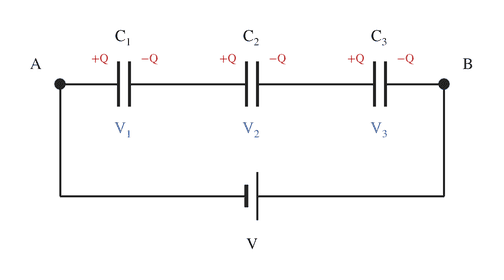
Step 2 — Note that the charge is the same on each.
When the battery puts on the left plate of , induction puts on its right plate and on the left plate of , and so on. So every capacitor carries the same charge .
Step 3 — Write the p.d. across each capacitor.
From for each capacitor:
Step 4 — Add the p.d.s.
The total p.d. across A and B is the sum of the separate p.d.s.
Step 5 — Use the equivalent capacitance.
If is the equivalent capacitance, it carries the same charge at the same p.d. , so is also .
Dividing both sides by :
The equivalent capacitance in series is smaller than the smallest of the three.
Therefore, for three capacitors in series .
- 33 marks
Board paper question 3
Three capacitors , and are connected to a battery as shown in the Figure 1 below :
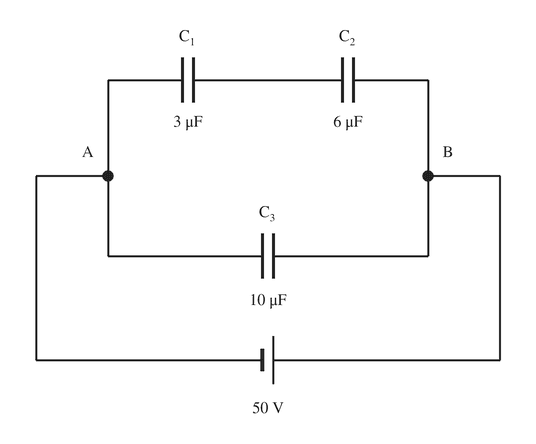
Calculate :
(i) The equivalent capacitance of the circuit between points A and B.
(ii) The charge on
Solve with AIWritten solution
Solution:
Key idea: Capacitors and are in series (same charge), and that pair is in parallel with (same p.d.). The charge on a capacitor is .
Step 1 — (i) Combine and in series.
The capacitors and are on the same branch with nothing between them, so they are in series.
Step 2 — (i) Add in parallel.
The branch and the branch both join A to B, so they are in parallel.
Step 3 — (ii) Find the charge on .
The upper branch has the full across it, and its two capacitors in series carry the same charge as their combination .
Step 4 — Check with the p.d.s.
The p.d. across is and across is . These add up to , as they must.
Watch out: Do not use with the full ; shares the branch p.d. with .
Therefore, (i) the equivalent capacitance is ; (ii) the charge on is ().
- 43 marks
Board paper question 4
Deduce an expression for equivalent capacitance C when three capacitors , and connected in parallel.
Solve with AIWritten solution
Solution:
Key idea: In a parallel combination every capacitor has the same p.d. across it, and the total charge drawn from the source is shared among the capacitors. The equivalent capacitor stores the same total charge at the same p.d.
Step 1 — Describe the arrangement.
Three capacitors , and are each connected between the same two points A and B, and a battery keeps a p.d. across A and B.
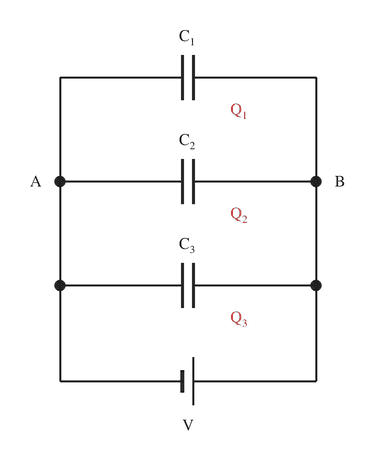
Step 2 — Write the charge on each capacitor.
Each capacitor has the same p.d. , so from :
Step 3 — Add the charges.
The total charge given by the battery is the sum of the three charges.
Step 4 — Use the equivalent capacitance.
The equivalent capacitor holds the same total charge at the same p.d. , so is also .
Dividing both sides by :
The equivalent capacitance in parallel is larger than the largest of the three.
Therefore, for three capacitors in parallel .
- 53 marks
Board paper question 5
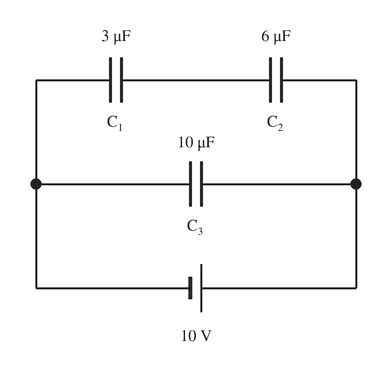
Three capacitors of capacitance , and are connected to a battery as shown in the figure given below.
(i) Equivalent capacitance
(ii) Electrostatic potential energy stored in the system.
 Solve with AI
Written solution
Solution:
Key idea: Capacitors and are in series, and that pair is in parallel with ; all of it sits across the battery. The energy stored is , using the equivalent capacitance.
Step 1 — (i) Combine and in series.
The capacitors and are on the same branch, one after the other.
Step 2 — (i) Add in parallel.
The branch with and the branch with both connect the same two vertical wires, so they are in parallel.
Step 3 — (ii) Find the stored energy.
The whole combination has the battery p.d. of across it. We use in farad: is .
Therefore, (i) the equivalent capacitance is ; (ii) the energy stored is .
- 63 marks
Board paper question 6
A parallel plate capacitor is charged by a battery, which is then disconnected. A dielectric constant (relative permittivity) K, is now introduced between its two plates in order to occupy the space completely.
State, in terms of K, its effect on the following:
(i) The capacitance of the capacitor.
(ii) The potential difference between its plates.
(iii) The energy stored in the capacitor.
Solve with AIWritten solution
Solution:
Key idea: Once the battery is disconnected, the charge on the plates cannot change. A dielectric of constant filling the gap makes the capacitance times larger, and then and tell us the rest.
Step 1 — State what stays fixed.
Let the capacitance, p.d. and energy before the slab be , and , and let the charge be . The battery is disconnected, so stays the same throughout.
Step 2 — (i) Capacitance.
A dielectric filling the whole space between the plates multiplies the capacitance by .
So the capacitance increases times.
Step 3 — (ii) Potential difference.
With fixed, is inversely proportional to .
So the p.d. decreases to of its value. The polarised dielectric weakens the field between the plates by the factor .
Step 4 — (iii) Energy stored.
With fixed we use .
So the energy decreases to of its value. The lost energy goes into the work done on the dielectric as the field pulls it in.
Watch out: If the battery were kept connected, would stay fixed instead, and the charge and energy would both increase times.
Therefore, (i) the capacitance becomes times; (ii) the p.d. becomes times; (iii) the energy becomes times its original value.
All 10 board paper questions for this chapter, solved the same way.
Class 12 Physics Ch 4 questions students ask
How many questions are there in Class 12 Physics Ch 4?
118 questions. Every one is solved step by step on this page.
Are these Class 12 Physics solutions free?
Yes. Every question and its full working is free to read, with no account needed.
Can I download the Class 12 Physics Ch 4 solutions as a PDF?
There is no PDF to download. Every solution is on this page instead, which means it is searchable, always the current syllabus, and readable on a phone. Use your browser's print option if you want it on paper.