
Question 685 marksMedium
A number of capacitors are connected (i) in series and (ii) in parallel. Derive an expression for the effective capacitance in each case.
Confirming your payment
Sign up now and get 250 free tokens.
Capacitors and Dielectrics · Question 68 of 118
A number of capacitors are connected (i) in series and (ii) in parallel. Derive an expression for the effective capacitance in each case.
Solution:
Key idea: In series every capacitor carries the same charge, and the potential differences add. In parallel every capacitor has the same potential difference, and the charges add.
(i) Series combination
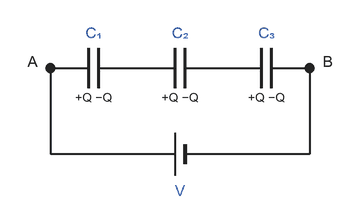
Step 1 — Describe the series connection.
Capacitors are joined end to end, and a potential difference is applied across the chain. The battery puts on the first plate. By induction every capacitor in the chain gets the same charge , with on one plate and on the other.
Step 2 — Write the potential difference across each capacitor.
For each capacitor the potential difference is its charge divided by its capacitance.
The same holds for every capacitor, up to .
Step 3 — Add the potential differences.
The applied potential difference is shared among the capacitors.
Step 4 — Compare with one equivalent capacitor.
A single capacitor that takes the same charge at the same obeys . Comparing this with Step 3 gives
The equivalent capacitance in series is smaller than the smallest capacitance in the chain.
(ii) Parallel combination
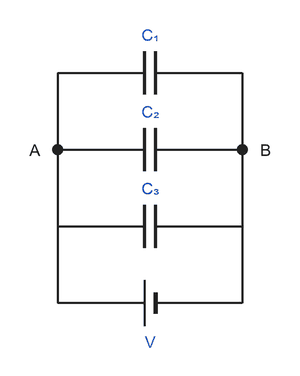
Step 5 — Describe the parallel connection.
Each capacitor is connected between the same two points A and B. So each has the same potential difference .
Step 6 — Write the charge on each capacitor.
Each capacitor takes a charge equal to its capacitance times the common potential difference.
The same holds for every capacitor, up to .
Step 7 — Add the charges.
The battery supplies the total charge.
Step 8 — Compare with one equivalent capacitor.
A single capacitor that takes the same total charge at the same obeys . Comparing this with Step 7 gives
The equivalent capacitance in parallel is larger than the largest capacitance in the group.
Therefore, in series , and in parallel .