Solution:
Key idea: For each network we find the effective capacitance C and the voltage rating Vmax (the largest p.d. that keeps every capacitor at or below 10 V). The maximum energy is then given below.
Umax=21CVmax2
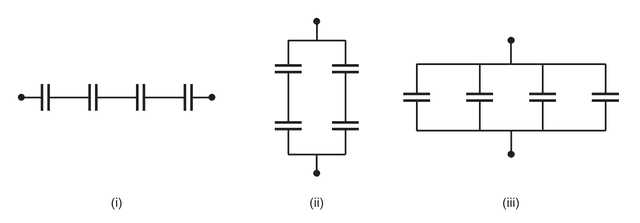
Step 1 — Network (i): all four in series.
Four equal capacitors in series give a quarter of 100 μF.
C=4100 μF
C=25 μF
The p.d. divides equally, so the network can take 40 V (four times 10 V).
Umax=21×25×10−6×402
Umax=0.020 J
Step 2 — Network (ii): two series pairs in parallel.
Each pair is 50 μF and can take 20 V; the two pairs in parallel give 100 μF with the rating still 20 V.
Umax=21×100×10−6×202
Umax=0.020 J
Step 3 — Network (iii): all four in parallel.
The capacitances add to 400 μF, and each capacitor has the full p.d., so the rating is 10 V.
Umax=21×400×10−6×102
Umax=0.020 J
Step 4 — Compare the three quantities.
The effective capacitances (25, 100 and 400 μF) differ, and so do the ratings (40, 20 and 10 V). The maximum energy is the same each time, because in every network each capacitor can hold at most 0.005 J (half of 100 μF times 102 V2), and there are four of them.
Therefore, the maximum energy the system can store, (iii), is the same for all three networks: 0.020 J.