
Opening your dashboard
Class 12 Physics Chapter 4 Capacitors and Dielectrics: Practice Questions
138 questions on Chapter 4, each worked through on its own page with the AI tutor. Class 12 Physics, ICSE 2026-27.
138 questions
1–3 marks · Mixed difficulty
- 11 mark
Question 1
Which one of the following pairs of a material and its free charge carriers is incorrect?
- 23 marks
Question 2
An aluminium atom has 13 electrons arranged as 2, 8, 3. In the metal, the 3 outermost electrons of each atom become free. A piece of aluminium foil has a mass of . (Hypothetical data.)
(i) In one aluminium atom, which charges are free and which are bound? Find the net bound charge per atom.
(ii) Find the number of free electrons in the foil and the magnitude of their total charge.
(iii) Explain why the foil is still electrically neutral.
(Molar mass of aluminium , , .)
- 31 mark
Question 3
An uncharged metal rod is placed along the direction of a uniform electric field. Which statement is correct once the charges in the rod stop moving?
- 41 mark
Question 4
An isolated conductor has a capacitance of . About how many electrons must be removed from it to raise its potential by ? (Take .)
- 53 marks
Question 5
An insulated metal plate , standing alone, has a capacitance of . It is given a charge of . An earthed metal plate is then brought close and parallel to . The charge on stays the same, but its potential falls to . (Hypothetical data.)
(i) Find the potential of before was brought near, and the new capacitance of .
(ii) How much more charge can now be given to before its potential rises back to its original value?
(iii) Explain why the potential of falls so much when is earthed.
- 61 mark
Question 6
Which one of the following is not equal to one farad?
- 72 marks
Question 7
An insulated conductor is connected to an electrometer. When an extra charge of is given to it, its potential rises from to . (Hypothetical data.)
Find (i) the capacitance of the conductor and (ii) the charge it carried at first.
- 81 mark
Question 8
A metal-coated spherical balloon of radius is charged until its potential is . It is then inflated to a radius of without any loss of charge. Its new potential is (Hypothetical data.)
- 93 marks
Question 9
The spherical dome of a small electrostatic generator has a radius of . Air near it breaks down when the electric field reaches . (Hypothetical data.)
(i) Find the capacitance of the dome.
(ii) Find the greatest charge the dome can hold.
(iii) Find the greatest potential it can reach.
(Take .)
- 103 marks
Question 10
A parallel plate capacitor has square plates of side with an air gap of .
(i) Find its capacitance.
(ii) Find the radius of an isolated metal sphere that would have the same capacitance.
(iii) Use your answers to explain why a pair of plates is a better way to store charge than a single conductor.
(Take and .)
- 111 mark
Question 11
A parallel plate capacitor with square plates has capacitance . The side of each plate is doubled and the separation between the plates is made three times as large. The new capacitance is
- 123 marks
Question 12
In a condenser microphone, a thin metal diaphragm and a fixed back plate form a parallel plate capacitor. Both are circular, of radius , with an air gap of . A steady supply keeps the p.d. across them at . A sound wave pushes the diaphragm closer to the back plate. (Hypothetical data.)
(i) Find the capacitance before and after the diaphragm moves.
(ii) Find the charge that flows from the supply to the capacitor.
(Take .)
- 131 mark
Question 13
The plates of a parallel plate air capacitor are apart and the p.d. across them is . The surface charge density on each plate is about (Take .)
- 143 marks
Question 14
A simple tuning capacitor has one fixed and one movable semicircular metal plate, each of radius , kept parallel with an air gap of . Turning a knob rotates the movable plate about the common centre, changing the overlapping area. (Hypothetical data.)
(i) Find the capacitance when the plates overlap completely.
(ii) Find the capacitance when the overlap is a sector of .
(iii) How does the capacitance vary with the angle of overlap ?
(Take ; neglect edge effects.)
- 151 mark
Question 15
Three capacitors, each of , are connected in series across an supply. The dielectric of one capacitor breaks down, and that capacitor behaves like a plain conducting wire. The charge on each of the other two capacitors is now
- 163 marks
Question 16
In the circuit shown, a battery is connected across two branches. One branch has and in series, meeting at . The other has and in series, meeting at . and are joined to the positive terminal. All capacitors were uncharged at the start.

(i) Find the charge on each capacitor.
(ii) Find the potentials of and , taking the negative terminal as zero.
(iii) Find the potential difference between and and state which point is at the higher potential.
- 172 marks
Question 17
A capacitor of unknown capacitance is connected in series with a capacitor across a battery. The p.d. across the capacitor is found to be . (Hypothetical data.)
Find (i) the charge on each capacitor and (ii) the value of .
- 183 marks
Question 18
A capacitor and a capacitor are available.
(i) Find their equivalent capacitance when connected in series and when connected in parallel.
(ii) The series combination is connected across a supply. Find the p.d. across each capacitor.
(iii) State what these results show about which capacitor controls each combination.
- 193 marks
Question 19
In the circuit shown, is in series with across a battery. An uncharged capacitor can be joined in parallel with by closing the switch .
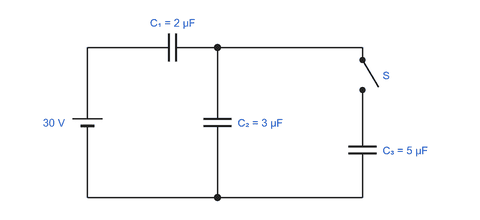
(i) With open, find the charge drawn from the battery and the p.d. across .
(ii) is now closed. Find the new charge drawn from the battery and the charges on and .
(iii) How much extra charge does the battery supply when is closed?
- 201 mark
Question 20
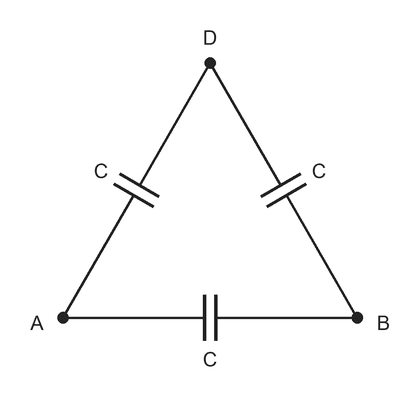
Three capacitors, each of capacitance , are connected to form a triangle : one capacitor along each side , and . The equivalent capacitance between the corners and is
- 211 mark
Question 21
The charge on a capacitor is increased from to . The increase in the energy stored in it is
- 223 marks
Question 22
Capacitors of and are connected to a battery, first in series and then in parallel.
(i) Find the total energy stored in each arrangement and the ratio (parallel : series).
(ii) In the series arrangement, find the energy stored in each capacitor. Which capacitor stores more?
- 233 marks
Question 23
A supercapacitor of capacitance is charged to its rated voltage of . It then powers a small circuit, which stops working when the p.d. falls to . (Hypothetical data.)
(i) Find the charge stored at .
(ii) Find the energy stored at .
(iii) What fraction of this energy has been delivered by the time the circuit stops working?
- 241 mark
Question 24
The charge on a capacitor is kept constant while its capacitance is changed (for example, by moving its plates). The graph of the stored energy against is
- 253 marks
Question 25
An uncharged capacitor is charged through a resistor from a d.c. supply until it is fully charged.
(i) Find the charge that passes through the supply and the work done by the supply.
(ii) Find the energy stored in the capacitor.
(iii) Account for the difference between (i) and (ii). Would it change if a resistor of a different value were used?
- 261 mark
Question 26
An uncharged capacitor is connected through a resistor to a battery and left until it is fully charged. The heat produced in the resistor during charging is
- 273 marks
Question 27
The plates of an isolated parallel plate air capacitor each have area and are apart. The surface charge density on the plates is . (; hypothetical data.)
(a) Find the electric field between the plates.
(b) Find the energy density of the field.
(c) Find the energy stored in the capacitor from the energy density, and check it with .
- 281 mark
Question 28
Capacitors of and are connected in series across a supply. The energy stored in the capacitor is
- 293 marks
Question 29
When the potential difference across a capacitor is raised from to , the energy stored in it increases by . (Hypothetical data.)
(a) Find the capacitance.
(b) Find the charge on the capacitor at .
(c) Find the energy stored at .
- 301 mark
Question 30
A parallel plate air capacitor is charged and then disconnected from the battery, so that it stores energy . Its plates are now pulled apart until the separation is three times the original. The energy stored becomes
- 313 marks
Question 31
Three capacitors of , and are available, with a battery.
(a) Find the total energy stored when all three are connected (i) in series and (ii) in parallel across the battery.
(b) Find the ratio of the parallel energy to the series energy.
(c) For the series connection, find the energy in each capacitor and show that they add up to the total found in (a)(i).
- 323 marks
Question 32
Capacitor A () is charged to and capacitor B () to . They are disconnected from their supplies and joined as shown, so that the positive plate of each meets the negative plate of the other. Switch S is then closed.

(a) Find the common potential difference after S is closed.
(b) Find the final charge on each capacitor.
(c) Find the heat produced in the connecting wires.
- 331 mark
Question 33
A capacitor charged to a potential difference is connected across an uncharged capacitor of capacitance . The fraction of the original stored energy that is lost as heat is
- 343 marks
Question 34
A capacitor is charged to an unknown potential difference and then connected across an uncharged capacitor (like plates joined). The heat produced in the connecting wires is . (Hypothetical data.)
(a) Find .
(b) Find the common potential difference.
(c) Find the final charge on each capacitor.
- 351 mark
Question 35
A capacitor charged to and a capacitor charged to are joined, positive plate to positive plate and negative to negative. The final charge on the capacitor is
- 362 marks
Question 36
Two capacitors charged to different potentials are joined by a thick copper wire of almost zero resistance. A student argues: "Heat in a wire is ; since , no energy is lost when the charges are shared."
(a) Is the student right? Give a reason.
(b) Into which forms does the energy go?
- 371 mark
Question 37
Each carbon–oxygen bond in a carbon dioxide molecule is polar, yet carbon dioxide is a non-polar molecule because
- 383 marks
Question 38
The space between the plates of a charged capacitor is completely filled with a dielectric of dielectric constant . The electric field inside the dielectric is . (; hypothetical data.)
(a) Find the electric susceptibility of the dielectric.
(b) Find the polarisation of the dielectric.
(c) Find the surface charge density of the free charge on the plates and of the induced (bound) charge on the faces of the dielectric.
- 391 mark
Question 39
A charged parallel plate air capacitor, disconnected from the battery, has a field between its plates. A dielectric of dielectric constant is now made to fill the space completely. The field produced by the polarisation charges of the dielectric is
- 403 marks
Question 40
A capacitor designer can use either of two plastic films, each thick, between the plates. (Hypothetical data.)
Film Dielectric constant Dielectric strength X Y (a) Find the largest potential difference each film can stand.
(b) Find the capacitance per square metre of plate area with each film.
(c) Hence find which film lets the capacitor hold more charge per square metre before breakdown. ()
- 412 marks
Question 41
Water has a very high dielectric constant (about ), yet ordinary tap water is never used as the dielectric between the plates of a capacitor.
(a) Give the reason.
(b) State two properties a material must have to be a good dielectric for a capacitor.
- 421 mark
Question 42
A dielectric slab whose thickness is half the plate separation is placed between the plates of a parallel plate air capacitor, parallel to them. The capacitance becomes times its value with air alone. The dielectric constant of the slab is
- 433 marks
Question 43
A parallel plate air capacitor has a capacitance of and a plate separation of .
(a) Find its capacitance when a metal sheet thick is placed between the plates, parallel to them and not touching them.
(b) Find its capacitance when, instead, a dielectric slab thick with dielectric constant is placed in the same way.
(c) Explain why the metal sheet raises the capacitance more than the dielectric slab.
- 441 mark
Question 44
A dielectric slab of dielectric constant partly fills the gap between the plates of a charged parallel plate capacitor. The field inside the slab is . The field in the air gap between the slab and a plate is
- 451 mark
Question 45
An isolated parallel plate air capacitor with plate separation is charged to . A dielectric slab thick, of dielectric constant , is then placed between the plates, parallel to them, as shown.
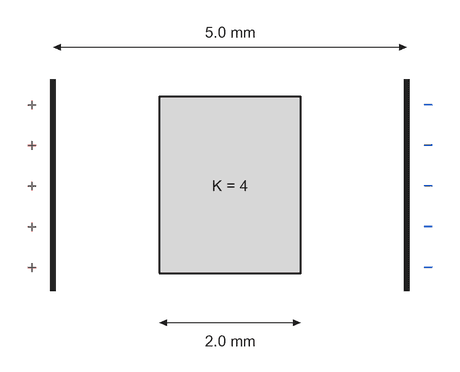
The potential difference between the plates becomes
- 462 marks
Question 46
A dielectric slab of thickness and dielectric constant is placed between the plates of a parallel plate capacitor (plate area , separation ), parallel to the plates. Show that the capacitance does not depend on where the slab sits between the plates — touching one plate, in the middle, or anywhere else.
- 473 marks
Question 47
A capacitor keeps the clock of a set-top box running during power cuts. It is charged to , and the clock draws a steady and keeps working until the voltage falls to . (Hypothetical data.)
(a) Find the energy stored at .
(b) Find the charge the capacitor gives out as its voltage falls from to .
(c) For how many days can the clock run on the capacitor alone?
- 481 mark
Question 48
A capacitor and a small bulb are connected in series. With a battery, the bulb flashes for a moment and then stays dark. With a alternating supply, the bulb keeps glowing. This shows that a capacitor
- 492 marks
Question 49
The smoothing capacitor in the power supply of an old television is and is charged to . A technician is told to discharge it through a suitable resistor before touching it, even after the set has been unplugged. (Hypothetical data.)
(a) Find the energy stored in the capacitor.
(b) Explain why the warning is needed.
- 501 mark
Question 50
The distance between the plates of a parallel plate capacitor is . A metal plate of thickness is placed between the plates. What will be its effect on the capacitance?
- 511 mark
Question 51
How will you increase the capacitance of a capacitor without increasing the area of the plates and decreasing the distance between the plates?
- 521 mark
Question 52
The top of the atmosphere is about 400 kV with respect to the surface of the Earth, corresponding to an electric field that decreases with altitude. Near the surface of the Earth, the field is about . Why then do we not get an electric shock as we step out of our house into the open? (Assume the house to be a steel cage, so that there is no field inside.)
- 531 mark
Question 53
A man fixed outside his house, one evening, a two-metre high insulating slab carrying on its top a large aluminium sheet of area . Will he get an electric shock if he touches the metal sheet next morning?
- 541 mark
Question 54
The discharging current in the atmosphere due to the small conductivity of air is known to be 1800 A on average over the globe. Why then does the atmosphere not discharge itself completely in due course and become electrically neutral? In other words, what keeps the atmosphere charged?
- 551 mark
Question 55
What are the forms of energy into which the electrical energy of the atmosphere is dissipated during a lightning?
- 561 mark
Question 56
A charged conical conductor loses its charge earlier than a similarly charged sphere, why?
- 571 mark
Question 57
You are given three condensers of value , and . How would you connect them so that the resultant capacity is equal to ?
- 581 mark
Question 58
“Which is safe to remain – inside the house or under a tree during lightning”?
- 593 marks
Question 59
Calculate the capacitance of Earth assuming it to be a spherical conductor of radius km.
- 603 marks
Question 60
A metal sphere of radius of cm cannot hold a charge of coulomb. Why?
- 613 marks
Question 61
A parallel plate capacitor has two plates of sides m and m. Their distance apart is mm. The dielectric constant of the medium in between is . Find the capacity of the capacitor.
- 623 marks
Question 62
Two parallel plate air capacitors have their plate areas and respectively. If they have the same charge and potential and the distance between the plates of the first capacitor is mm, what is the distance between the plates of the second capacitor?
- 633 marks
Question 63
A parallel plate capacitor has circular plates of radius cm and plate separation mm. Calculate the charge on the plates when a potential difference of one kilo volt is applied to it.
- 643 marks
Question 64
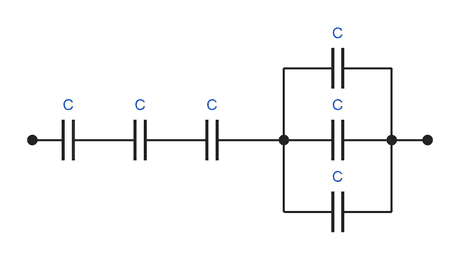
Three capacitors each of capacitance are connected together in series and are also connected in series with three other similar capacitors which are grouped together in parallel. Calculate the total capacitance.
- 653 marks
Question 65
Three capacitors of capacitances , and are connected in parallel to a V battery. Calculate the total energy stored in the capacitor.
- 663 marks
Question 66
A capacitor is charged through a potential difference of V, when C charge is stored in it. How much energy will it release, when it is discharged?
- 673 marks
Question 67
What should be the capacitance of a capacitor capable of storing one joule of energy when used with V d.c. supply?
- 682 marks
Question 68
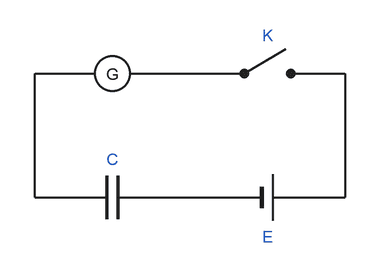
In the given figure, is a large value capacitance connected in series with a centre zero galvanometer , a d.c. battery and a key . What will be observed in when is suddenly closed? Give reasons for your answer.
- 692 marks
Question 69
An electric flash lamp has capacitors, each of capacitance , connected in parallel. The lamp is operated at V. Calculate how much energy will be radiated in a flash.
- 702 marks
Question 70
Assuming the Earth as an isolated spherical conductor of radius km, calculate its electrical capacitance in farad.
- 712 marks
Question 71
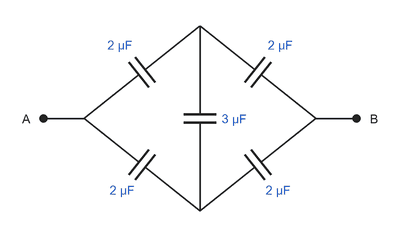
Find the equivalent capacitance between and .
- 722 marks
Question 72
A parallel plate capacitor of plate area and plate separation mm is connected to a d.c. source of V. Calculate in S.I. unit,
(i) the magnitude of uniform electric field between the plates
(ii) the charge density on any plate
- 733 marks
Question 73
Find the electric charge on plates of capacitor shown in the figure.

- 742 marks
Question 74
An isolated parallel plate air capacitor has a p.d. of V. A dielectric slab having relative permittivity is introduced to fill the space between the two plates completely. Calculate
(i) the new capacitance of the capacitor
(ii) the new potential difference between the two plates of the capacitor
- 751 mark
Question 75
A parallel plate capacitor has a uniform electric field in the space between the plates. If the distance between the plates is and area of each plate is , the energy stored in the capacitor is
- 761 mark
Question 76
A parallel plate condenser with oil between the plates (dielectric constant of oil ) has a capacitance . If the oil is removed, then capacitance of the capacitor becomes
- 771 mark
Question 77
Eight drops of mercury of equal radii possessing equal charges combine to form a big drop. Then the capacitance of bigger drop compared to each individual small drop is
- 781 mark
Question 78
The energy of a charged capacitor is given by the expression ( = charge on the conductor and = its capacity)
- 791 mark
Question 79
The energy stored in a condenser of capacity which has been raised to a potential is given by
- 801 mark
Question 80
The Earth has volume '' and surface area '', then capacitance would be
- 811 mark
Question 81
In a charged capacitor, the energy resides
- 821 mark
Question 82
A parallel-plate air capacitor has capacity '', distance of separation between plates is '' and potential difference '' is applied between the plates. Force of attraction between the plates of the parallel plate air capacitor is
- 831 mark
Question 83
The energy required to charge a parallel plate condenser, of plate separation and plate area of cross-section , such that the uniform electric field between the plates is , is
- 841 mark
Question 84
The capacity of parallel plate condenser depends on
- 851 mark
Question 85
, , and are capacitance, potential difference, energy stored and charge of parallel plate capacitor, respectively. The quantities that increase when a dielectric slab introduced between the plates without disconnecting the battery are
- 861 mark
Question 86
In a parallel plate capacitor, if the intervening medium of permittivity between the plates is replaced by another medium of permittivity , then its capacitance is
- 871 mark
Question 87
A capacitor of capacitance value is charged to and the battery is then disconnected. If it is connected across a capacitor, the energy lost by the system is
- 881 mark
Question 88
The energy stored in a capacitor of capacitance is . Its potential difference is
- 891 mark
Question 89
A parallel plate capacitor is charged and then isolated. The effect of increasing the plate separation on charge, potential and capacitance, respectively are
- 901 mark
Question 90
When a lamp is connected in series with capacitor, then
- 911 mark
Question 91
There is an air-filled parallel plate capacitor. When the plate separation is doubled and the space is filled with wax, the capacitance increases to . The dielectric constant of wax is
- 921 mark
Question 92
A parallel plate capacitor is charged. If the plates are pulled apart
- 931 mark
Question 93
Work done by an external agent in separating the parallel plate capacitor is
- 941 mark
Question 94
If the charge on a capacitor is doubled, the value of its capacitance will be
- 951 mark
Question 95
The plates of a parallel plate capacitor of capacity are charged to a potential of 100 volts and then separated from each other so that the distance between them is doubled. How much is the energy spent in doing so?
- 961 mark
Question 96
Capacitance (in F) of a spherical conductor with radius is
- 971 mark
Question 97
The net charge on capacitor is
- 981 mark
Question 98
The potentials of the two plates of capacitor are and . The charge on one of the plates is . The capacitance of the capacitor is
- 991 mark
Question 99
The work done in placing a charge of coulomb on a condenser of capacity 100 micro-farad is
- 1001 mark
Question 100
A parallel plate condenser with a dielectric of dielectric constant between the plates has a capacity and is charged to a potential volts. The dielectric slab is slowly removed from between the plates and then reinserted. The net work done by the system in this process is
- 1011 mark
Question 101
A capacitor is charged to volt and then its plates are connected by a conducting wire. The heat produced is
- 1021 mark
Question 102
A capacitor is connected to a battery. How much electrostatic energy is stored in the capacitor?
- 1031 mark
Question 103
Putting a dielectric substance between two plates of condenser, capacity, potential and potential energy, respectively
- 1041 mark
Question 104
A battery is used to charge a parallel plate capacitor till the potential difference between the plates becomes equal to the electromotive force of the battery. The ratio of the energy stored in the capacitor and the work done by the battery will be
- 1051 mark
Question 105
If there are capacitors in parallel connected to volt source, then the energy stored is equal to
- 1061 mark
Question 106
A capacitor in a defibrillator is charged to . The energy stored in the capacitor is sent through the patient during a pulse of duration . The power delivered to the patient is
- 1071 mark
Question 107
When we touch the terminals of a high voltage capacitor, even after a high voltage has been cut off, the capacitor has a tendency to
- 1081 mark
Question 108
A capacitor is charged by a battery. The battery is removed and another identical uncharged capacitor is connected in parallel. The total electrostatic energy of the resulting system
- 1091 mark
Question 109
A parallel plate capacitor is made by stacking equally spaced plates connected alternately. If the capacitance between any two plates is then the resultant capacitance is
- 1101 mark
Question 110
A capacitor is connected in series with another capacitor . The combination is connected across d.c. source of . The ratio of potential across to is
- 1111 mark
Question 111
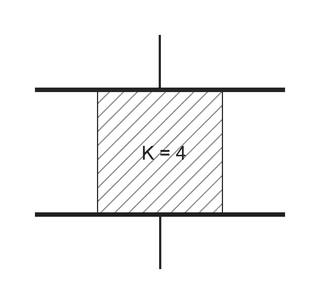
Consider a parallel plate capacitor of (micro-farad) with air filled in the gap between the plates. Now one half of the space between the plates is filled with a dielectric of dielectric constant 4 as shown in the figure. The capacity of the capacitor changes to
- 1121 mark
Question 112
Three capacitors are connected in the arms of a triangle ABC as shown in the figure. is applied between A and B. The voltage between B and C is

- 1131 mark
Question 113
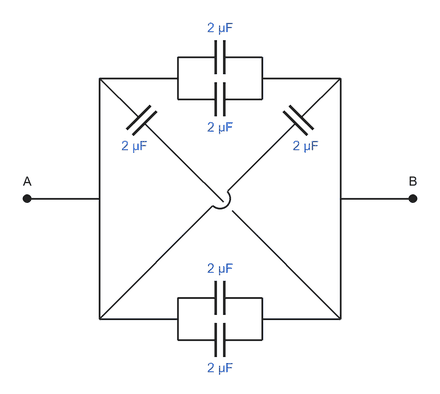
Six capacitors each of capacitance are connected as shown in the figure. The effective capacitance between A and B is
- 1141 mark
Question 114
What is the effective capacitance between points X and Y?
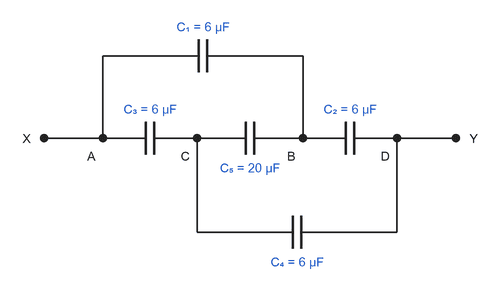
- 1151 mark
Question 115
In the circuit shown in the figure, each capacitor has a capacity of . The equivalent capacity between A and B is
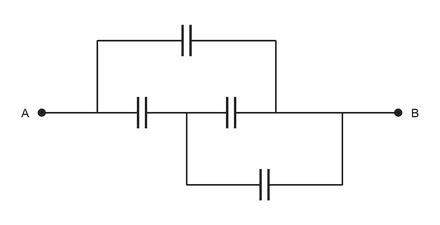
- 1161 mark
Question 116
A parallel plate air capacitor has capacity . Distance of separation between plates is and potential difference is applied between the plates. Force of attraction between the plates of the parallel plate air capacitor is
- 1171 mark
Question 117
A capacitor is charged by a battery. The battery is removed and another identical uncharged capacitor is connected in parallel. The total electrostatic energy of resulting system
- 1181 mark
Question 118
The electrostatic force between the metal plates of an isolated parallel plate capacitor having charge and area is
- 1191 mark
Question 119
Two identical capacitors and of equal capacitance are connected as shown in the figure. Terminals a and b of the key K are connected to charge capacitor using battery of emf volt. Now disconnecting a and b, the terminals b and c are connected. Due to this, what will be the percentage loss of energy?
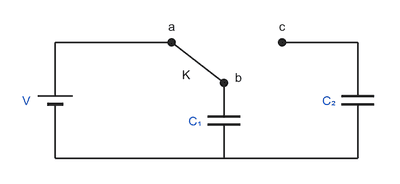
- 1201 mark
Question 120
A parallel plate air capacitor is charged to a potential difference of . After disconnecting the battery, distance between the plates of the capacitor is increased using an insulating handle. As a result, the potential difference between the plates
- 1211 mark
Question 121
A parallel plate capacitor with plates of area each, and separation of . If the electric field between the plates is , the magnitude of charge on each plate is (Take )
- 1221 mark
Question 122
A parallel plate capacitor is of area and a separation . The gap is filled with three dielectric materials of equal thickness (see figure) with dielectric constants , and . The dielectric constant of a material which when fully inserted in above capacitor, gives same capacitance would be
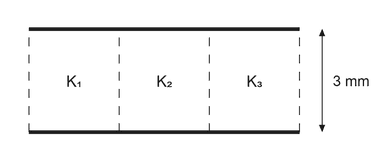
- 1231 mark
Question 123
A parallel plate capacitor having capacitance is charged by a battery to a potential difference of between its plates. The charging battery is now disconnected and a porcelain slab of dielectric constant 6.5 is slipped between the plates. The work done by the capacitor on the slab is
- 1241 mark
Question 124
Voltage rating of a parallel plate capacitor is . Its dielectric can withstand a maximum electric field of . The plate area is . What is the dielectric constant if the capacitance is ? [Given ]
- 1251 mark
Question 125
A capacitor with capacitance is charged to . If the plates are pulled apart to reduce the capacitance to , how much work is done?
- 1261 mark
Question 126
The given figure shows charge () versus voltage () graph for series and parallel combinations of two given capacitors. The capacitances are
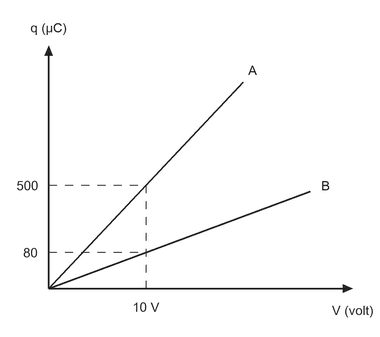
- 1271 mark
Question 127
In the given circuit, the charge on capacitor will be
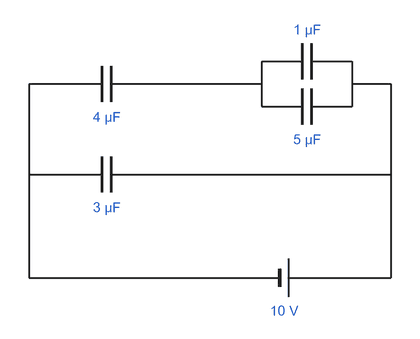
- 1281 mark
Question 128
A parallel plate capacitor of capacitance is being charged by a voltage source whose potential is changing at the rate of . The conduction current through the connecting wires and the displacement current through the plates of the capacitor, would be, respectively
- 1291 mark
Question 129
Effective capacitance of parallel combination of two capacitors and is . When these capacitors are individually connected to a voltage source of , the energy stored in the capacitor is 4 times that of . If these capacitors are connected in series, their effective capacitance will be
- 1301 mark
Question 130
A capacitor is fully charged to a potential difference of . After removing the source voltage, it is connected to an uncharged capacitor in parallel. Now the potential difference across them becomes . The capacitance of the second capacitor is
- 1311 mark
Question 131
In the given circuit, the total charge is and the voltage across capacitor is . Then the charge on capacitor is

- 1321 mark
Question 132
The capacitance of a parallel plate capacitor with air as medium is . With the introduction of a dielectric medium, the capacitance becomes . The permittivity of the medium is [Given ]
- 1331 mark
Question 133
Two equal capacitors are first connected in series and then in parallel. The ratio of the equivalent capacities in the two cases will be
- 1341 mark
Question 134
In the given figure, a capacitor is formed by placing a compound dielectric between the plates of parallel plate capacitor. The expression for the capacity of the said capacitor will be (Given area of plate )

- 1351 mark
Question 135
Three capacitors , and are connected as shown in the figure. Find the ratio of the charges on capacitors , and respectively.

- 1361 mark
Question 136
The equivalent capacitance of the combination shown in the figure is
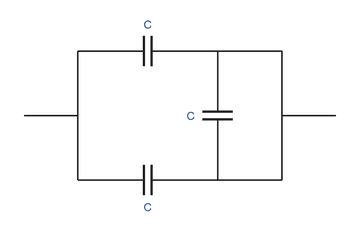
- 1371 mark
Question 137
A parallel plate capacitor has a uniform electric field '' in the space between the plates. If the distance between the plates is '' and the area of each plate is '', the energy stored in the capacitor is ( = permittivity of free space)
- 1381 mark
Question 138
A parallel plate capacitor of plate area and plate separation is connected to a d.c. source of .
(i) What is the magnitude of the uniform electric field between the plates?
(A)
(B)
(C)
(D)
(ii) What is the charge density on any one of the two plates?
(A)
(B)
(C)
(D)