Solution:
Key idea: The charge on a capacitor is proportional to its p.d., Q=CV. So the graph of Q against V is a straight line through the origin, and its slope is the capacitance.
C=ΔVΔQ
Step 1 — Plot the graph.
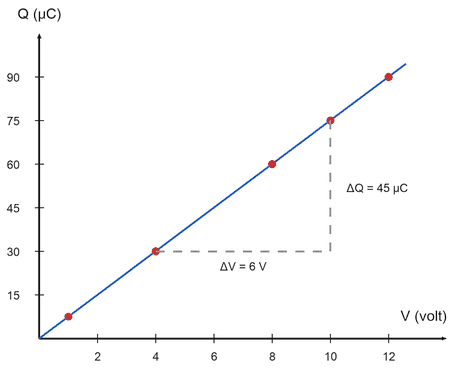
We plot the five points with V on the x-axis and Q on the y-axis, and draw the best straight line through them and the origin.
Step 2 — Choose two points on the line.
We take two points far apart on the line, (4 V,30 μC) and (10 V,75 μC), so that reading errors matter little.
ΔQ=75−30 μC
ΔV=10−4 V
Step 3 — Find the slope.
The slope is the rise in charge divided by the rise in p.d.
C=6 V45 μC
C=7.5 μF
Note: the book prints the answer as 7.5×10⁻⁶ C; the unit of capacitance is the farad, so the value is 7.5×10⁻⁶ F.
Therefore, the capacitance of the capacitor is 7.5×10⁻⁶ F (7.5 μF).
