(ii) What is the effect of introducing a dielectric on the capacitance of a parallel plate capacitor?
(iii) What is the effect of dielectric on
(a) electric field in between the plates?
(b) potential difference between the plates?
(c) energy stored in the capacitor?
Solution:
Key idea: A dielectric in a field is polarised, and its bound charges weaken the field inside it. In a capacitor this means the same charge gives a smaller potential difference, so the capacitance rises.
(i) Electric polarisation
Step 1 — Explain polarisation.
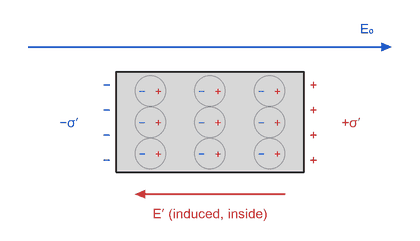
Place a dielectric in an electric field E0, as in the figure.
The positive charges in each molecule shift slightly along the field and the negative charges shift slightly against it. Non-polar molecules become induced dipoles, and polar molecules turn partly into line with the field. The dielectric is then polarised.
Bound charges −σ′ and +σ′ appear on its two faces and set up a field opposite to E0. The polarisationP is the induced dipole moment per unit volume.
(ii) Effect on capacitance
Step 2 — Compare the capacitance with and without the dielectric.
Without the dielectric, the capacitance is
C0=dε0A
When a dielectric of constant K fills the gap, the field, and hence the potential difference, for the same charge is reduced K times. So the capacitance rises K times.
C=dKε0A
C=KC0
(iii) Effect on the field, the potential difference and the energy
Step 3 — State the condition used.
Take the capacitor charged to V0, with charge Q0, field E0 and energy U0. It is then disconnected from the battery before the dielectric goes in, so its charge stays Q0.
Step 4 — Find the effect on the field (a).
The bound charges oppose the field, so the field between the plates falls K times.
E=KE0
Step 5 — Find the effect on the potential difference (b).
The field is uniform, so the potential difference is the field times d, and it falls in the same way.
V=KV0
Step 6 — Find the effect on the energy (c).
With the charge fixed, the energy is 2CQ02, and the capacitance is now KC0.
U=2KC0Q02
U=KU0
Step 7 — Note the other case.
If instead the battery stays connected, the potential difference stays V0 and the field stays E0. The charge then rises to KQ0 and the energy rises to KU0.
Therefore, a dielectric multiplies the capacitance by K; for a disconnected capacitor it divides the field, the potential difference and the stored energy by K.