
Question 633 marksMedium
Explain the principle of working of a capacitor. Derive an expression for the capacitance of a spherical conductor.
Confirming your payment
Sign up now and get 250 free tokens.
Capacitors and Dielectrics · Question 63 of 118
Explain the principle of working of a capacitor. Derive an expression for the capacitance of a spherical conductor.
Solution:
Key idea: Capacitance is the charge a conductor holds per volt of potential, . Bringing an earthed conductor close to a charged one lowers its potential while its charge stays the same, so its capacitance rises.
Step 1 — State the principle of a capacitor.
Take an insulated metal plate and give it a charge . Its potential rises to some value .
Now bring an uncharged, earthed metal plate close to it. By induction an equal and opposite charge appears on the near face of the earthed plate, and the matching positive charge flows away to earth.
The nearby negative charge lowers the potential of the first plate, while its charge is still . Since , a smaller potential for the same charge means a larger capacitance.
So two conductors placed close together, carrying equal and opposite charges, store much more charge at a given potential difference than one conductor alone. This arrangement is a capacitor.
Step 2 — Charge an isolated sphere.
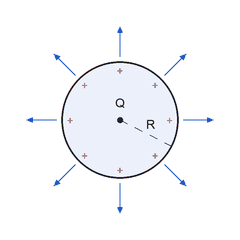
Give a charge to an isolated conducting sphere of radius in vacuum (or air). The charge spreads uniformly over its outer surface, as the figure shows.
Step 3 — Find the potential of the sphere.
Outside a uniformly charged sphere the field is the same as if the whole charge were at the centre. So the potential at the surface, which is the potential of the whole conductor, is
Step 4 — Divide the charge by the potential.
The capacitance is the charge per unit potential.
Now put in the potential from Step 3.
The charge cancels.
Step 5 — Read the result.
The capacitance of an isolated sphere is proportional to its radius. It does not depend on the charge given to it or on the metal it is made of. If the sphere sits in a medium of dielectric constant , its capacitance becomes .
Therefore, the capacitance of an isolated spherical conductor of radius is .