
Question 1053 marksHard
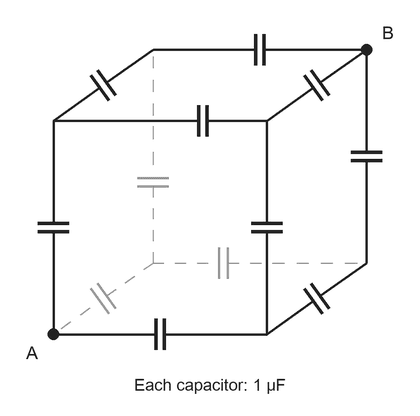
Twelve capacitors of capacitance each, are connected to form a cube. What is the equivalent capacitance between the diagonally opposite corners?
Confirming your payment
Sign up now and get 250 free tokens.
Capacitors and Dielectrics · Question 105 of 118
Twelve capacitors of capacitance each, are connected to form a cube. What is the equivalent capacitance between the diagonally opposite corners?
Solution:
Key idea: Points that are at the same potential by symmetry can be joined by a wire without changing anything, because no charge would flow along it. This turns the cube into three groups of capacitors in series.
Step 1 — Use the symmetry at corner A.
The three edges from corner A lead to three corners that are placed exactly alike with respect to A and B. These three corners are at the same potential, so we may join them.
Step 2 — Use the symmetry at corner B.
In the same way, the three corners joined to B by edges are at the same potential, so we may join them too.
Step 3 — Count the capacitors in each group.
The 3 edges from A to the first group of corners are in parallel. The 6 edges joining the first group of three corners to the second group of three are in parallel. The 3 edges from the second group to B are in parallel. This uses edges, all 12 of them.
Step 4 — Join the three groups in series.
The three groups follow one another from A to B, so we add their reciprocals (in ).
Therefore, the equivalent capacitance between diagonally opposite corners is (1.2 μF).