Solution:
Key idea: For any capacitor C=VQ. A dielectric reduces the field between the plates for the same charge, so it reduces the potential difference and raises the capacitance.
(i) Capacitance with a dielectric

Step 1 — Set up the capacitor.
Two parallel plates, each of area A, are a distance d apart and carry charges +Q and −Q. The surface charge density on each plate is
σ=AQ
Step 2 — Write the field with vacuum between the plates.
For plates that are large compared with d, the field between them is uniform.
E0=ε0σ
Step 3 — Put in the dielectric.
A dielectric of dielectric constant K now fills the gap. It is polarised, and its bound surface charges reduce the field K times.
E=KE0
In terms of the charge, this field is
E=Kε0AQ
Step 4 — Find the potential difference.
The field is uniform, so the potential difference is the field times the separation.
V=Ed
V=Kε0AQd
Step 5 — Find the capacitance.
The capacitance is the charge divided by the potential difference.
C=VQ
C=dKε0A
With vacuum K is 1, and the capacitance is C0=dε0A. So the dielectric multiplies the capacitance by K.
C=KC0
(ii) Factors affecting the capacitance
Step 6 — Read the factors from the formula.
The result C=dKε0A shows three factors.
(a) Area of the plates: C∝A, so larger plates hold more charge at the same potential difference.
(b) Separation: C∝d1, so bringing the plates closer increases C.
(c) Medium between the plates: C∝K, so filling the gap with a dielectric increases C by the factor K.
The capacitance does not depend on the charge, on the potential difference or on the metal the plates are made of.
(iii) Capacitor partly filled with a dielectric slab
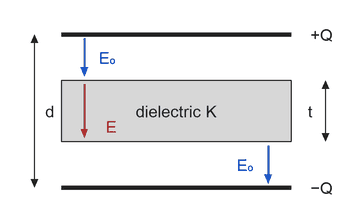
Step 7 — Set up the partly filled capacitor.
A slab of thickness t (less than d) and dielectric constant K is placed parallel to the plates. Air fills the rest of the gap, a total thickness d−t.
Step 8 — Write the fields in the air and in the slab.
In the air the field is the same as with no slab.
E0=ε0AQ
Inside the slab the field is reduced K times.
E=KE0
Step 9 — Add the potential differences.
The potential difference between the plates is the field times the thickness in the air, plus the field times the thickness in the slab.
V=E0(d−t)+KE0t
Take out the common factor E0 and put in its value.
V=ε0AQ(d−t+Kt)
Step 10 — Find the capacitance.
Divide the charge by this potential difference.
C=VQ
C=d−t+Ktε0A
The same result can be written as
C=d−t(1−K1)ε0A
Since 1−K1 is positive, the denominator is less than d, and the capacitance is larger than the air value dε0A.
Two checks follow. For a metal slab (K→∞) the result becomes d−tε0A. For a slab that fills the whole gap (t equal to d) it becomes dKε0A, the result of part (i).
Therefore, C=dKε0A with the gap filled, C depends on A, d and K only, and C=d−t+t/Kε0A with a slab of thickness t.
