
Question 653 marksEasy
Distinguish between polar and non-polar molecules with examples. Explain electric polarisation. What is dielectric strength?
Confirming your payment
Sign up now and get 250 free tokens.
Capacitors and Dielectrics · Question 65 of 118
Distinguish between polar and non-polar molecules with examples. Explain electric polarisation. What is dielectric strength?
Solution:
Key idea: A molecule is polar when the centres of its positive and negative charges do not coincide. In an electric field the molecules of a dielectric stretch or turn into line with the field, and this is called polarisation.
Step 1 — Describe polar molecules.
In a polar molecule the centre of positive charge and the centre of negative charge do not coincide, so the molecule has a permanent electric dipole moment. With no external field these dipoles point in random directions, so the material as a whole has no net dipole moment. Examples are , HCl and .
Step 2 — Describe non-polar molecules.
In a non-polar molecule the two centres coincide, so there is no permanent dipole moment. Examples are , , and . The molecule is linear, so its two bond dipoles cancel.
Step 3 — Explain electric polarisation.
Place a slab of dielectric in an external field , as in the figure.
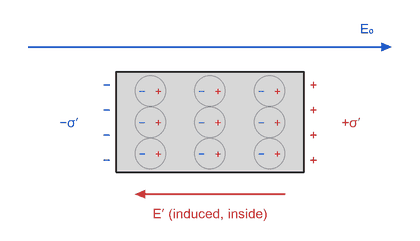
The field pushes the positive charges of each molecule slightly along and the negative charges slightly against it. Non-polar molecules become induced dipoles. The permanent dipoles of polar molecules turn partly into line with the field. The dielectric is now polarised.
Inside the slab the ends of neighbouring dipoles cancel each other. A bound charge of density is left on the face where the field enters, and a bound charge on the face where it leaves.
Step 4 — Find the effect on the field inside.
The bound charges set up a field opposite to , so the net field inside the dielectric is smaller.
For a slab that fills a region of uniform field, the reduced field is
Here is the dielectric constant. The polarisation is the dipole moment per unit volume of the dielectric.
Step 5 — Define dielectric strength.
The dielectric strength of an insulator is the largest electric field it can withstand without breaking down. Above this field its molecules are ionised and it starts to conduct. For dry air the dielectric strength is about .
Therefore, polar molecules have a permanent dipole moment and non-polar molecules do not; polarisation is the lining up and stretching of molecular dipoles by a field; dielectric strength is the largest field a dielectric can bear without breakdown.