
Opening your dashboard
Class 12 Physics Chapter 4 Capacitors and Dielectrics: Previous Year Questions
10 questions on Chapter 4, each solved step by step. Class 12 Physics, ICSE 2026-27.
10 questions with solutions
2–3 marks · Mixed difficulty
- 13 marks
Question 1
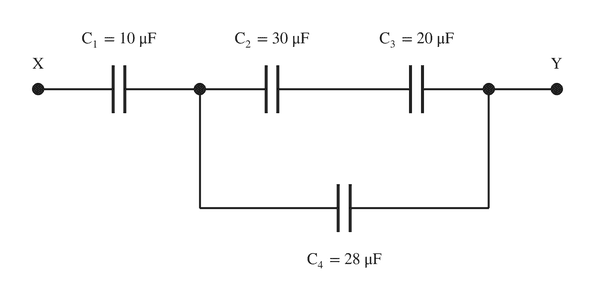
Four capacitors, , , and are connected as shown in Figure 3 below. Calculate equivalent capacitance of the circuit between points X and Y.
 Solve with AI
Written solution
Solution:
Key idea: For capacitors in series, ; in parallel, . We reduce the network step by step, starting from the innermost group.
Step 1 — Combine and (series).
The capacitors and sit one after the other on the top line with no branch between them, so they are in series.
Step 2 — Combine with (parallel).
Capacitor is connected between the same two junctions as the pair , , so it is in parallel with .
Step 3 — Combine with (series).
Capacitor is in series with this whole group between X and Y.
Watch out: A series combination is always smaller than the smallest capacitor in it; here is less than , as it should be.
Therefore, the equivalent capacitance between X and Y is .
- 23 marks
Question 2
Obtain an expression for equivalent capacitance when three capacitors , and are connected in series.
Solve with AIWritten solution
Solution:
Key idea: In a series combination every capacitor carries the same charge , and the p.d. of the source is shared among the capacitors. The equivalent capacitor is the single capacitor that would store the same charge at the same total p.d. .
Step 1 — Describe the arrangement.
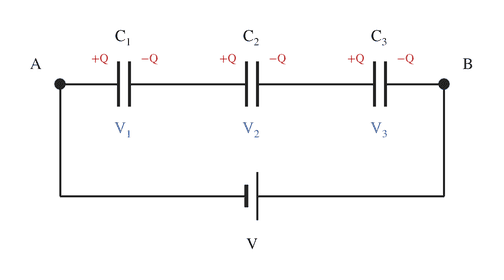
Three capacitors , and are joined end to end between A and B, and a battery keeps a p.d. across A and B.
Step 2 — Note that the charge is the same on each.
When the battery puts on the left plate of , induction puts on its right plate and on the left plate of , and so on. So every capacitor carries the same charge .
Step 3 — Write the p.d. across each capacitor.
From for each capacitor:
Step 4 — Add the p.d.s.
The total p.d. across A and B is the sum of the separate p.d.s.
Step 5 — Use the equivalent capacitance.
If is the equivalent capacitance, it carries the same charge at the same p.d. , so is also .
Dividing both sides by :
The equivalent capacitance in series is smaller than the smallest of the three.
Therefore, for three capacitors in series .
- 33 marks
Question 3
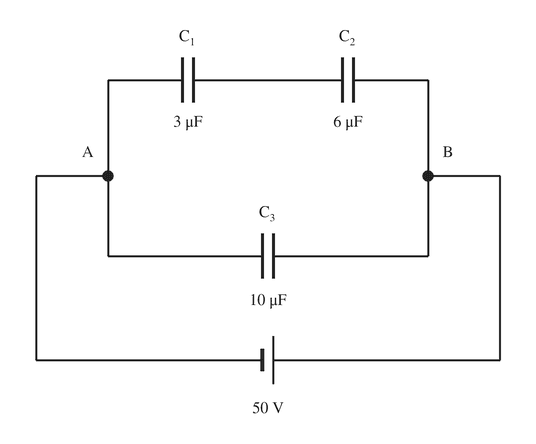
Three capacitors , and are connected to a battery as shown in the Figure 1 below :
Calculate :
(i) The equivalent capacitance of the circuit between points A and B.
(ii) The charge on
Solve with AIWritten solution
Solution:
Key idea: Capacitors and are in series (same charge), and that pair is in parallel with (same p.d.). The charge on a capacitor is .
Step 1 — (i) Combine and in series.
The capacitors and are on the same branch with nothing between them, so they are in series.
Step 2 — (i) Add in parallel.
The branch and the branch both join A to B, so they are in parallel.
Step 3 — (ii) Find the charge on .
The upper branch has the full across it, and its two capacitors in series carry the same charge as their combination .
Step 4 — Check with the p.d.s.
The p.d. across is and across is . These add up to , as they must.
Watch out: Do not use with the full ; shares the branch p.d. with .
Therefore, (i) the equivalent capacitance is ; (ii) the charge on is ().
- 43 marks
Question 4
Deduce an expression for equivalent capacitance C when three capacitors , and connected in parallel.
Solve with AIWritten solution
Solution:
Key idea: In a parallel combination every capacitor has the same p.d. across it, and the total charge drawn from the source is shared among the capacitors. The equivalent capacitor stores the same total charge at the same p.d.
Step 1 — Describe the arrangement.
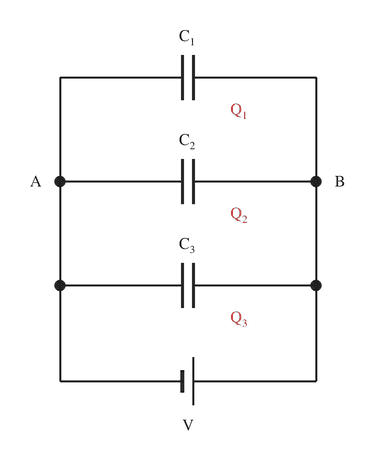
Three capacitors , and are each connected between the same two points A and B, and a battery keeps a p.d. across A and B.
Step 2 — Write the charge on each capacitor.
Each capacitor has the same p.d. , so from :
Step 3 — Add the charges.
The total charge given by the battery is the sum of the three charges.
Step 4 — Use the equivalent capacitance.
The equivalent capacitor holds the same total charge at the same p.d. , so is also .
Dividing both sides by :
The equivalent capacitance in parallel is larger than the largest of the three.
Therefore, for three capacitors in parallel .
- 53 marks
Question 5
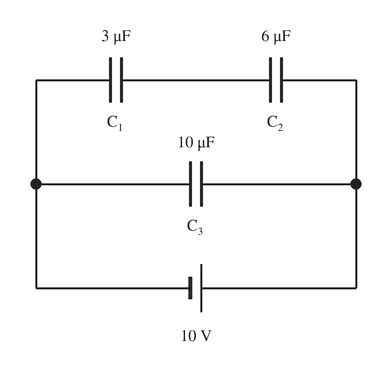
Three capacitors of capacitance , and are connected to a battery as shown in the figure given below.
(i) Equivalent capacitance
(ii) Electrostatic potential energy stored in the system.
 Solve with AI
Written solution
Solution:
Key idea: Capacitors and are in series, and that pair is in parallel with ; all of it sits across the battery. The energy stored is , using the equivalent capacitance.
Step 1 — (i) Combine and in series.
The capacitors and are on the same branch, one after the other.
Step 2 — (i) Add in parallel.
The branch with and the branch with both connect the same two vertical wires, so they are in parallel.
Step 3 — (ii) Find the stored energy.
The whole combination has the battery p.d. of across it. We use in farad: is .
Therefore, (i) the equivalent capacitance is ; (ii) the energy stored is .
- 63 marks
Question 6
A parallel plate capacitor is charged by a battery, which is then disconnected. A dielectric constant (relative permittivity) K, is now introduced between its two plates in order to occupy the space completely.
State, in terms of K, its effect on the following:
(i) The capacitance of the capacitor.
(ii) The potential difference between its plates.
(iii) The energy stored in the capacitor.
Solve with AIWritten solution
Solution:
Key idea: Once the battery is disconnected, the charge on the plates cannot change. A dielectric of constant filling the gap makes the capacitance times larger, and then and tell us the rest.
Step 1 — State what stays fixed.
Let the capacitance, p.d. and energy before the slab be , and , and let the charge be . The battery is disconnected, so stays the same throughout.
Step 2 — (i) Capacitance.
A dielectric filling the whole space between the plates multiplies the capacitance by .
So the capacitance increases times.
Step 3 — (ii) Potential difference.
With fixed, is inversely proportional to .
So the p.d. decreases to of its value. The polarised dielectric weakens the field between the plates by the factor .
Step 4 — (iii) Energy stored.
With fixed we use .
So the energy decreases to of its value. The lost energy goes into the work done on the dielectric as the field pulls it in.
Watch out: If the battery were kept connected, would stay fixed instead, and the charge and energy would both increase times.
Therefore, (i) the capacitance becomes times; (ii) the p.d. becomes times; (iii) the energy becomes times its original value.
- 72 marks
Question 7
Calculate equivalent capacitance of the circuit shown in Figure 1 given below:
 Solve with AI
Written solution
Solution:
Key idea: Capacitors in parallel add directly, ; capacitors in series combine as .
Step 1 — Combine and (parallel).
The capacitors and are connected between the same two junctions, so they are in parallel.
Step 2 — Combine with (series).
The parallel pair is followed by on the same line, so they are in series.
Therefore, the equivalent capacitance of the circuit is .
- 83 marks
Question 8
Obtain an expression for equivalent capacitance when three capacitors , and are connected in series.
Solve with AIWritten solution
Solution:
Key idea: Capacitors in series all carry the same charge , while the applied p.d. is shared among them. The equivalent capacitor stores the same charge when the same total p.d. is applied.
Step 1 — Describe the arrangement.
The capacitors , and are connected one after another between A and B, with a battery of p.d. across A and B.
Step 2 — Same charge on each capacitor.
The battery moves charge onto the outer plate of . By induction, the facing plates of neighbouring capacitors get equal and opposite charges, so each capacitor holds the same charge .
Step 3 — p.d. across each capacitor.
We apply to each capacitor:
Step 4 — Total p.d.
The p.d.s across capacitors in series add up to the applied p.d.
Step 5 — Equivalent capacitance.
The single equivalent capacitor carries the same at the same , so is also .
Cancelling on both sides:
Therefore, the equivalent capacitance of three capacitors in series is given by .
- 92 marks
Question 9
(a) What is the effect on capacitance of a parallel plate capacitor if the distance between its plates is increased?
(b) How will capacitance of a capacitor change if a dielectric slab is introduced between its plates?
Solve with AIWritten solution
Solution:
Key idea: A parallel plate capacitor with plate area and separation in vacuum has . A dielectric of constant between the plates raises the capacitance.
Step 1 — (a) Increase the plate separation.
The capacitance is inversely proportional to .
So when is increased, decreases. For example, doubling halves .
Step 2 — (b) Introduce a dielectric slab.
The slab is polarised by the field between the plates. Its bound charges reduce the field, and so the p.d., for the same charge, which means a larger capacitance. A slab of thickness gives:
Since , the denominator is less than , so is greater than . If the slab fills the whole gap, the capacitance becomes times.
Therefore, (a) the capacitance decreases (it is inversely proportional to ); (b) the capacitance increases, becoming times when the slab fills the space between the plates.
- 102 marks
Question 10
You are provided with three identical capacitors, each of capacitance 'C'.
If is equivalent capacitance when they are connected in parallel and is equivalent capacitance when they are connected in series, calculate the ratio .
Solve with AIWritten solution
Solution:
Key idea: In parallel, capacitances add: . In series, reciprocals add: .
Step 1 — Parallel combination.
Three equal capacitors in parallel add directly.
Step 2 — Series combination.
For three equal capacitors in series we add the reciprocals.
Step 3 — Take the ratio.
We divide the series value by the parallel value.
Therefore, , that is, .