
Opening your dashboard
Class 12 Physics Chapter 4 Capacitors and Dielectrics: Competency-Based Questions (CBQ)
41 questions on Chapter 4, each worked through on its own page with the AI tutor. Class 12 Physics, ICSE 2026-27.
41 questions
1–4 marks · Mixed difficulty
- 11 mark
Question 1
Competency: Analysis & Evaluation
A thick sheet of mica is placed between two metal plates that are kept at a steady potential difference of a few hundred volts. A sensitive meter in the circuit shows that, once the plates are charged, no steady current flows through the mica.
Assertion (A): An insulator placed in a steady electric field does not carry a steady current.
Reason (R): In an insulator the electrons are bound to their own atoms or molecules and are not free to drift through the material.
- 21 mark
Question 2
Competency: Application
A technician places a sensitive electronic instrument inside a closed, uncharged, hollow metal box that stands on an insulating table. The box is not earthed. A strongly charged plastic rod is then brought close to the outside of the box. The electric field inside the box (in the hollow space, due to the rod and the charges on the box together) is
- 33 marks
Question 3
Competency: Application
On a dry winter day, a person walks across a nylon carpet in rubber-soled shoes and becomes charged. Standing on the floor, the person's body (treated as an insulated conductor) has a capacitance of with respect to the earthed floor, and the body's potential reaches .
(a) Find the charge on the person's body.
(b) Find the energy that would be released as a spark if the person touched an earthed metal tap.
(c) Before touching anything, the person climbs onto a tall, dry wooden stool, so that the capacitance with respect to the floor falls to . No charge is lost. Explain why the capacitance falls, and find the new potential of the body.
(Hypothetical data.)
- 41 mark
Question 4
Competency: Analysis & Evaluation
A circuit board uses two capacitors in different parts of a circuit. One sits across a line and the other across a line.
Assertion (A): Two capacitors of equal capacitance must always carry equal charges.
Reason (R): The capacitance of a capacitor depends only on the size and shape of its plates, the separation between them and the medium between them.
- 51 mark
Question 5
Competency: Application
During a magnetic storm, a spherical satellite of diameter collects electrons from the surrounding space plasma until its potential is with respect to its distant surroundings. Treat it as an isolated metal sphere. The charge on the satellite is (, ) (Hypothetical data.)
- 61 mark
Question 6
Competency: Analysis & Evaluation
A student checks the space around a charged parallel plate capacitor with a small charged test body. Between the plates the body is pushed strongly; just outside the plates, well away from their edges, it is hardly pushed at all.
Assertion (A): The electric field just outside a charged parallel plate capacitor, away from its edges, is practically zero.
Reason (R): Outside the plates, the fields due to the two oppositely charged plates are in the same direction.
- 73 marks
Question 7
Competency: Application
A science museum shows a working copy of a Leyden jar, one of the earliest capacitors. It is a glass jar coated with metal foil on the inside and on the outside, up to the same height. Each coating has an area of , the glass wall is thick and the glass has dielectric constant . The outer coating is earthed. Because the glass is thin compared with the size of the jar, treat it as a parallel plate capacitor. ()
(a) Find the capacitance of the jar.
(b) The inner coating is charged to . Find the charge stored and the energy stored.
(c) Explain why the jar stores far more charge at than the inner foil would if it stood alone, with no earthed outer coating.
(Hypothetical data.)
- 83 marks
Question 8
Competency: Application
A high-voltage laboratory measures a steady high voltage with a capacitive divider: a small capacitor (built to withstand high voltage) is connected in series with a large capacitor . The high voltage is applied across the pair, and an electrostatic voltmeter (which draws no charge) reads the p.d. across only.
(a) The divider is connected across . Find the charge on each capacitor.
(b) Find the p.d. across and across . Which capacitor takes almost all the voltage, and why?
(c) On another day the voltmeter reads . Find the high voltage being measured.
(Hypothetical data.)
- 91 mark
Question 9
Competency: Application
A technician repairing an amplifier needs a capacitance of but has only a capacitor of that type. The technician decides to connect a second capacitor in series with the capacitor. The capacitance of the second capacitor should be
- 101 mark
Question 10
Competency: Analysis & Evaluation
A student needs a large capacitance for a power-supply circuit and joins three capacitors of , and side by side, all positive plates together and all negative plates together.
Assertion (A): The equivalent capacitance of capacitors connected in parallel is greater than the largest of the individual capacitances.
Reason (R): In a series combination, every capacitor carries the same charge.
- 113 marks
Question 11
Competency: Application
In a school robotics project, a capacitor is charged to and then disconnected from the supply. It is discharged through a small electric motor that winds a thread and lifts a load of mass . The motor turns of the energy it receives into gravitational potential energy of the load. ()
(a) Find the energy stored in the capacitor.
(b) Find the height through which the load is lifted when the capacitor discharges completely.
(c) The capacitor is now charged to only . Find the new height, and explain why it is not half the earlier height.
(Hypothetical data.)
- 121 mark
Question 12
Competency: Analysis & Evaluation
In an experiment, a capacitor is charged to different potential differences . Each time, an energy meter records the energy given out when the capacitor is fully discharged. A graph of (on the -axis) against (on the -axis) is a straight line through the origin with slope . The capacitance of the capacitor is (Hypothetical data.)
- 131 mark
Question 13
Competency: Application
A capacitor charged to is disconnected from the supply and left on the bench. Slow leakage through its dielectric lowers the stored energy until it is half its original value. The potential difference across the capacitor is then about
- 141 mark
Question 14
Competency: Analysis & Evaluation
Two students each discharge an identical capacitor, charged to the same p.d., through a resistor dipped in a small calorimeter. One uses a resistor and the other a resistor.
Assertion (A): The total heat produced in the resistor when the charged capacitor discharges completely does not depend on the value of the resistance.
Reason (R): A larger resistance allows a smaller current to flow.
- 153 marks
Question 15
Competency: Application
In a computer memory chip, each bit is stored on a tiny cell capacitor of (). A "1" is stored as across the cell and a "0" as . To read the cell, it is connected to a long wire called the bit line, which has a capacitance of and has first been charged to . Charge is then shared between the cell and the bit line (like plates joined).
(a) Find the common potential of the bit line after a "1" is read.
(b) Find the common potential after a "0" is read, and hence the change in bit-line potential that the read circuit must detect in each case.
(c) In a larger chip, the bit-line capacitance is with the same cell. Find the change in bit-line potential when a "1" is read, and state why the cell capacitance must not be too small.
(Hypothetical data.)
- 161 mark
Question 16
Competency: Analysis & Evaluation
A capacitor and a capacitor are each charged to , disconnected from the supply and then joined, positive plate to positive plate and negative plate to negative plate.
Assertion (A): When two capacitors charged to the same potential are joined in this way, no energy is lost.
Reason (R): Charge flows between two connected conductors only when there is a potential difference between them.
- 171 mark
Question 17
Competency: Application
To show how charge sharing divides a charge, a teacher charges a capacitor to and disconnects it from the supply. The teacher then joins across an identical uncharged capacitor , separates them, and discharges completely. This "join, separate, discharge " step is repeated until has been joined to three times in all. The p.d. across at the end is
- 183 marks
Question 18
Competency: Application
A humidity sensor in a weather station is a parallel plate capacitor whose dielectric is a thin polymer film. The film absorbs water vapour from the air. In dry air its dielectric constant is and the sensor's capacitance is . Its dielectric constant rises by for every rise in relative humidity (RH), so .
(a) Water molecules are polar. Explain why absorbed water raises the dielectric constant of the film.
(b) Find the capacitance of the sensor at RH.
(c) One morning the sensor reads . Find the relative humidity.
(Hypothetical data.)
- 191 mark
Question 19
Competency: Analysis & Evaluation
Nitrogen gas, made of non-polar molecules, is used as the dielectric in some high-voltage capacitors. A student claims that nitrogen cannot be polarised, since its molecules have no dipole moment.
Assertion (A): A non-polar molecule cannot be polarised by an external electric field.
Reason (R): In a non-polar molecule, the centres of positive and negative charge coincide when no field is applied.
- 201 mark
Question 20
Competency: Analysis & Evaluation
A thin metal sheet is slid between the plates of a charged, isolated parallel plate capacitor, parallel to the plates and not touching them. Charges are induced on its two faces, and a probe shows no electric field inside the sheet.
Assertion (A): The dielectric constant of a metal can be taken as infinite.
Reason (R): A metal contains no free electrons.
- 213 marks
Question 21
Competency: Application
A living cell membrane behaves like a parallel plate capacitor. The fluids inside and outside the cell act as the two "plates", and the membrane between them is a layer of dielectric thick with dielectric constant . The inside of a resting nerve cell is at a potential below the outside. (, )
(a) Find the capacitance of a patch of membrane.
(b) Find the electric field inside the membrane.
(c) Find the charge on each face of the patch, and the number of singly charged ions this charge represents.
(Hypothetical data.)
- 223 marks
Question 22
Competency: Analysis & Evaluation
The oil level in a storage tank is measured with a capacitance gauge: two vertical parallel metal plates, each tall and wide, apart, stand in the tank from top to bottom. Oil (dielectric constant ) fills the gap between the plates up to the oil level; above it there is air. ()
(a) Find the capacitance of the gauge when the tank is empty and when it is full.
(b) When the oil stands at height , the gauge behaves as two capacitors in parallel. Show that its capacitance is , where is the plate height and the plate width.
(c) The gauge reads . Find the height of the oil.
(Hypothetical data.)
- 233 marks
Question 23
Competency: Analysis & Evaluation
A touch screen senses a finger through the capacitance between the finger and a small transparent electrode under the cover glass. Treat the fingertip and the electrode as the two plates of a parallel plate capacitor, each . The cover glass is thick with dielectric constant . A touch is registered only if this capacitance is at least . ()
(a) Find the capacitance when a bare finger rests on the glass.
(b) A woollen glove adds a layer thick with effective dielectric constant between the finger and the glass. Find the capacitance now, and say whether the touch is registered.
(c) "Touch-screen gloves" have conducting threads woven into the fingertips. Explain why they work.
(Hypothetical data.)
- 241 mark
Question 24
Competency: Analysis & Evaluation
In a physics laboratory, a strong electric field of about is needed in a small region. A teacher obtains it simply by connecting two flat metal plates, apart, across a supply.
Assertion (A): A parallel plate capacitor can be used to produce a strong electric field in a small space.
Reason (R): Between closely spaced parallel plates, the field is large even for a moderate potential difference.
- 251 mark
Question 25
Competency: Application
Each key of a computer keyboard is a small variable capacitor. Pressing the key moves its top plate towards a fixed plate below it. In one keyboard, each plate has an area of , the air gap is when the key is up, and the circuit registers a key press when the capacitance reaches . The least distance through which the key must be pressed is () (Hypothetical data.)
- 264 marks
Question 26
A parallel plate air capacitor of capacitance and plate separation is kept connected to a battery. A dielectric slab thick, of dielectric constant , is slid in between the plates, parallel to them. (Hypothetical data.)
(a) Find the new capacitance.
(b) Find the extra charge drawn from the battery.
(c) Find the change in the energy stored in the capacitor.
(d) Find the work done by the battery, and account for the difference between (c) and (d).
- 273 marks
Question 27
A parallel plate capacitor is made of plates separated by paraffined paper cm thick of relative permittivity . The effective size of each plate is cm. What is the capacitance of this capacitor?
- 283 marks
Question 28
Three capacitors of capacitance , and are connected in series and a p.d. of V is applied to the combination. Calculate the potential difference across each capacitor.
- 293 marks
Question 29
The effective capacitance of two capacitors and when connected in series is and when connected in parallel. Calculate their individual capacitance.
- 303 marks
Question 30
A capacitor is charged by a V supply. It is then disconnected from the supply and is connected to another uncharged capacitor. How much electrostatic energy of the first capacitor is lost in the form of heat and electromagnetic radiation?
- 313 marks
Question 31
A parallel plate capacitor is to be designed with a voltage rating kV, using a material of dielectric constant and dielectric strength about V/m. For safety, we should let the field never to exceed say of the dielectric strength. What minimum area of the plate is required to have a capacitance of pF?
- 324 marks
Question 32
A parallel plate capacitor has two plates separated by a glass plate mm thick of dielectric constant . Find
(i) the capacity of the capacitor,
(ii) the energy stored if a potential of V is applied and
(iii) the energy density of the medium.
- 333 marks
Question 33
Two identical plates are given charges and respectively. If they are now brought close together to form a parallel plate capacitor with capacitance , what will be the potential difference between the plates?
- 343 marks
Question 34
Four similar metal plates of area each are placed parallel to each other such that the distance between the consecutive plates is as shown in the figure. The two outer plates are connected to the point and the two inner plates to the point . Calculate the equivalent capacitance between and .

- 353 marks
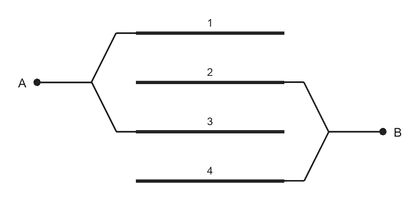
Question 35
If the same metal plates as in Question 17 are connected as shown in the figure, then what is the equivalent capacitance between the two points and ?
- 364 marks
Question 36
The space between the plates of a parallel plate capacitor is filled with two dielectrics ( and ) as shown in Figs. (a) and (b). What is the capacitance of the capacitor in each case?

- 374 marks
Question 37
A parallel plate capacitor is constructed using three different dielectric materials as shown in the figure. The parallel plates across which a potential difference is applied are of area and are separated by a distance . Find the capacitance across and .

- 383 marks
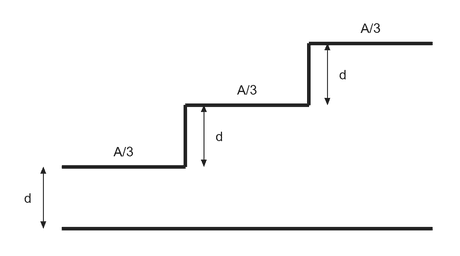
Question 38
A capacitor is made of a flat plate of area and a second plate having a stair-like structure as shown in the figure. If the width of each stair is and the height is , find the capacitance of the arrangement.
- 394 marks
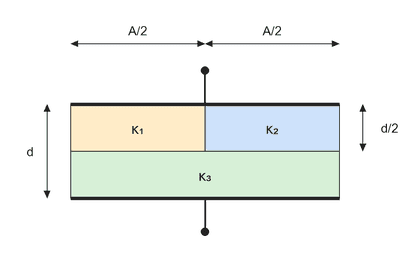
Question 39
A parallel plate capacitor of area , plate separation and capacitance is filled with different dielectric materials having dielectric constants , and as shown in the figure. If a single dielectric material is to be used to have the same capacitance in this capacitor, then what is the value of ?
- 404 marks
Question 40
The capacitance of a parallel plate capacitor with plate area and separation is . The space between the plates is filled with two wedges of dielectric constants and respectively. Find the capacitance of the resulting capacitor.

- 413 marks
Question 41
The given figure shows a circuit for a camera flash. A capacitor is charged by a V cell. When a flash is required, the energy stored in the capacitor is made to discharge through the discharge tube in millisecond giving a powerful flash. Calculate the energy stored in the capacitor and the power of the flash.
