
Opening your dashboard
Class 12 Physics Chapter 21: Diffraction of Light Solutions
51 textbook questions with step-by-step answers, free to read, for ISC 2026-27.
Get talked through Ch 21, not just shown the answer
Reading a finished solution is not the same as being able to do it. The AI tutor takes one question at a time and works it with you, in your own words, until you can.
- Ask it out loud, in your own words
- It gives you the next step, not the answer
- Stuck on part (ii)? Start there
51 questions with solutions
1–5 marks · Mixed difficulty
The first 42 solutions are on this page. This chapter is a long one, so the rest open on their own page to keep this one quick to load.
- 11 mark
Question 1
The bending of beam of light around corners of obstacles is called
Solve with AIAnswer
(A) reflection
- Correct
(B) diffraction
(C) refraction
(D) interference
Answer: (B) diffraction
Concept: Diffraction is the bending of light round the edges and corners of an obstacle or aperture into its geometrical shadow.
Step 1 — Match the description. The question describes light bending round the corners of obstacles, which is exactly the definition of diffraction.
Step 2 — Check the other options. Each of them names a different effect:
- (A) Reflection is the bouncing back of light from a surface; it does not carry light into a shadow.
- (C) Refraction is the change of direction when light passes from one medium into another, at the boundary between them.
- (D) Interference is the superposition of waves from two coherent sources, giving bright and dark fringes.
Therefore, the answer is (B).
- 21 mark
Question 2
To observe diffraction, the size of an aperture
Solve with AIAnswer
(A) should be much larger than the wavelength
(B) should be exactly
- Correct
(C) should be of the same order as the wavelength
(D) has no relation to wavelength
Answer: (C) should be of the same order as the wavelength
Concept: The angle through which light spreads is fixed by , so diffraction is clearly seen only when is comparable with .
Step 1 — Use the spreading condition. When is about the same as (a few wavelengths), is a sizeable fraction and the light spreads through a large, easily seen angle with clear bands.
Step 2 — Check the other options. None of the others gives an observable pattern:
- (A) For , is tiny; for openings very much larger than the wavelength, such as everyday doors and windows, the bending is far too small to notice.
- (B) For , , which is more than 1, so there is no direction of minimum at all: the light simply spreads out with no bands, and "exactly" is not a condition anyway.
- (D) The spreading depends on , so the size is closely related to the wavelength.
Therefore, the answer is (C).
- 31 mark
Question 3
A single slit of width is placed in the path of a light beam of wavelength . The angular width of the principal maxima obtained is
Solve with AIAnswer
(A)
(B)
- Correct
(C)
(D)
Answer: (C)
Concept: The angular width of the central (principal) maximum is the angle between the first minima on either side of it. The first minima lie at , and for small angles .
Step 1 — Find the direction of each first minimum. The condition for the first minimum with slit width is , and for a small angle . So each first minimum, one on either side of the centre, lies at this angle:
Step 2 — Add the two halves. The central maximum stretches from to , so its angular width is twice this angle:
Step 3 — Check the other options. The others do not give the full angle between the first minima:
- (A) is upside down: it would grow as the slit is widened, but a wider slit gives a narrower maximum.
- (B) is the angle of the first minimum on one side only, the angular half-width.
- (D) is also upside down and would grow with the slit width.
Note: The book's key is (most likely meant as ). That gives the directions of the two first minima, that is, the angular half-width; the chapter itself defines the angular width of the central maximum as , so the angular width asked for is .
Therefore, the answer is (C).
- 41 mark
Question 4
A parallel beam of light of wavelength 5000 Å is incident normally on a single slit of width 0.001 mm. The light is focused by a convex lens on a screen placed in focal plane. The first minimum is formed for the angle of diffraction of
 Solve with AI
Answer
- Correct
(A)
(B)
(C)
(D)
Answer: (A)
Concept: The first minimum of a single-slit pattern lies in the direction given by . The lens only brings each set of parallel diffracted rays to a point in its focal plane; it does not change the angles.
Step 1 — Write the data in metres. The wavelength is 5000 Å, so ; the slit width is 0.001 mm, so .
Step 2 — Find . We divide the wavelength by the slit width:
Step 3 — Check the other options. The other angles do not satisfy :
- (B) is half of the correct angle; , not 0.5.
- (C) is the direction of the central maximum, where all the wavelets arrive in phase, not a minimum.
- (D) is the angular width between the two first minima, not the angle of one minimum.
Therefore, the answer is (A).
- 51 mark
Question 5
Light appears to travel in a straight line because
Solve with AIAnswer
- Correct
(A) wavelength of light is very small
(B) frequency of light is very small
(C) light consists of very small particles
(D) velocity is different for different colours
Answer: (A) wavelength of light is very small
Concept: Light spreads into the shadow through an angle of about , where is the size of the opening or obstacle.
Step 1 — Compare the wavelength with everyday objects. The wavelength of light is about m, while everyday objects are millimetres to metres in size. So is tiny and the bending is far too small to notice, and light seems to travel in straight lines.
Step 2 — Check the other options. None of them explains the effect:
- (B) The frequency of light is very high, about Hz, not small.
- (C) This was the old corpuscular idea; it cannot account for the diffraction and interference that light does show, which need a wave picture.
- (D) Different colours travel at the same speed in a vacuum; different speeds in a medium cause dispersion, which has nothing to do with straight-line travel.
Therefore, the answer is (A).
- 61 mark
Question 6
A diffraction pattern is obtained by using a beam of red light. What will happen if red light is replaced by blue light?
Solve with AIAnswer
(A) bands disappear
(B) no change will take place
(C) bands become broader and farther apart
- Correct
(D) bands become narrower and crowded apart
Answer: (D) bands become narrower and crowded apart
Concept: The width of each band is proportional to the wavelength, for example the central band has linear width .
Step 1 — Compare the wavelengths. Blue light has a shorter wavelength (about 450 nm) than red light (about 700 nm).
Step 2 — Apply the proportion. With and unchanged, a shorter wavelength gives narrower bands that lie closer together.
Step 3 — Check the other options. The other changes do not happen:
- (A) Blue light still diffracts, so the bands are still formed.
- (B) The band width depends on , so changing the colour does change the pattern.
- (C) Broader, wider-spaced bands would need a longer wavelength, the opposite of the change from red to blue.
Therefore, the answer is (D).
- 71 mark
Question 7
In the experiment of diffraction at a single slit, if the slit width decreases, the width of the central maximum
Solve with AIAnswer
- Correct
(A) increases
(B) decreases
(C) is unchanged
(D) data incomplete
Answer: (A) increases
Concept: The width of the central maximum is (or the angle ), inversely proportional to the slit width .
Step 1 — Apply the inverse proportion. A smaller makes larger, so the central maximum widens.
Step 2 — Check the other options. The others contradict the formula:
- (B) A decrease would need a wider slit, not a narrower one.
- (C) The width depends on , so it cannot stay the same.
- (D) The formula is enough to decide the change, so no more data is needed.
Therefore, the answer is (A).
- 81 mark
Question 8
The dual nature of light (wave nature and particle nature) is exhibited by
Solve with AIAnswer
(A) diffraction and reflection
- Correct
(B) diffraction and photoelectric effect
(C) photoelectric effect
(D) refraction and interference
Answer: (B) diffraction and photoelectric effect
Concept: Diffraction can be explained only if light is a wave. The photoelectric effect can be explained only if light comes in packets of energy (photons), that is, if it behaves as particles.
Step 1 — Pick one effect for each nature. Option (B) pairs a wave effect (diffraction) with a particle effect (photoelectric effect), so together they show both natures.
Step 2 — Check the other options. Each of the others shows at most one nature:
- (A) Reflection can be explained by both the wave and the particle model, so it does not by itself show the particle nature.
- (C) The photoelectric effect alone shows only the particle nature.
- (D) Refraction and interference are both explained by the wave theory; neither needs photons.
Therefore, the answer is (B).
- 91 mark
Question 9
The penetration of light into the region of geometrical shadow is called
Solve with AIAnswer
(A) polarisation
(B) interference
- Correct
(C) diffraction
(D) refraction
Answer: (C) diffraction
Concept: Diffraction is the spreading of light waves into the geometrical shadow of an obstacle.
Step 1 — Match the description. Light entering the region of geometrical shadow is the defining feature of diffraction.
Step 2 — Check the other options. Each names a different effect:
- (A) Polarisation is the restriction of the vibrations of a transverse wave to one plane.
- (B) Interference is the superposition of waves from two coherent sources, redistributing energy into fringes.
- (D) Refraction is the bending of light at the boundary between two media.
Therefore, the answer is (C).
- 101 mark
Question 10
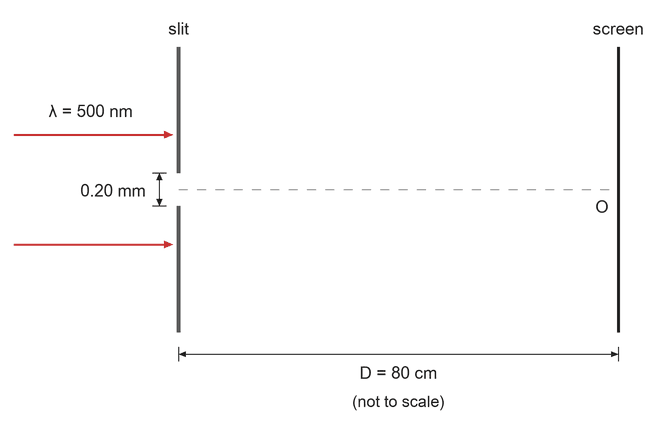
A single slit of width 0.20 mm is illuminated with light of wavelength 500 nm. The observing screen is placed 80 cm from the slit. The width of the central bright fringe will be
 Solve with AI
Answer
(A) 1 mm
(B) 2 mm
- Correct
(C) 4 mm
(D) 5 mm
Answer: (C) 4 mm
Concept: The central bright fringe stretches between the first minima on either side, at distances from the centre, so its width is .
Step 1 — Write the data in SI units. The slit width is 0.20 mm, so ; the wavelength is 500 nm, so ; the screen is 80 cm away, so .
Step 2 — Substitute into the width formula. We put these values into :
This is 4 mm.
Step 3 — Check the other options. The other values come from slips:
- (A) 1 mm is , half the distance to one first minimum.
- (B) 2 mm is , the distance from the centre to one first minimum, the half-width.
- (D) 5 mm would need a slit of width mm, not 0.20 mm.
Therefore, the answer is (C).
- 111 mark
Question 11
What is diffraction of light?
Solve with AIWritten solution
Solution:
Concept: By Huygens' principle every point of a wavefront sends out secondary wavelets in all forward directions.
Step 1 — State what happens at an edge. When part of a wavefront is cut off by an obstacle or slit, the secondary wavelets from the unobstructed part spread into the region behind the edges.
Step 2 — Describe what is seen. These spreading wavelets superpose behind the obstacle, so some light reaches the region of geometrical shadow and bright and dark bands appear near the edge of the shadow. The effect is easy to see when the obstacle or aperture is small, not too large compared with the wavelength of light.
Therefore, diffraction is the bending of light round the edges and corners of an obstacle or aperture, that is, the spreading of light waves into the region of geometrical shadow.
- 121 mark
Question 12
Which three phenomena establish the wave nature of light?
Solve with AIWritten solution
Solution:
Concept: A phenomenon proves the wave nature of light if it can be explained only by waves adding up (superposing) or vibrating in a particular way.
Step 1 — Name the effects that need superposition. Interference and diffraction both arise when waves superpose: where crests meet crests the light is bright, and where crests meet troughs it is dark. A stream of particles moving in straight lines cannot produce dark bands in this way, so both effects show that light is a wave.
Step 2 — Name the effect that shows the waves are transverse. Polarisation shows that the vibrations of light can be confined to one direction across the direction of travel, which is possible only for a transverse wave.
Therefore, interference, diffraction and polarisation establish the wave nature of light (polarisation also shows that the waves are transverse).
- 131 mark
Question 13
State the condition for diffraction of light to occur.
Solve with AIWritten solution
Solution:
Concept: When light of wavelength passes an aperture or obstacle of size , it spreads through an angle of about radian.
Step 1 — See how the spreading depends on the size. The angle grows as becomes smaller, so a large obstacle bends light through only a tiny angle, while a small one bends it through a large angle.
Step 2 — State when the spreading is noticeable. The bending is clearest when is comparable with , and it can still be seen for apertures up to a few hundred wavelengths wide (a slit a fraction of a millimetre wide). Everyday objects are millions of times larger than , so light passing them shows no noticeable bending.
Therefore, diffraction of light is noticeable when the size of the obstacle or aperture is comparable with the wavelength of light used.
- 141 mark
Question 14
What should be the order of size of obstacle/aperture for diffraction of light?
Solve with AIWritten solution
Solution:
Concept: The bending is about radian for an aperture of width and light of wavelength .
Step 1 — Note the wavelength of light. Visible light has wavelengths from about m to m (400 nm to 700 nm).
Step 2 — Compare the sizes. For the bending to be seen, must not be very small, so the aperture or obstacle should be of the order of the wavelength. Slits up to a fraction of a millimetre wide (a few hundred wavelengths) still give a pattern a few millimetres wide on a screen about a metre away, but for larger objects the bending is too small to notice.
Therefore, the aperture or obstacle should be of the order of the wavelength of light.
- 151 mark
Question 15
What is the condition for first minimum in case of diffraction due to a single slit?
Solve with AIWritten solution
Solution:
Concept: At the first minimum the path difference between the waves from the two edges of the slit is one wavelength, so the waves from the upper and lower halves of the slit cancel in pairs.
Step 1 — Write the path difference between the edge waves. For a slit of width and a direction , the wave from one edge of the slit travels farther than the wave from the other edge by .
Step 2 — Apply the condition for darkness. Divide the slit into an upper and a lower half. When the edge path difference is one wavelength, each point in the upper half has a partner in the lower half whose path differs by , so the pairs cancel and the intensity is zero. The condition for the first minimum is therefore:
For a small angle , which gives the direction of the first minimum:
Therefore, the first minimum occurs where , that is, for small angles.
- 161 mark
Question 16
What is the basic difference between interference and diffraction of light?
Solve with AIWritten solution
Solution:
Concept: Both effects are due to the superposition of waves; they differ in where the superposing waves come from.
Step 1 — Find where the waves come from in interference. In interference the superposing waves come from two separate coherent sources (two wavefronts, as from the two slits of Young's experiment).
Step 2 — Find where the waves come from in diffraction. In diffraction the superposing waves are secondary wavelets from different points of the same wavefront, coming from a single source through one opening or past one edge.
Therefore, interference is the superposition of waves from two different coherent sources, while diffraction is the superposition of secondary wavelets from different parts of the same wavefront.
- 171 mark
Question 17
What changes in diffraction pattern of a single slit will you observe, when the monochromatic source of light is replaced by a source of white light?
Solve with AIWritten solution
Solution:
Concept: Each colour forms its own single-slit pattern, with its first minima at .
Step 1 — Look at the centre of the pattern. At the centre, the wavelets of every colour arrive in phase, so all the colours are bright there together and the central maximum stays white.
Step 2 — Look away from the centre. The minima and maxima of different colours fall at different angles, because depends on : violet has its first minimum nearest the centre and red farthest out. So the edges of the central maximum are coloured (reddish on the outside), and the secondary maxima appear as coloured fringes; farther out the colours overlap and the fringes wash out.
Therefore, the pattern becomes coloured: a white central maximum with coloured fringes on either side, because the overlapping patterns of the different colours do not coincide.
- 181 mark
Question 18
Radiowaves diffract pronouncedly around buildings; while, light waves, which are electromagnetic waves, do not. Why?
Solve with AIWritten solution
Solution:
Concept: Diffraction is marked only when the obstacle is comparable with the wavelength; the bending angle is about for an obstacle of size .
Step 1 — Compare the wavelength of radio waves with a building. Broadcast radio waves have wavelengths from about 1 m to several hundred metres (a 1 MHz medium-wave signal has a wavelength of 300 m). Buildings are a few metres to tens of metres in size, comparable with these wavelengths, so radio waves bend round them strongly.
Step 2 — Compare the wavelength of light with a building. Light has a wavelength of only about m, about a hundred million times smaller than a 50 m building. The bending angle is then far too small to notice.
Therefore, radio waves bend round buildings because their wavelength is comparable with the size of the buildings, while the wavelength of light is far too small for any noticeable bending.
- 191 mark
Question 19
Yellow light is used in a single-slit diffraction experiment with slit width of 0.6 mm. If yellow light is replaced by X-rays, how will the diffraction pattern be affected?
Solve with AIWritten solution
Solution:
Concept: The minima lie at , so the spreading falls as the wavelength falls.
Step 1 — Find the spreading for yellow light. Yellow light has m, so with m the ratio is about . On a screen 1 m away the first minima lie about 1 mm from the centre, so a pattern is seen.
Step 2 — Find the spreading for X-rays. X-rays have wavelengths of about m, so the ratio is only about , several thousand times smaller. On a screen 1 m away the first minima would lie only about from the centre, far too close to separate, so no pattern can be seen in practice.
Therefore, no diffraction pattern will be observed in practice, because the wavelength of X-rays is very small compared with the slit width; the X-rays pass straight through.
- 201 mark
Question 20
State the condition for diffraction of light to occur.
Solve with AIWritten solution
Solution:
Concept: When light of wavelength passes an aperture or obstacle of size , it spreads through an angle of about radian.
Step 1 — See how the spreading depends on the size. The angle grows as becomes smaller, so a large obstacle bends light through only a tiny angle, while a small one bends it through a large angle.
Step 2 — State when the spreading is noticeable. The bending is clearest when is comparable with , and it can still be seen for apertures up to a few hundred wavelengths wide (a slit a fraction of a millimetre wide). Everyday objects are millions of times larger than , so light passing them shows no noticeable bending.
Therefore, diffraction of light is noticeable when the size of the obstacle or aperture is comparable with the wavelength of light used.
- 211 mark
Question 21
In the diffraction at a single-slit experiment, how would the width and intensity of central maximum change, if (i) slit width is halved and (ii) visible light of longer wavelength is used?
Solve with AIWritten solution
Solution:
Concept: For small angles the angular width of the central maximum is .
Step 1 — Part (i): slit width halved. Halving doubles , so the central maximum becomes twice as wide. Half as much light now passes and it is spread over twice the width, so the intensity at the centre falls to of its value.
Step 2 — Part (ii): longer wavelength. A larger makes larger, so the central maximum widens; the same light is spread more widely, so its intensity decreases.
Therefore, (i) the width doubles and the intensity becomes one-quarter; (ii) the width increases and the intensity decreases.
- 221 mark
Question 22
In a single-slit diffraction pattern how does the angular width of central maximum change when (i) the distance between the slit and screen is increased and (ii) light of smaller visible wavelength is used?
Solve with AIWritten solution
Solution:
Concept: For small angles the angular width of the central maximum is ; it contains only and .
Step 1 — Part (i): larger slit–screen distance. The distance does not appear in , so the angular width does not change (only the linear width grows).
Step 2 — Part (ii): smaller wavelength. A smaller makes smaller.
Therefore, (i) the angular width stays the same, and (ii) the angular width decreases.
- 231 mark
Question 23
Diffraction is common in sound but not in light waves. Why?
Solve with AIWritten solution
Solution:
Concept: Diffraction is easy to notice when the obstacle or opening is of the order of the wavelength. The bending angle, about for an obstacle or opening of size , becomes tiny when the obstacle is very much larger than the wavelength.
Step 1 — Compare the wavelength of sound with everyday obstacles. Audible sound in air has wavelengths from about 1.7 cm (at 20 kHz) to about 17 m (at 20 Hz). These are the sizes of doors, windows and walls, so sound bends round them easily and we can hear sounds round a corner.
Step 2 — Compare the wavelength of light with everyday obstacles. Light waves are only about m to m long, so everyday obstacles are millions of times larger and the bending of light round them is far too small to notice. Light shows clear diffraction only at openings or edges up to a fraction of a millimetre across (a few hundred wavelengths), such as a narrow slit or a thin wire, and these are rare in daily life.
Therefore, diffraction of sound is common because its wavelength matches the size of everyday obstacles, while the wavelength of light is far smaller than everyday objects, so its diffraction is noticed only with very small openings or obstacles.
- 241 mark
Question 24
In a single-slit diffraction experiment, the width of the slit is made double the original width. How does this affect the size and intensity of the central diffraction band?
Solve with AIWritten solution
Solution:
Concept: For small angles the angular width of the central band is , so it is inversely proportional to the slit width . The amount of light passing through the slit is proportional to .
Step 1 — Find the new width of the central band. Doubling halves :
So the central band becomes half as wide.
Step 2 — Find the new intensity at its centre. Twice as much light now passes through the slit, and it falls on a band half as wide, so the intensity at the centre grows by both factors of 2. Writing for the original central intensity:
Therefore, the central band becomes half as wide and its intensity at the centre becomes four times as great.
- 252 marks
Question 25
What is diffraction?
Solve with AIWritten solution
Solution:
Concept: By Huygens' principle every point of a wavefront acts as a source of secondary wavelets.
Step 1 — Define the effect. Diffraction is the bending of light round the edges and corners of an obstacle or aperture, so that light spreads into the region of geometrical shadow.
Step 2 — Give its cause. When an obstacle or slit cuts off part of a wavefront, the secondary wavelets from the unobstructed part spread into the region behind the edges and superpose there. This gives bright and dark bands near the edge of the shadow. The effect is clear when the obstacle or aperture is comparable with the wavelength, for example light through a very narrow slit or round a thin wire.
Therefore, diffraction is the bending and spreading of light into the geometrical shadow at the edges of an obstacle or aperture, produced by the superposition of secondary wavelets from the unobstructed part of the wavefront.
- 262 marks
Question 26
What are the essential conditions for diffraction to take place?
Solve with AIWritten solution
Solution:
Concept: The spreading angle in diffraction is about , and a clear pattern needs light of one wavelength coming from a narrow source.
Step 1 — Condition on the obstacle. The size of the obstacle or aperture should be of the order of the wavelength of light, so that is large enough for the bending to be seen. The bending is largest for openings only a few wavelengths wide, and it can still be seen with slits up to a fraction of a millimetre wide (a few hundred wavelengths).
Step 2 — Condition on the source. In most cases a narrow source (a pinhole or narrow slit) emitting monochromatic light is needed. A broad source gives many overlapping patterns, and white light gives patterns of different widths for different colours, both of which blur the bands.
Therefore, diffraction needs an obstacle or aperture of size of the order of the wavelength (up to a few hundred wavelengths for a slit), and in most cases a narrow, monochromatic source such as a pinhole or narrow slit.
- 272 marks
Question 27
“Diffraction of sound is very easily noticed but diffraction of light is not observed in day-to-day life.” Why?
Solve with AIWritten solution
Solution:
Concept: Diffraction is marked only when the obstacle or opening is comparable with the wavelength.
Step 1 — Compare the wavelengths. Audible sound has wavelengths of a few centimetres to several metres, while visible light has a wavelength of about m.
Step 2 — Compare with everyday objects. Doors, windows and walls are of the order of a metre, comparable with the wavelength of sound, so sound bends round them and can be heard round a corner. These objects are millions of times larger than the wavelength of light, so light hardly bends at all.
Therefore, the wavelength of light is very small compared with that of sound and with everyday obstacles, so its diffraction is not noticed in daily life.
- 282 marks
Question 28
What is diffraction pattern?
Solve with AIWritten solution
Solution:
Concept: Light bent at the edges of a slit or obstacle superposes on the screen, so the light energy is not spread evenly.
Step 1 — Describe the distribution. The diffraction pattern is the non-uniform distribution of light energy on the screen produced by the bending of light at the edges of the slit or obstacle.
Step 2 — Describe the single-slit pattern. For a single slit it consists of a broad, intense central maximum with a number of narrower and much fainter secondary maxima on both sides, separated by minima. The central maximum is twice as wide as each secondary maximum.
Therefore, a diffraction pattern is the uneven distribution of light energy on the screen due to diffraction: for a single slit, a broad bright central maximum flanked by dark minima and fainter secondary maxima.
- 292 marks
Question 29
What is the nature of the incident wavefront in a Fraunhofer diffraction?
Solve with AIWritten solution
Solution:
Concept: In Fraunhofer diffraction both the source and the screen are effectively at infinite distance from the slit.
Step 1 — Describe the set-up. A point source (or a narrow slit source) is placed at the principal focus of a convex lens, so the light leaving the lens is a parallel beam. This puts the source effectively at infinity.
Step 2 — Name the wavefront. Wavefronts are always perpendicular to the rays, so the wavefronts of a parallel beam are flat planes, and they fall normally on the slit.
Therefore, the incident wavefront in Fraunhofer diffraction is a plane wavefront.
- 302 marks
Question 30
In Fraunhofer diffraction at a single slit, pass monochromatic light through a rectangular slit. What is the nature of the slit image that got onto the screen? If the width of the slit is very wide, what would have been the nature of the image?
Solve with AIWritten solution
Solution:
Concept: In Fraunhofer diffraction at a single slit of width , the minima (dark bands) lie in the directions given by
Here is the wavelength. The central maximum lies between the two first minima, .
Step 1 — Describe the image for a narrow slit. The screen shows a broad central bright band parallel to the slit. Above and below it there are alternate dark bands (minima) and fainter bright bands (secondary maxima), whose brightness falls off rapidly.
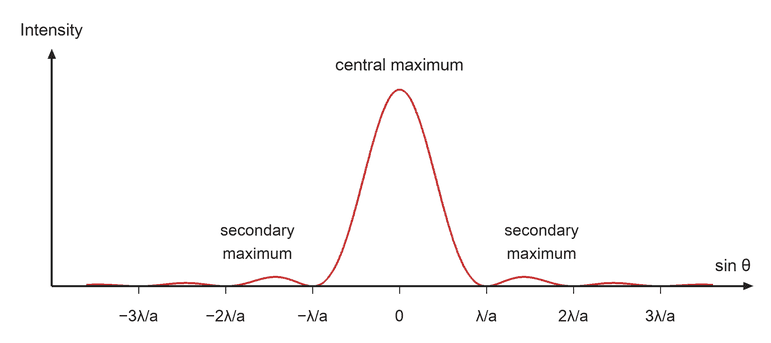
Step 2 — Describe the image for a very wide slit. If , the first minimum is at a tiny angle, . The central maximum and all the secondary bands are then squeezed into this tiny angle round the straight-through direction, too close together to be seen separately, so there is no visible spreading of light.
Therefore, a narrow slit gives a broad central bright band with secondary minima and maxima on either side; a very wide slit gives just a sharp geometrical image of the slit, with no visible diffraction bands.
- 312 marks
Question 31
How is central maximum produced in the Fraunhofer single-slit diffraction pattern?
Solve with AIWritten solution
Solution:
Concept: All the secondary wavelets start from the slit in the same phase, because the incident plane wavefront reaches every point of the slit at the same time.
Step 1 — Follow the wavelets in the straight-ahead direction. The wavelets travelling in the same direction as the incident light () are focused at the central point P of the screen. Any two corresponding points, such as the edges A and B or two points symmetric about the centre C, are at equal distances from P, so the path difference between their wavelets is zero.
Step 2 — Add the wavelets. With zero path difference all the wavelets arrive at P in phase, so they superpose constructively.
Therefore, the central maximum is produced at P because all the secondary wavelets travelling in the direction of the incident wavefront reach P with zero path difference and interfere constructively.
- 322 marks
Question 32
In Fraunhofer diffraction at a single slit, what is the condition for getting the first secondary minimum? How will you explain its formation? Use appropriate diagrams.
Solve with AIWritten solution
Solution:
Concept: Divide the slit into two equal halves. If every wavelet from the upper half is cancelled by the matching wavelet from the lower half, the screen is dark in that direction.
Step 1 — Draw the slit and the diffracted rays. Let a plane wavefront fall normally on a slit AB of width with centre C. Consider the wavelets diffracted at an angle ; a lens focuses them at one point of the screen. Draw AE perpendicular to the diffracted rays.
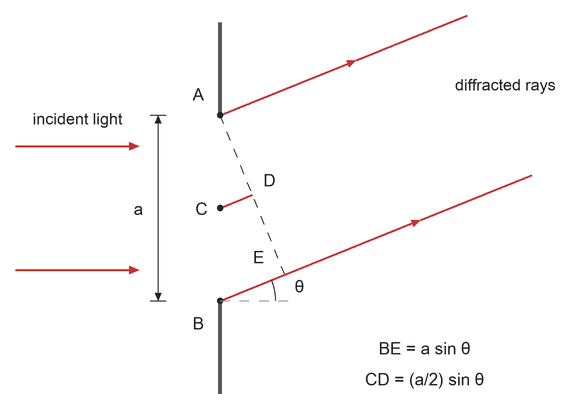
Step 2 — Find the path differences. Beyond the line AE all the diffracted rays travel equal optical paths to their meeting point on the screen, because a lens adds no path difference between parallel rays. So the path differences arise before AE: compared with the ray from A, the ray from B travels the extra distance BE and the ray from C travels the extra distance CD:
Step 3 — Pair the two halves. Take a point in the upper half AC and the point a distance below it in the lower half CB (for example A and C). Every such pair has the same path difference . If this equals , each pair arrives in opposite phase and cancels:
Step 4 — Conclude. Since the whole upper half is cancelled by the whole lower half, the intensity in this direction is zero: this is the first secondary minimum.
Therefore, the first secondary minimum occurs in the direction where (path difference between the edge rays equal to one wavelength), because the wavelets from the two halves of the slit then cancel in pairs.
- 332 marks
Question 33
Explain the term secondary maxima with reference to the Fraunhofer diffraction at a single slit.
Solve with AIWritten solution
Solution:
Concept: Secondary maxima are the fainter bright bands that lie between successive minima on either side of the central maximum.
Step 1 — Divide the slit into three equal strips. Let the slit AB of width be divided into three equal strips AC, CD and DB. Consider the direction in which the path difference between the edge rays, , is ; then each strip has a path difference of across it.
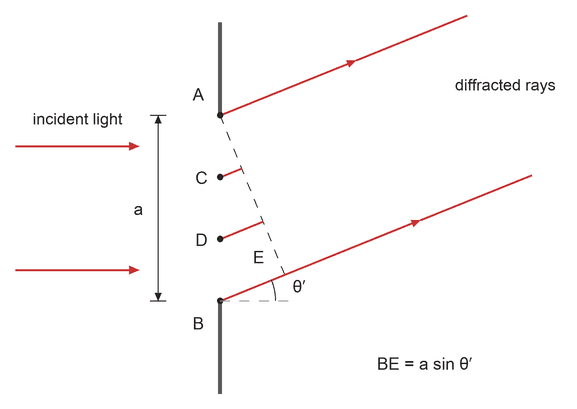
Step 2 — Cancel two of the strips. Wavelets from corresponding points of the neighbouring strips AC and CD differ in path by , so these two strips cancel each other. The third strip DB is left uncancelled and sends light in this direction. This gives the first secondary maximum:
Step 3 — Generalise. Dividing the slit into 5, 7, 9, … strips in the same way gives the 2nd, 3rd, 4th, … secondary maxima:
Only one strip out of 3, 5, 7, … is left uncancelled, so these maxima get rapidly weaker (about 4.7 %, 1.6 % and 0.8 % of the central intensity).
Watch out: The rule is the simple ISC rule for the secondary maxima. It places each one midway between two minima; the exact maxima lie slightly nearer the centre (the first at instead of ).
Therefore, secondary maxima are the weak bright bands between the minima, formed approximately where , where only one uncancelled strip of the slit contributes light, so their intensity falls off quickly.
- 342 marks
Question 34
Name the factors on which the width of the central maxima depends, in the Fraunhofer diffraction pattern.
Solve with AIWritten solution
Solution:
Concept: The central maximum lies between the first minima on the two sides. For small angles the first minima are at , where is the wavelength and the slit width.

Step 1 — Write the linear width. On a screen at distance (or in the focal plane of a lens of focal length , with in place of ) each first minimum lies a distance from the centre O, and the angle is small.
The central maximum spans both first minima:
Step 2 — Read the factors from the formula. The width is directly proportional to the wavelength and to the distance (or ), and inversely proportional to the slit width .
Therefore, the width of the central maximum depends on the wavelength of light (greater for red than violet), the slit width (narrower slit, wider maximum) and the distance of the screen from the slit or the focal length of the focusing lens.
- 352 marks
Question 35
What is meant by angular half width of the central maximum? What is full width?
Solve with AIWritten solution
Solution:
Concept: The first minima on either side of the centre lie at ; for small angles .
Step 1 — Define the angular half width. The angular half width is the angle between the centre of the central maximum and the first minimum on one side. For small angles it is:
Step 2 — Define the full width. The (full) angular width is the angle between the first minima on the two sides of the central maximum. For small angles it is:
Therefore, the angular half width is the angle from the centre to the first minimum, about for small angles, and the full angular width is the angle between the first minima on either side, about .
- 362 marks
Question 36
What is Fresnel's distance?
Solve with AIWritten solution
Solution:
Concept: A beam leaving an aperture of width spreads by diffraction through an angle , so after a distance its edges have moved out by about .
Step 1 — Define the distance. Fresnel's distance is the distance from the aperture at which the spreading due to diffraction becomes equal to the size of the aperture. Up to this distance ray optics (straight-line travel) is a good approximation.
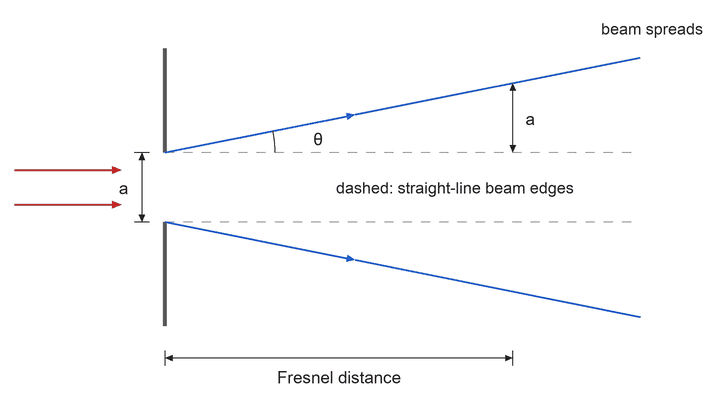
Step 2 — Find its value. We set the spread equal to :
Therefore, Fresnel's distance is the distance at which the diffraction spread of a beam equals the aperture size, ; beyond it diffraction can no longer be ignored.
- 372 marks
Question 37
Draw a diagram to show the variation of intensity on the diffraction pattern due to a single slit with .
Solve with AIWritten solution
Solution:
Concept: The intensity is greatest at , zero at the minima , and the secondary maxima between the minima are much weaker.
Step 1 — Mark the minima on the angle axis. The zeros of intensity are at ; for small angles these are the angles
Step 2 — Draw the maxima. A tall central peak lies between and . Small secondary maxima lie between the later minima, with heights about 4.7 %, 1.6 % and 0.8 % of the central peak.
Therefore, the graph is a tall central peak of angular width , with zeros at and much weaker secondary maxima, each half as wide as the central one, on either side.
- 382 marks
Question 38
State with a reason, how the linear width of central maximum change if monochromatic yellow light is replaced with red light.
Solve with AIWritten solution
Solution:
Concept: The linear width of the central maximum is , directly proportional to the wavelength.
Step 1 — Compare the wavelengths. Red light (about 700 nm) has a longer wavelength than yellow light (about 589 nm).
Step 2 — Apply the proportion. With and unchanged, a larger gives a larger .
Therefore, the linear width of the central maximum increases, because it is directly proportional to the wavelength and .
- 392 marks
Question 39
A slit of width is illuminated by a monochromatic light of wavelength 700 nm at normal incidence. Calculate the value of ‘’ for position of
(i) first minimum at an angle of diffraction of .
(ii) first maximum at an angle of diffraction of .
Solve with AIWritten solution
Solution:
Key idea: The minima of a single slit lie where , and (by the ISC rule) the secondary maxima where . The first maximum away from the centre is the first secondary maximum, .
Step 1 — Part (i): use the first-minimum condition. We put , m and :
Step 2 — Part (ii): use the first-secondary-maximum condition. Now :
Watch out: The rule is the simple ISC rule for the secondary maxima. It places each one midway between two minima; the exact maxima lie slightly nearer the centre (the first at instead of ).
Note: The book prints m for part (ii); its own working, , gives m, so the decimal point has been lost in print.
Therefore, (i) and (ii) .
- 402 marks
Question 40
Two wavelength of sodium light 590 nm, 596 nm are used in turn, to study the diffraction take place at a single slit of aperture m. The distance between the slit and the screen is 1.5 m. Calculate the separation between the positions of first maximum of the diffraction pattern obtained in the two cases.
 Solve with AI
Written solution
Solution:
Key idea: The first secondary maximum lies (by the ISC rule) at ; for a small angle its distance from the centre of the screen is ; so .
Step 1 — Write the position for each wavelength. The same formula holds for both wavelengths:
Step 2 — Subtract to find the separation. Only the wavelength changes, so
Step 3 — Substitute the data. We use m and m; the two wavelengths differ by 6 nm, so m:
This is 0.0675 mm. As a check, the two maxima are at about 6.638 mm and 6.705 mm from the centre.
Watch out: The rule is the simple ISC rule for the secondary maxima. It places each one midway between two minima; the exact maxima lie slightly nearer the centre (the first at instead of ).
Note: The book prints 6.75 mm. The working gives m (0.0675 mm): the digits agree but the printed power of ten is wrong.
Therefore, the first maxima for the two wavelengths are (0.0675 mm) apart.
- 412 marks
Question 41
Determine the angular separation between central maximum and first order maximum of the diffraction pattern due to a single slit of width of 0.25 mm when light of wavelength 5890 Å is incident on it normally.
Solve with AIWritten solution
Solution:
Key idea: The central maximum is at . The first-order (first secondary) maximum lies, by the ISC rule, at , and for a small angle .
Step 1 — Write the angle of the first maximum. Since the angle is small, :
Step 2 — Substitute the data. We use m and m:
Step 3 — Find the separation. The central maximum is at , so the angular separation is , about rad.
Watch out: The rule is the simple ISC rule for the secondary maxima. It places each one midway between two minima; the exact maxima lie slightly nearer the centre (the first at instead of ).
Therefore, the angular separation is about rad.
- 423 marks
Question 42
Explain Fraunhofer diffraction of light at a single slit.
Solve with AIWritten solution
Solution:
Concept: In Fraunhofer diffraction the source and the screen are effectively at infinite distance from the slit: lenses make the incident light parallel and bring the parallel diffracted light to a focus.
Step 1 — Describe the experimental set-up. A point source S of monochromatic light is placed at the focus of a convex lens , so a plane wavefront falls normally on a narrow slit. The light diffracted by the slit is collected by a second convex lens , and the screen is placed in its focal plane. Parallel rays leaving the slit straight ahead meet at P; parallel rays leaving at an angle meet at another point P′.
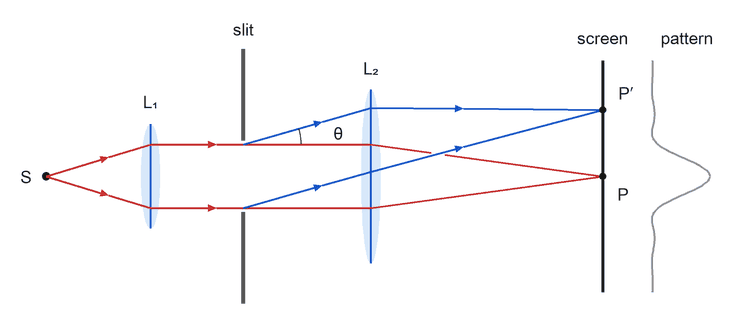
Step 2 — Explain the central maximum. All points of the slit are on one wavefront, so their secondary wavelets start in phase. In the straight-ahead direction the path difference between any two of them is zero, so they reinforce at P and give the bright central maximum.
Step 3 — Explain the minima. In a direction the path difference between the waves from the two edges of the slit (width ) is . When it is , the two halves of the slit cancel each other in pairs; when it is , the four quarters cancel in pairs, and so on:
Step 4 — Explain the secondary maxima. Between the minima, roughly where , the slit can be divided into an odd number of strips. All but one strip cancel in pairs, so these secondary maxima are weak, and they get weaker as increases.
Therefore, Fraunhofer diffraction at a single slit gives a bright central maximum at , minima at , and weaker secondary maxima in between; the central maximum has angular width .
- 433 marks
Question 43
Obtain the relation, for the first minimum of the diffraction pattern of a single slit of width ‘’ using light of wavelength .
- 443 marks
Question 44
Draw a labelled diagram showing the variation in intensity of light with distance in a single-slit Fraunhofer diffraction experiment
- 455 marks
Question 45
What is diffraction? What are secondary wavelets? What is diffraction pattern? Explain the formation of the diffraction pattern in a Fraunhofer single-slit diffraction experiment.
- 465 marks
Question 46
Compare interference and diffraction. Explain the formation of central maximum, secondary maxima and minima in a Fraunhofer single-slit diffraction experiment. Derive the equations.
- 473 marks
Question 47
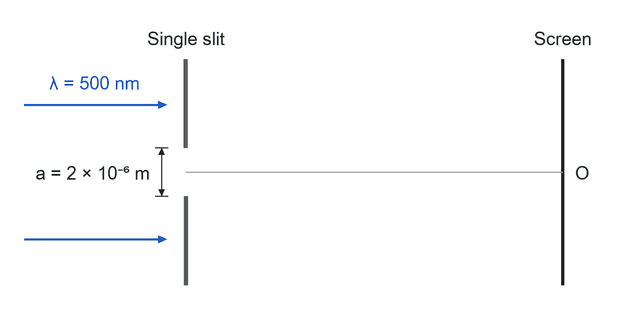
Calculate the half angular width of the central bright maximum in the Fraunhofer diffraction pattern of a slit of width when the slit is illuminated by a monochromatic light of wavelength .
- 483 marks
Question 48
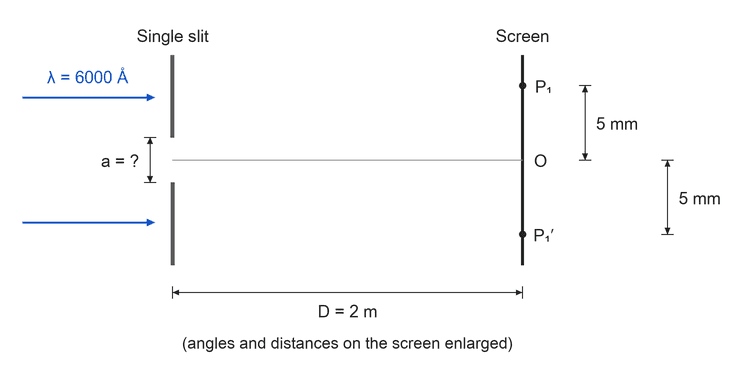
A screen is placed away from a narrow slit which is illuminated with light of wavelength . If the first minimum lies on either side of the central maximum, calculate the slit width.
- 493 marks
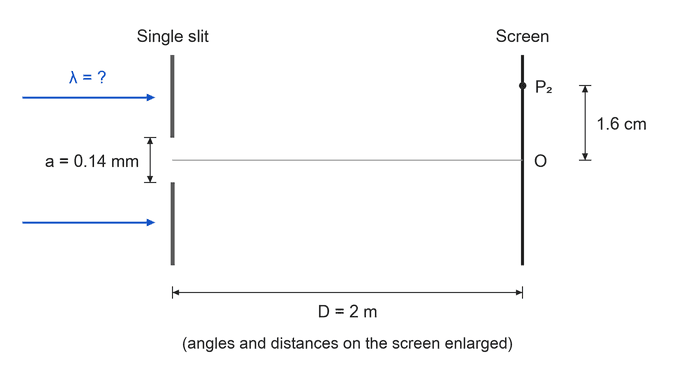
Question 49
A single slit of width is illuminated normally by monochromatic light and diffraction bands are observed on a screen away. If the centre of the second dark band is from the middle of the central bright band, deduce the wavelength of light used.
- 503 marks
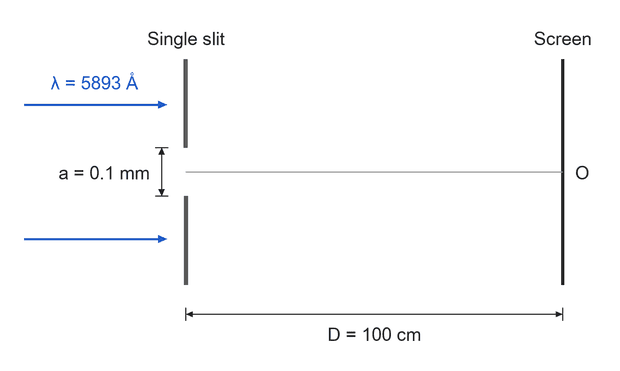
Question 50
In Fraunhofer diffraction pattern due to a single slit the screen is at a distance of from the slit and the slit is illuminated by monochromatic light of wavelength . The width of the slit is . Calculate the separation between the central maximum and the first secondary minimum.
- 513 marks
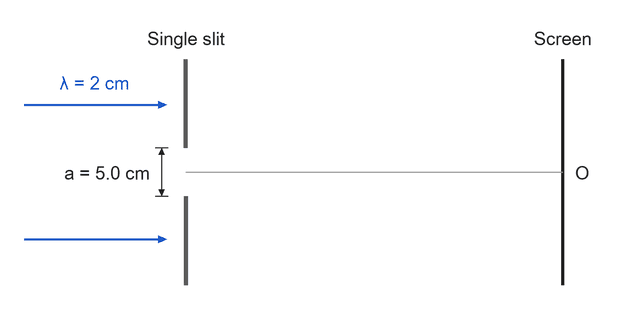
Question 51
Microwaves of wavelength are incident normally on a slit wide. Deduce the angular spread of the central maximum.
What Class 12 Physics Ch 21 covers
The sections of the chapter, in the order the book takes them. Every question above comes from one of these.
- 01Meaning of Diffraction
- 02Fraunhofer Diffraction at a Single Slit
- 03Intensity Distribution and Width of the Central Maximum
- 04Effect of Slit Width
- 05Interference and Diffraction Compared
More ways to study this chapter
The same chapter asked three other ways. Practise it, revise it, and see what the board has set on Ch 21 before.
- Competency-Based Questions (CBQ)Case study questions: a situation, and the part of the chapter that answers it.40questionsOpen
- Previous Year QuestionsQuestions that have actually appeared in board papers, each tagged with its year.8questionsOpen
- Practice QuestionsExtra questions per chapter, for when one attempt at a method is not enough.93questionsOpen
Ch 21 in past ISC papers
The same chapter as the board has actually asked it. These are worded differently from the textbook exercise, which is the point of reading them.
- 11 mark
Board paper question 1
State any one difference between interference of light and diffraction of light.
Solve with AIWritten solution
Solution:
Key idea: Both interference and diffraction come from the superposition of light waves. They differ in where the superposing waves come from.
Step 1 — Say where the waves come from in interference.
In interference, the waves that superpose come from two separate coherent sources (for example the two slits of Young's experiment).
Step 2 — Say where the waves come from in diffraction.
In diffraction, the waves that superpose are secondary wavelets from different points of the same wavefront (for example from different parts of a single slit).
Step 3 — Note what this does to the fringes.
Because of this, interference fringes all have the same intensity and (for small angles) the same width, while in a diffraction pattern the central band is the brightest and widest and the other bands are narrower and quickly become fainter.
Therefore, one difference: interference is the superposition of waves from two coherent sources, whereas diffraction is the superposition of secondary wavelets from different parts of the same wavefront (so interference fringes are equally bright, while diffraction bands fade away from the bright central band).
- 22 marks
Board paper question 2
Show graphically the intensity distribution in Fraunhofer's single slit diffraction experiment. Label the axes.
Solve with AIWritten solution
Solution:
Key idea: In Fraunhofer diffraction at a single slit of width , light of wavelength gives a minimum (zero intensity) wherever , with , and a bright central maximum at .
Step 1 — Choose the axes.
We plot the intensity of the diffracted light on the vertical axis against the angle of diffraction on the horizontal axis, with (the straight-through direction) at the centre.
Step 2 — Describe the shape of the curve.
The intensity is greatest at the centre (), where all the secondary wavelets from the slit arrive in phase. It falls to zero at the first minima, where ( is the slit width and the wavelength). Beyond them come weak secondary maxima separated by further zeros at The central maximum is twice as wide as each secondary maximum, and the secondary maxima are much fainter (the first ones have only about of the central intensity) and grow fainter still away from the centre.

For small angles , so the ticks on the angle axis are marked .
Therefore, the graph shows a tall central maximum I₀ at θ = 0, zero intensity at a sin θ = ±λ, ±2λ, ±3λ, … and much weaker secondary maxima in between, with intensity I on the vertical axis and angle θ on the horizontal axis.
- 32 marks
Board paper question 3
Monochromatic light of wavelength falls normally on a slit of width and the resulting Fraunhofer diffraction is obtained on a screen. Find the angular width of the central maxima.
Solve with AIWritten solution
Solution:
Key idea: In single-slit Fraunhofer diffraction the first minimum on each side of the centre is at an angle given by , where is the slit width and the wavelength. The angular width of the central maximum is the angle between these two minima, .
Step 1 — Write the data in SI units.
We convert the wavelength from nanometres and the slit width from centimetres to metres.
Step 2 — Find the angle of the first minimum.
We rearrange for and substitute.
Step 3 — Find the angular width of the central maximum.
The central maximum stretches from the first minimum on one side to the first minimum on the other side.
In radians this is .
Watch out: The slit is only twice as wide as the wavelength, so the angle is large. The small-angle result would give (), which is not accurate here; we must use exactly.
Therefore, the angular width of the central maximum is 60° (π/3 rad, about 1.05 rad).
- 42 marks
Board paper question 4
(i) What is meant by diffraction of light ?
(ii) In Fraunhofer diffraction, what kind of source of light is used and where is it situated?
Solve with AIWritten solution
Solution:
Key idea: Diffraction is the spreading of light as it passes an obstacle or an opening. Fraunhofer diffraction is the special case in which both the light falling on the slit and the light reaching the screen are parallel beams (plane wavefronts).
Step 1 — Part (i): define diffraction.
When light meets an obstacle or an aperture whose size is comparable to its wavelength, it bends round the edges and spreads into the region of the geometrical shadow. This bending and spreading of light, which produces a pattern of bright and dark bands, is called diffraction of light.
Step 2 — Part (ii): name the kind of source.
A monochromatic point source, or a narrow illuminated slit (a line source parallel to the diffracting slit), is used.
Step 3 — Part (ii): say where it is placed.
The source is effectively at an infinite distance from the slit. In practice it is placed at the principal focus of a convex lens, so that a parallel beam (a plane wavefront) falls on the slit. The diffracted parallel beams are then brought together on a screen placed in the focal plane of a second convex lens.
Therefore, (i) diffraction is the bending of light round the edges of an obstacle or aperture (of size comparable to its wavelength) into the region of its geometrical shadow; (ii) a monochromatic point (or narrow slit) source is used, placed at the focus of a convex lens so that it is effectively at infinity and sends a plane wavefront to the slit.
- 51 mark
Board paper question 5
In a single slit Fraunhofer diffraction experiment, how does the angular width of central maximum change when the slit width is increased?
Solve with AIWritten solution
Solution:
Key idea: For a slit of width and light of wavelength , the angular width of the central maximum is (for small angles), so it is inversely proportional to the slit width.
Step 1 — Read the formula.
With the wavelength unchanged, the angular width varies as .
Step 2 — Apply the change.
Increasing the slit width makes smaller, so the central maximum becomes narrower (for example, doubling halves the angular width).
Therefore, the angular width of the central maximum decreases when the slit width is increased.
- 62 marks
Board paper question 6
Draw a labelled graph showing the variation in intensity of diffracted light with diffracting angle in a single slit Fraunhofer diffraction experiment.
Solve with AIWritten solution
Solution:
Key idea: In single-slit Fraunhofer diffraction with a slit of width and light of wavelength , the minima lie at the angles where is a whole number of wavelengths (other than zero).
Between the minima lie a bright central maximum and much weaker secondary maxima.
Step 1 — Choose the axes.
We plot the intensity of the diffracted light on the vertical axis against the diffracting angle on the horizontal axis, with at the centre of the pattern.
Step 2 — Draw and label the curve.
The intensity is greatest at the centre (), where all the secondary wavelets from the slit arrive in phase. It falls to zero at the first minima, where ( is the slit width and the wavelength). Beyond them come weak secondary maxima separated by further zeros at The central maximum is twice as wide as each secondary maximum, and the secondary maxima are much fainter (the first ones have only about of the central intensity) and grow fainter still away from the centre.
For small angles , so the ticks on the angle axis are marked .
Therefore, the labelled graph has a tall central maximum I₀ at θ = 0, zero intensity at θ ≈ ±λ/a, ±2λ/a, ±3λ/a and weak secondary maxima that fade away from the centre.
All 8 board paper questions for this chapter, solved the same way.
Class 12 Physics Ch 21 questions students ask
How many questions are there in Class 12 Physics Ch 21?
51 questions. Every one is solved step by step on this page.
Are these Class 12 Physics solutions free?
Yes. Every question and its full working is free to read, with no account needed.
Can I download the Class 12 Physics Ch 21 solutions as a PDF?
There is no PDF to download. Every solution is on this page instead, which means it is searchable, always the current syllabus, and readable on a phone. Use your browser's print option if you want it on paper.