
Question 423 marksMedium
Explain Fraunhofer diffraction of light at a single slit.
Confirming your payment
Sign up now and get 250 free tokens.
Diffraction of Light · Question 42 of 51
Explain Fraunhofer diffraction of light at a single slit.
Solution:
Concept: In Fraunhofer diffraction the source and the screen are effectively at infinite distance from the slit: lenses make the incident light parallel and bring the parallel diffracted light to a focus.
Step 1 — Describe the experimental set-up. A point source S of monochromatic light is placed at the focus of a convex lens , so a plane wavefront falls normally on a narrow slit. The light diffracted by the slit is collected by a second convex lens , and the screen is placed in its focal plane. Parallel rays leaving the slit straight ahead meet at P; parallel rays leaving at an angle meet at another point P′.
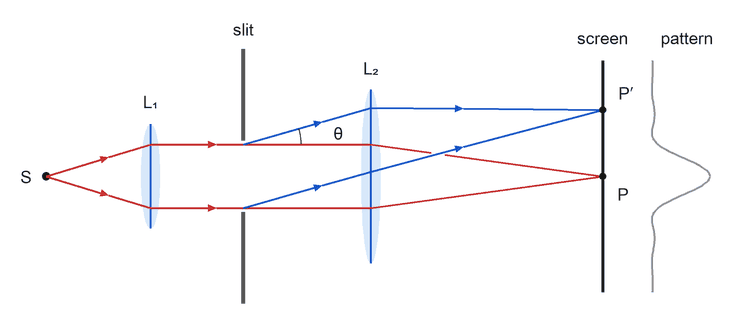
Step 2 — Explain the central maximum. All points of the slit are on one wavefront, so their secondary wavelets start in phase. In the straight-ahead direction the path difference between any two of them is zero, so they reinforce at P and give the bright central maximum.
Step 3 — Explain the minima. In a direction the path difference between the waves from the two edges of the slit (width ) is . When it is , the two halves of the slit cancel each other in pairs; when it is , the four quarters cancel in pairs, and so on:
Step 4 — Explain the secondary maxima. Between the minima, roughly where , the slit can be divided into an odd number of strips. All but one strip cancel in pairs, so these secondary maxima are weak, and they get weaker as increases.
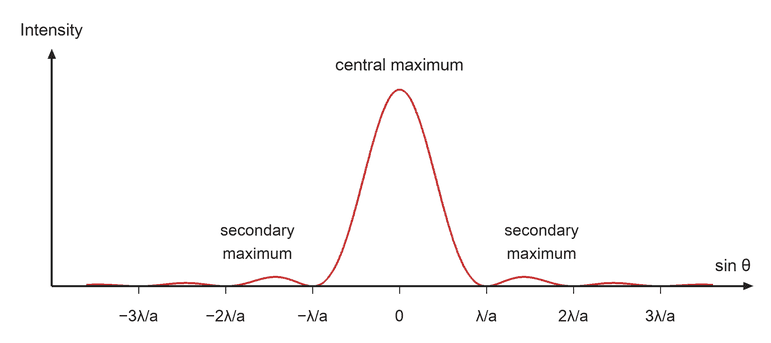
Therefore, Fraunhofer diffraction at a single slit gives a bright central maximum at , minima at , and weaker secondary maxima in between; the central maximum has angular width .