
Question 433 marksMedium
Obtain the relation, for the first minimum of the diffraction pattern of a single slit of width ‘’ using light of wavelength .
Confirming your payment
Sign up now and get 250 free tokens.
Diffraction of Light · Question 43 of 51
Obtain the relation, for the first minimum of the diffraction pattern of a single slit of width ‘’ using light of wavelength .
Solution:
Concept: A direction is dark when the wavelets from the slit cancel in pairs. Pairing each point of the upper half of the slit with the point a distance below it covers the whole slit.
Step 1 — Set up the geometry. A plane wavefront falls normally on the slit AB of width , centre C. Consider the wavelets diffracted at angle and draw AE perpendicular to them. The figure shows the path differences BE and CD.
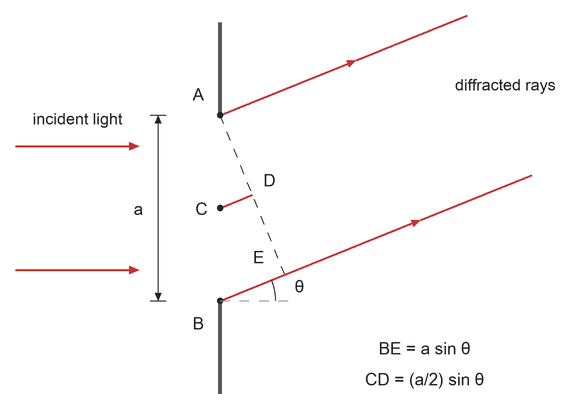
Step 2 — Write the path differences. Beyond the line AE all the diffracted rays travel equal optical paths to their meeting point on the screen, because a lens adds no path difference between parallel rays. So, compared with the ray from A, the ray from B travels the extra distance BE and the ray from C the extra distance CD. In the right-angled triangles ABE and ACD the angle at A is , which gives the two extra paths:
Step 3 — Apply the condition for cancellation. The waves from A and C differ in path by CD. If CD is half a wavelength, they arrive in opposite phase and cancel. The same is true for every pair of points a distance apart (the second point of the upper half with the second point of the lower half, and so on), so the whole upper half cancels the whole lower half:
Step 4 — Simplify. We multiply both sides by 2:
So the path difference BE between the edge rays is one whole wavelength at the first minimum.
Therefore, at the first minimum : the path difference between the waves from the two edges of the slit is one wavelength, so the two halves of the slit cancel each other.