
Opening your dashboard
Class 12 Physics Chapter 21 Diffraction of Light: Competency-Based Questions (CBQ)
40 questions on Chapter 21, each worked through on its own page with the AI tutor. Class 12 Physics, ICSE 2026-27.
40 questions
1–5 marks · Mixed difficulty
- 13 marks
Question 1
Competency: Application
A band is practising in a music room whose door is open. The doorway is wide. A listener L stands in the hall outside, several metres from the doorway, in a direction from the straight-through direction, as shown. Take the speed of sound as . Treat the doorway as a single slit for sound, ignore sound reflected from the walls, and take the sound beyond the first minimum () to be weak. (Hypothetical data.)

(a) Find the wavelength of a bass note, and explain why this note spreads into the whole hall.
(b) Find the angle of the first minimum (the half angular width of the central maximum) for a treble note, and decide whether L hears this note strongly.
(c) Find the widest opening for which the central maximum of the note would just reach L. Explain why a wider doorway would not help L to hear the treble notes.
- 21 mark
Question 2
Competency: Analysis & Evaluation
Many bats find flying insects in the dark by echolocation: they send out short calls and listen for the echoes. Take the speed of sound in air as .
Assertion (A): To detect small insects, bats use calls of very high frequency, mostly well above (ultrasound).
Reason (R): A wave meeting an object much smaller than its wavelength bends round the object and sends back very little as an echo.
- 31 mark
Question 3
Competency: Application
Scientists find how the atoms are arranged in a crystal, and in large molecules such as proteins, by sending a beam of X-rays (wavelength about ) through a small crystal and recording the pattern of spots made by the diffracted X-rays. Neighbouring atoms in a crystal are about – apart.
Why are X-rays used for this, and not visible light (wavelength –)?
- 43 marks
Question 4
Competency: Application
A small town T lies in a valley behind a range of steep ridges. The only gap in the ridges facing the distant radio transmitters is wide, and T is in a direction from the straight-through direction of the gap, as shown. The radio waves arrive at the gap as plane waves. Model the gap as a single slit, take the waves beyond the first minimum () to be weak, and take . (In reality, medium waves also travel along the ground and are reflected by hills; use only the single-slit model here.) (Hypothetical data.)
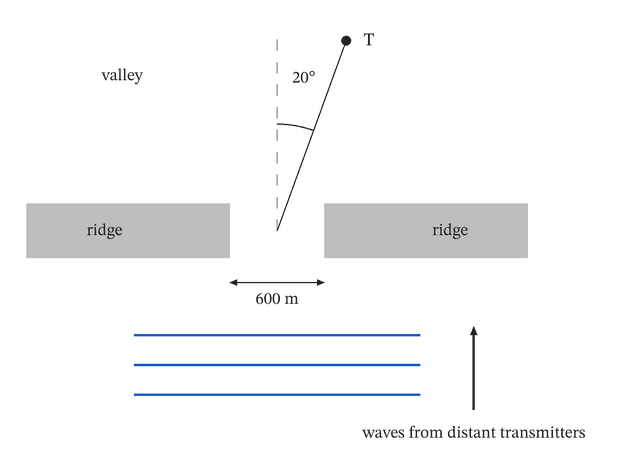
(a) An AM (medium-wave) station broadcasts at . Find the wavelength and the half angular width of its central maximum beyond the gap. Is T inside this central maximum?
(b) An FM station broadcasts at . Find for it, and say whether T receives this station well.
(c) Find the frequency of an AM station whose first minimum would fall exactly on T. Is this frequency inside the medium-wave band, about –?
- 51 mark
Question 5
Competency: Analysis & Evaluation
On a night with thin cloud, a small coloured ring (a corona) of angular radius about is seen close round the Moon. On another night, with high, thin cloud made of ice crystals, a much larger and paler ring (a halo) of radius appears.
Which statement about these two rings is correct?
- 63 marks
Question 6
Competency: Application
A student measures the thickness of a hair. The student stretches the hair across the beam of a red laser () and looks at the diffraction pattern on a screen away, as shown. A hair gives the same dark bands as a slit of the same width, so the slit condition may be used, and all the angles are small. On one side of the centre, the student measures the nd dark band at and the th dark band at from the centre of the pattern. (Hypothetical data.)
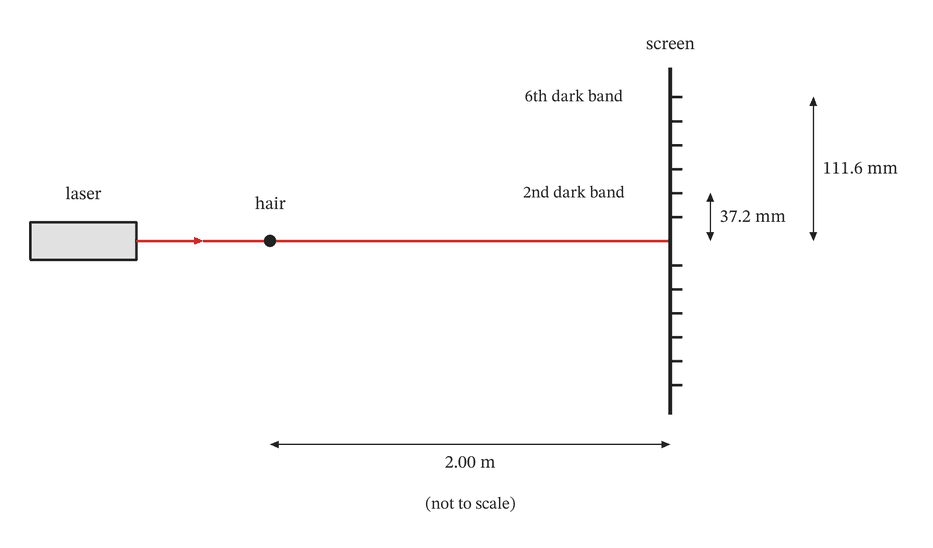
(a) Find the spacing between neighbouring dark bands, and hence the thickness of the hair.
(b) A second hair, measured in the same way, gives dark bands apart. Is it thicker or thinner than the first, and how thick is it?
(c) Give two reasons why using the nd and th dark bands gives a more reliable result than measuring the width of the central bright band.
- 71 mark
Question 7
Competency: Analysis & Evaluation
A wide parallel beam of laser light falls normally on a long, narrow slit, lighting the whole of it, and the Fraunhofer pattern is seen on a distant screen.
Assertion (A): If the slit is made longer, with its width unchanged, the dark bands across the pattern stay in the same places.
Reason (R): The two short ends of a slit do not diffract light at all; only its two long edges do.
- 81 mark
Question 8
Competency: Analysis & Evaluation
In a Fraunhofer single-slit experiment, a parallel laser beam passes through a narrow slit, and a lens of focal length forms the pattern on a screen in its focal plane. At first the beam falls normally on the slit, and the centre of the pattern is at the focus F of . The laser is then turned so that the beam meets the slit at to the axis, in the plane at right angles to the length of the slit, as shown. Nothing else is moved.
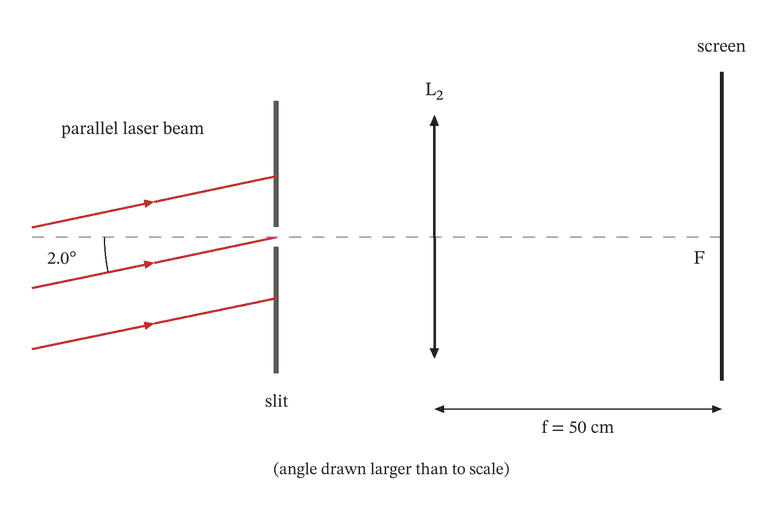
What happens to the central maximum of the pattern?
- 93 marks
Question 9
Competency: Application
A cement works checks how fine its powder is with a laser particle sizer. A parallel beam from a helium–neon laser () passes through a thin glass cell in which grains of the powder drift, and a lens of focal length focuses the light onto ring-shaped detectors in its focal plane, as shown. In a simple model, each grain spreads the light like a slit of the same width : its first dark ring is in the direction with , at a distance from the centre of the detectors. (For round grains the exact factor is a little larger, ; use the simple model.) (Hypothetical data.)
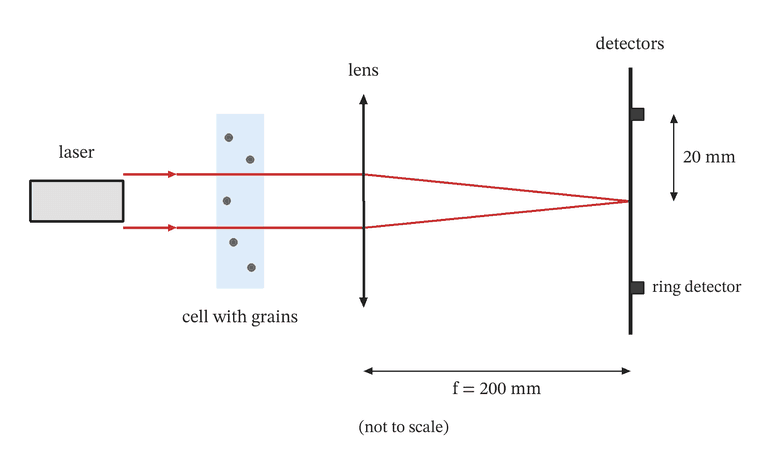
(a) Find the radius of the first dark ring produced by grains across.
(b) A ring detector is from the centre. For grains of what size does the first dark ring fall on this detector?
(c) Real powder contains grains of many sizes. Explain why no sharp dark rings are then seen, and why the light reaching the outer detectors comes mainly from the finest grains.
- 101 mark
Question 10
Competency: Analysis & Evaluation
A laser gives a narrow, nearly parallel beam, so plane wavefronts fall on a slit wide. The diffraction pattern is seen on a wall beyond the slit, and no lens is used. The laser light has a wavelength of .
Assertion (A): The pattern on the wall is very nearly a Fraunhofer pattern, even though no lens is used after the slit.
Reason (R): The Fresnel distance of the slit, , is only about , far less than the distance to the wall.
- 114 marks
Question 11
Competency: Analysis & Evaluation
A student uses a red LED instead of a laser for a single-slit experiment. The LED is at the focus of a lens, so a parallel beam falls normally on a slit wide, and the pattern is seen on a screen away, as shown. The LED does not give a single wavelength: its light is spread over wavelengths from to . Each wavelength makes its own pattern, with its th dark band at from the centre (small angles). (Hypothetical data.)
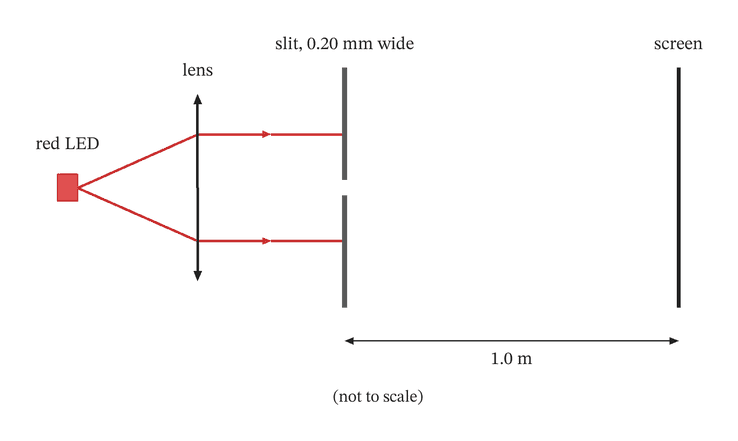
(a) For the rd dark band on one side, find its distance from the centre for and for , and so the width of the region over which this dark band is smeared.
(b) Find the spacing between neighbouring dark bands for the middle wavelength, .
(c) A dark band can no longer be seen once its smear is about half the spacing between dark bands. Find the order at which this happens. Explain why a laser, whose light is spread over far less than , shows every dark band sharply.
- 123 marks
Question 12
Competency: Application
The astronauts of Apollo 11, 14 and 15 left panels of corner-cube reflectors on the Moon, and observatories still time laser pulses that bounce back from them to measure the distance to the Moon. A station sends green laser pulses () out through a telescope whose opening is wide. The Moon is away. In a single-slit model, the beam leaving the opening spreads like the light from a slit of width , and the width of its central maximum is measured between the first minima. Ignore the effect of the air. (Hypothetical data.)

(a) Find the half angular width and the angular width of the central maximum.
(b) Find the width of the central maximum on the Moon.
(c) The Apollo 11 reflector panel is about square. If the light were spread evenly over a square patch of side , what fraction of it would fall on the panel? Comment on your answer.
- 131 mark
Question 13
Competency: Analysis & Evaluation
A student uses a light meter to explore the Fraunhofer pattern of a single slit of width , lit normally by light of wavelength . Its first minima are in the directions , and the student now looks at the region between the centre and a first minimum.
Assertion (A): In the direction where , halfway (in ) between the centre and the first minimum, the intensity is zero.
Reason (R): In this direction, the waves from the two edges of the slit differ in path by exactly .
- 141 mark
Question 14
Competency: Application
A red laser pointer () is aimed at a wall away. The beam leaves the pointer through an opening wide. (Hypothetical data.)
Using the single-slit model, with the central maximum taken between the first minima (angular width ), how wide is the central bright patch on the wall?
- 151 mark
Question 15
Competency: Analysis & Evaluation
The Fraunhofer pattern of a single slit lit by a laser is examined with a light meter.
Assertion (A): The centre of the pattern is much brighter than any other point of the pattern.
Reason (R): The central maximum is twice as wide as each of the secondary maxima.
- 161 mark
Question 16
Competency: Analysis & Evaluation
The lens panel of a lighthouse is wide and has a focal length of . The glowing part of its lamp, at the focus, is across. Ships find that the beam spreads through an angle of about . Take . (Hypothetical data.)
What mainly sets this spread of the beam?
- 174 marks
Question 17
Competency: Application
A photographer uses a lens of focal length and can set its aperture, the circular opening of diameter , to different f-numbers , as shown. Light from a distant point does not focus to a perfect point: diffraction at the circular aperture makes a small bright disc whose angular radius, out to the first dark ring, is . (This is the circular-opening form of for a slit.) The disc's diameter on the sensor is therefore about . Take . (Hypothetical data.)

(a) Find the aperture diameter and the diameter of the bright disc at and at .
(b) The sensor's pixels are apart, and diffraction starts to soften the picture once the disc is wider than about two pixels. Above what f-number does this happen?
(c) A phone camera has pixels apart and a fixed aperture of . Find the diameter of its bright disc and compare it with the pixel spacing. What does this suggest about making the phone's aperture smaller?
- 183 marks
Question 18
Competency: Analysis & Evaluation
In a small spectrometer, light enters through a narrow entrance slit of width and spreads out by diffraction towards a collimating mirror wide, placed from the slit with its centre on the axis, as shown. In this design the whole central maximum of the slit's diffraction pattern, out to the first minima (), should fall on the mirror; light that misses the mirror is lost. The spectrometer is used from to . (Hypothetical data.)

(a) Find the angle between the axis and the line from the slit to an edge of the mirror.
(b) For a slit wide, find at ; for a slit wide, find at . Does the central maximum fit on the mirror in each case?
(c) Which wavelength sets the limit on the slit width? Find the narrowest slit that meets the design rule over the whole range.
- 191 mark
Question 19
Competency: Analysis & Evaluation
Computer chips are made by shining light through a patterned mask onto a light-sensitive coating on a silicon wafer. The mask has very narrow openings, and each opening must print a sharp line on the coating.
Assertion (A): To print the smallest features on the most advanced chips, manufacturers now use extreme-ultraviolet light of wavelength in place of deep-ultraviolet light of wavelength .
Reason (R): Extreme-ultraviolet light is strongly absorbed by air, so the machines that use it must work in a vacuum.
- 203 marks
Question 20
Competency: Application
A ship's navigation radar sends out microwaves of wavelength from a long, narrow rotating antenna. In the horizontal plane the antenna acts like a slit whose width equals its length , so its beam has an angular width, between the first minima, of . Two buoys, side by side, are away and apart, as shown. The radar can show them as two separate objects only if its beam, at that range, is narrower than their separation. (Hypothetical data.)

(a) Find the angular width of the beam for an antenna long and for one long.
(b) Find the width of each beam at the buoys, and decide which antenna can show the buoys as separate objects.
(c) Some ships also carry a radar using waves, which pass through heavy rain better. How long would its antenna have to be to give the same angular width as the antenna on waves?
- 211 mark
Question 21
Competency: Analysis & Evaluation
The width of a single slit lit by monochromatic light is slowly increased, while the light and the screen are not changed.
Assertion (A): As the slit is widened, the secondary maxima move closer to the centre, but the central maximum keeps the same width.
Reason (R): The minima of a single-slit pattern are in the directions given by , with
- 221 mark
Question 22
Competency: Application
In bright sunlight the pupil of the eye narrows to about ; in dim light it opens to about . Treat the pupil as a slit and take , with the angular width of the central maximum (between the first minima) equal to .
How does this angular width change when the pupil narrows from its dim-light size to its bright-light size?
- 233 marks
Question 23
Competency: Application
The tracks of an optical disc are evenly spaced, very narrow lines, like the lines of a reflection grating. A student shines a red laser pointer () normally onto the shiny side of a disc, as shown, and sees a few bright spots on a large white card, with a small hole for the beam, held parallel to the disc. Each narrow track spreads the light widely by diffraction, and the waves from the many tracks interfere: they reinforce only in the directions , measured from the normal, for which with , where is the track spacing. The track spacing is on a CD, on a DVD and on a Blu-ray disc.
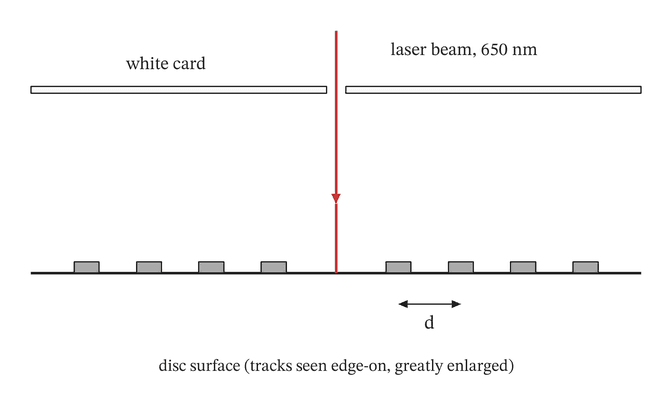
(a) Find the angle of the first-order () bright spot for a CD and for a DVD.
(b) How many bright spots does each of these two discs give in all, counting ? Why does a Blu-ray disc give no spot except with this laser?
(c) Explain the parts played by diffraction and by interference in forming these spots, and why the DVD's first-order spots lie farther from the normal than the CD's.
- 241 mark
Question 24
Competency: Analysis & Evaluation
Interference patterns and diffraction patterns both show bright bands between dark bands.
Assertion (A): In a single-slit diffraction pattern, the total light energy reaching the screen is the same as the energy passing through the slit, provided none is absorbed on the way.
Reason (R): The dark bands of a single-slit pattern are formed because the edges of the slit absorb the light that would have reached them.
- 251 mark
Question 25
Competency: Analysis & Evaluation
At night, a student looks at a distant street lamp through a fine net curtain. The threads of the net form a regular square mesh and are about apart, centre to centre. Around the lamp, the student sees a small square grid of fainter images of it, with coloured edges.
Which statement best explains the grid?
- 263 marks
Question 26
The graph shows how the intensity varies across a single-slit Fraunhofer pattern. Y and Z are the first and second secondary maxima on one side of the centre.
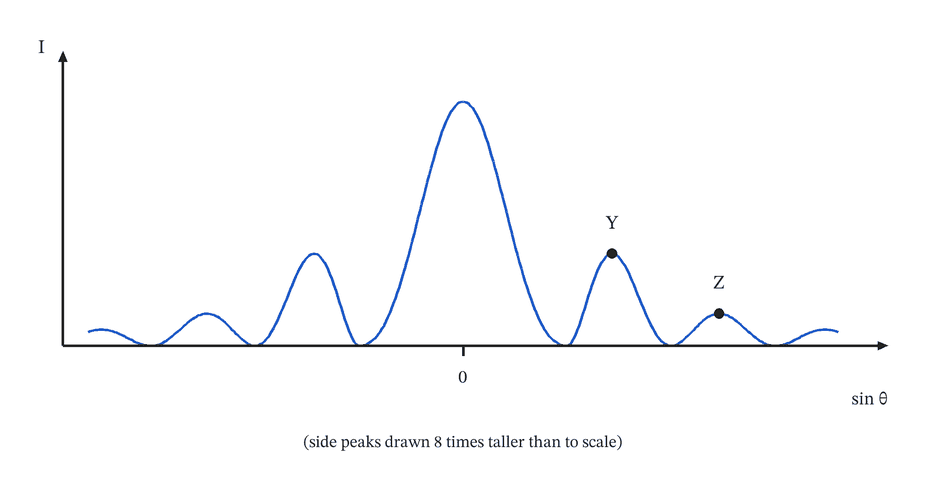
By the ISC rule, in the direction of Y the slit divides into three equal strips: two of them cancel each other, and the third is left over.
(i) If all the wavelets from the left-over strip arrived in phase, what fraction of the central intensity would Y have?
(ii) In fact the wavelets from one strip are spread over a phase difference of , so together they give only of the amplitude they would give in phase. Find the fraction now, as a percentage.
(iii) Repeat (ii) for Z, where the slit divides into five equal strips, and compare both results with the measured values, for Y and for Z.
- 273 marks
Question 27
Light of wavelength 5900 Å falls normally on a slit of width m. The resulting diffraction pattern is received on a screen. Calculate angular position of the first minimum. Also find the angular width of the central maximum.
- 283 marks
Question 28
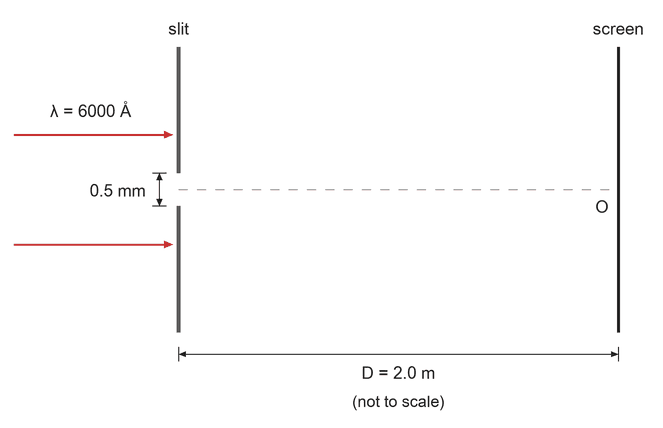
Light of wavelength 6000 Å from a distant source falls on a slit 0.5 mm wide. What is the distance between the two dark bands on each side of the central band of the diffraction pattern observed on a screen placed 2.0 m from the slit?
- 293 marks
Question 29
A slit of width ‘’ is illuminated by a light of wavelength 5500 Å. What will be the value of ‘’ when (a) the first minimum falls at an angle of diffraction of and (b) the first maximum falls at an angle of diffraction of ?
- 303 marks
Question 30
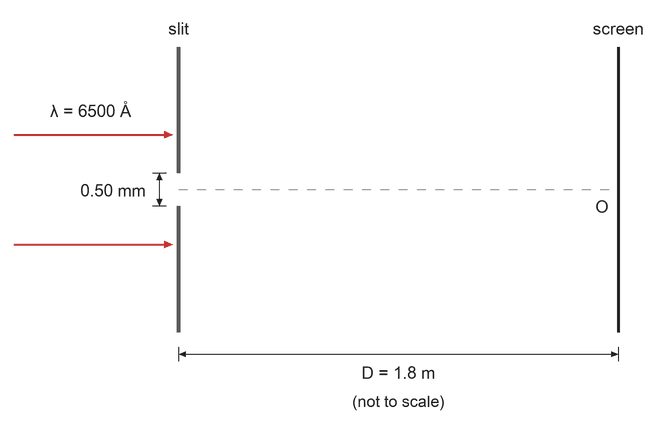
Red light of wavelength 6500 Å from a distant source falls in a slit 0.50 mm wide. What is the distance between the two dark bands on each side of the central bright band of the diffraction pattern observed on a screen placed 1.8 m from the slit?
- 313 marks
Question 31
Plane waves of cm, falls normally on straight slit of width 0.20 mm. Calculate the total angular width of the central maximum and also the linear width as observed on a screen placed 2 m away.

- 323 marks
Question 32
A lens whose focal length is 40 cm forms a Fraunhofer diffraction pattern of a slit 0.3 mm wide. Calculate the distance of the first dark band from the axis. Wavelength of light used is 5890 Å.

- 333 marks
Question 33
A single slit of width is illuminated normally with white light. Find the value of for which the first minimum of red light ( Å) falls at . Also calculate the wavelength of light whose first secondary maximum coincides with the first minimum of red light.
- 343 marks
Question 34
Plane waves of cm falls normally on a straight slit of width 0.20 mm. Calculate the angular width of the central maximum and also the linear width as observed on a screen placed 2 m away.

- 353 marks
Question 35
Angular width of central maximum in the Fraunhofer diffraction pattern of a slit is measured. The slit is illuminated by light of wavelength 6000 Å. When the slit is illuminated by light of another wavelength, the angular width decreases by 30%. Calculate the wavelength of this light. The same decrease in the angular width of central maximum is obtained, when the original apparatus is immersed in a liquid. Find the refractive index of the liquid.
- 363 marks
Question 36
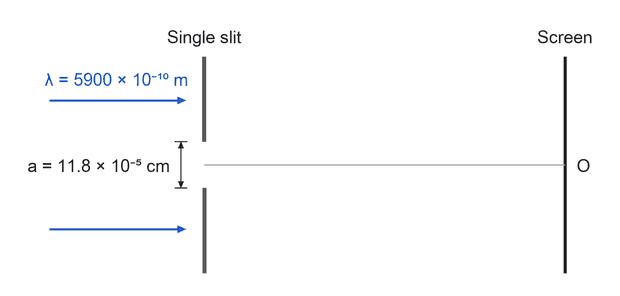
Light of wavelength falls normally on a slit of width and the resulting Fraunhofer diffraction is received on a screen. Calculate the angular position of the first minimum. Also find the angular width of the central maximum.
- 373 marks
Question 37
Obtain the relation for the first minimum of the diffraction pattern of a single slit of width ‘’ using light of wavelength .
- 381 mark
Question 38
Competency: Analysis & Evaluation
A parallel beam of monochromatic light of wavelength falls normally on a single slit of width , and a convex lens forms the Fraunhofer diffraction pattern on a screen in its focal plane. A student then covers the upper half of the slit, and only that half, with a very thin, clear plastic film. The film absorbs almost no light, but it delays the light passing through it by exactly half a period, just as if that light had travelled an extra path of .
What does the screen now show at the centre of the pattern (), and in the two directions where , which were the first minima before the film was added?
- 393 marks
Question 39
Competency: Analysis & Evaluation
In many reflecting telescopes a small secondary mirror is held in the middle of the tube by thin, flat metal strips called vanes, which stand edge-on in the path of the incoming parallel starlight. The figure shows the open ends of two such telescopes, P and Q, seen from the front. Each vane is a long, narrow obstacle that diffracts light like a slit of the same width: it spreads light out at right angles to its own length, on both sides, but not along its length. In photographs this spread light forms thin bright streaks, called diffraction spikes, through the image of every bright star. The vanes are thick, and the starlight may be taken to have a wavelength of . (Hypothetical data.)

(a) How many spikes does each star image show in telescope P, and in which directions? Explain.
(b) How many spikes does each star image show in telescope Q? Explain.
(c) An amateur astronomer says: “If the vanes of P are replaced by vanes only thick, the spikes will become much shorter.” For each vane thickness, find the angle from the star's image to the first dark band along a spike, and evaluate the claim.
- 405 marks
Question 40
Competency: Application
Meera studies how the diffraction pattern of a slit grows as the screen is moved away. On an optical bench fitted with a metre scale, she fixes a green laser () and an adjustable slit, and moves a white screen along the bench. At each position she records the scale reading of the screen and the width of the central bright band, measured between the first dark bands on either side of the centre. She forgets to note the scale reading of the slit holder. All the angles are small, so , where is the distance from the slit to the screen and is the slit width. (Hypothetical data.)
Scale reading of the screen, (m) 0.65 1.15 1.65 2.15 Width of the central band, (mm) 3.8 7.6 11.4 15.2 (a) Show from the table that is not proportional to , but that increases by the same amount for every the screen moves. Find the rate .
(b) Use this rate to find the slit width .
(c) Find the scale reading at which the slit stands. Meera's partner works out the slit width from the first row alone, as . Find the value the partner gets, and explain why it is wrong.