
Competency: Application
The tracks of an optical disc are evenly spaced, very narrow lines, like the lines of a reflection grating. A student shines a red laser pointer () normally onto the shiny side of a disc, as shown, and sees a few bright spots on a large white card, with a small hole for the beam, held parallel to the disc. Each narrow track spreads the light widely by diffraction, and the waves from the many tracks interfere: they reinforce only in the directions , measured from the normal, for which with , where is the track spacing. The track spacing is on a CD, on a DVD and on a Blu-ray disc.
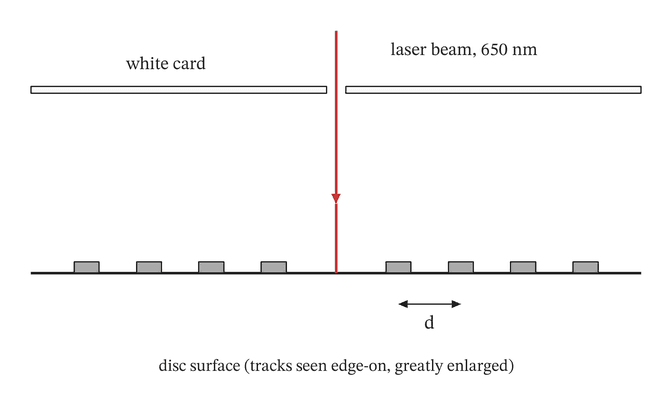
(a) Find the angle of the first-order () bright spot for a CD and for a DVD.
(b) How many bright spots does each of these two discs give in all, counting ? Why does a Blu-ray disc give no spot except with this laser?
(c) Explain the parts played by diffraction and by interference in forming these spots, and why the DVD's first-order spots lie farther from the normal than the CD's.