
Competency: Analysis & Evaluation
A student uses a red LED instead of a laser for a single-slit experiment. The LED is at the focus of a lens, so a parallel beam falls normally on a slit wide, and the pattern is seen on a screen away, as shown. The LED does not give a single wavelength: its light is spread over wavelengths from to . Each wavelength makes its own pattern, with its th dark band at from the centre (small angles). (Hypothetical data.)
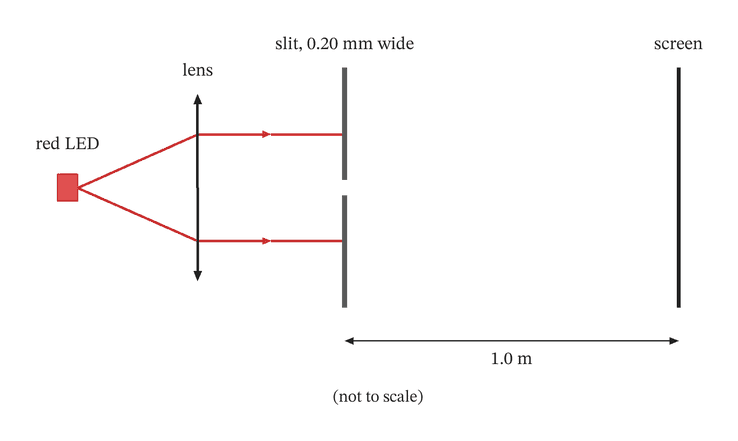
(a) For the rd dark band on one side, find its distance from the centre for and for , and so the width of the region over which this dark band is smeared.
(b) Find the spacing between neighbouring dark bands for the middle wavelength, .
(c) A dark band can no longer be seen once its smear is about half the spacing between dark bands. Find the order at which this happens. Explain why a laser, whose light is spread over far less than , shows every dark band sharply.