
Competency: Application
A cement works checks how fine its powder is with a laser particle sizer. A parallel beam from a helium–neon laser () passes through a thin glass cell in which grains of the powder drift, and a lens of focal length focuses the light onto ring-shaped detectors in its focal plane, as shown. In a simple model, each grain spreads the light like a slit of the same width : its first dark ring is in the direction with , at a distance from the centre of the detectors. (For round grains the exact factor is a little larger, ; use the simple model.) (Hypothetical data.)
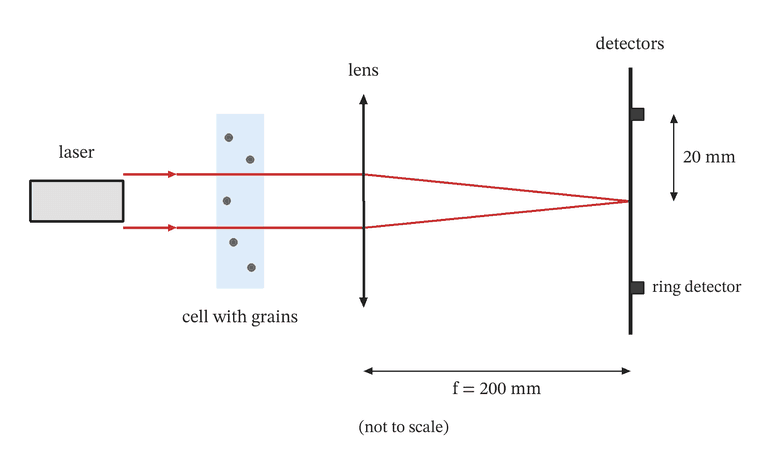
(a) Find the radius of the first dark ring produced by grains across.
(b) A ring detector is from the centre. For grains of what size does the first dark ring fall on this detector?
(c) Real powder contains grains of many sizes. Explain why no sharp dark rings are then seen, and why the light reaching the outer detectors comes mainly from the finest grains.