
Question 332 marksMedium
Explain the term secondary maxima with reference to the Fraunhofer diffraction at a single slit.
Confirming your payment
Sign up now and get 250 free tokens.
Diffraction of Light · Question 33 of 51
Explain the term secondary maxima with reference to the Fraunhofer diffraction at a single slit.
Solution:
Concept: Secondary maxima are the fainter bright bands that lie between successive minima on either side of the central maximum.
Step 1 — Divide the slit into three equal strips. Let the slit AB of width be divided into three equal strips AC, CD and DB. Consider the direction in which the path difference between the edge rays, , is ; then each strip has a path difference of across it.
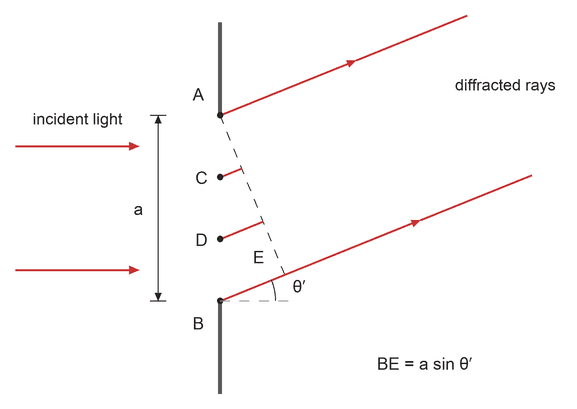
Step 2 — Cancel two of the strips. Wavelets from corresponding points of the neighbouring strips AC and CD differ in path by , so these two strips cancel each other. The third strip DB is left uncancelled and sends light in this direction. This gives the first secondary maximum:
Step 3 — Generalise. Dividing the slit into 5, 7, 9, … strips in the same way gives the 2nd, 3rd, 4th, … secondary maxima:
Only one strip out of 3, 5, 7, … is left uncancelled, so these maxima get rapidly weaker (about 4.7 %, 1.6 % and 0.8 % of the central intensity).
Watch out: The rule is the simple ISC rule for the secondary maxima. It places each one midway between two minima; the exact maxima lie slightly nearer the centre (the first at instead of ).
Therefore, secondary maxima are the weak bright bands between the minima, formed approximately where , where only one uncancelled strip of the slit contributes light, so their intensity falls off quickly.