
Question 322 marksMedium
In Fraunhofer diffraction at a single slit, what is the condition for getting the first secondary minimum? How will you explain its formation? Use appropriate diagrams.
Confirming your payment
Sign up now and get 250 free tokens.
Diffraction of Light · Question 32 of 51
In Fraunhofer diffraction at a single slit, what is the condition for getting the first secondary minimum? How will you explain its formation? Use appropriate diagrams.
Solution:
Concept: Divide the slit into two equal halves. If every wavelet from the upper half is cancelled by the matching wavelet from the lower half, the screen is dark in that direction.
Step 1 — Draw the slit and the diffracted rays. Let a plane wavefront fall normally on a slit AB of width with centre C. Consider the wavelets diffracted at an angle ; a lens focuses them at one point of the screen. Draw AE perpendicular to the diffracted rays.
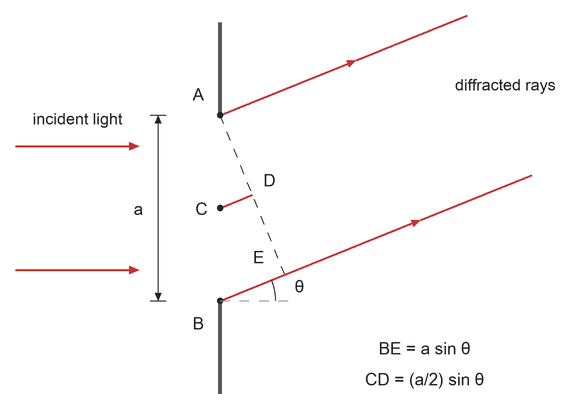
Step 2 — Find the path differences. Beyond the line AE all the diffracted rays travel equal optical paths to their meeting point on the screen, because a lens adds no path difference between parallel rays. So the path differences arise before AE: compared with the ray from A, the ray from B travels the extra distance BE and the ray from C travels the extra distance CD:
Step 3 — Pair the two halves. Take a point in the upper half AC and the point a distance below it in the lower half CB (for example A and C). Every such pair has the same path difference . If this equals , each pair arrives in opposite phase and cancels:
Step 4 — Conclude. Since the whole upper half is cancelled by the whole lower half, the intensity in this direction is zero: this is the first secondary minimum.
Therefore, the first secondary minimum occurs in the direction where (path difference between the edge rays equal to one wavelength), because the wavelets from the two halves of the slit then cancel in pairs.