
Question 513 marksMedium
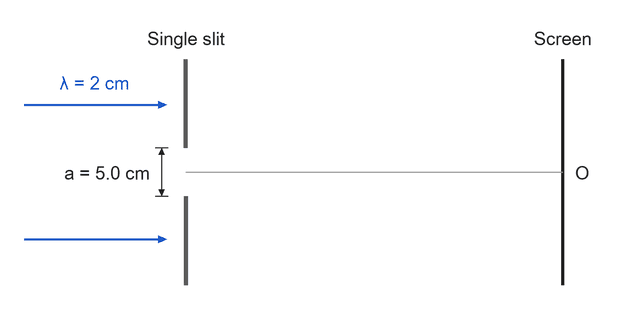
Microwaves of wavelength are incident normally on a slit wide. Deduce the angular spread of the central maximum.
Confirming your payment
Sign up now and get 250 free tokens.
Diffraction of Light · Question 51 of 51
Microwaves of wavelength are incident normally on a slit wide. Deduce the angular spread of the central maximum.
Solution:
Concept: When a plane wavefront falls normally on a single slit of width , the light spreads out (diffracts) beyond the slit. On a distant screen (or in the focal plane of a lens) there is a bright central maximum, with dark minima on either side at angles given by , where and is the wavelength. The central maximum stretches from the first minimum on one side () to the first minimum on the other, so its angular width is , with . Microwaves are electromagnetic waves too, so the same condition holds for them.
Given: Wavelength and slit width .
Step 1 — Find for the first minimum. Both lengths are in centimetres, so we may divide them directly:
Step 2 — Find the angle of the first minimum. We take the inverse sine. The angle is large, so we must not replace by :
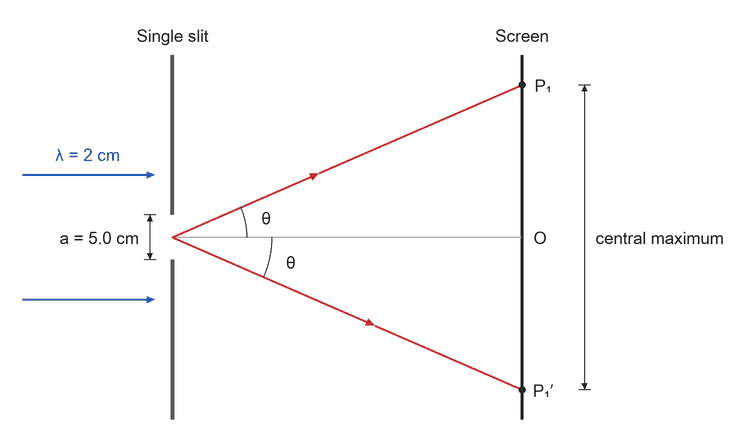
Step 3 — Find the angular spread of the central maximum. The central maximum spreads from to , so its angular spread is:
Watch out: The small-angle form would give , about ; here the slit is only 2.5 wavelengths wide, so the exact sine must be used.
Therefore, the angular spread of the central maximum is about 47.16°.