
Question 455 marksHard
What is diffraction? What are secondary wavelets? What is diffraction pattern? Explain the formation of the diffraction pattern in a Fraunhofer single-slit diffraction experiment.
Confirming your payment
Sign up now and get 250 free tokens.
Diffraction of Light · Question 45 of 51
What is diffraction? What are secondary wavelets? What is diffraction pattern? Explain the formation of the diffraction pattern in a Fraunhofer single-slit diffraction experiment.
Solution:
Concept: By Huygens' principle every point of a wavefront acts as a new source of waves, and the new wavefront is the forward envelope of these waves.
Step 1 — Define diffraction. Diffraction is the bending of light round the edges and corners of an obstacle or aperture, so that light spreads into the region of geometrical shadow.
Step 2 — Define secondary wavelets. Secondary wavelets are the spherical waves sent out, according to Huygens' principle, by every point of a wavefront; they travel forward with the speed of the wave.
Step 3 — Define the diffraction pattern. The diffraction pattern is the non-uniform distribution of light energy on the screen caused by diffraction. For a single slit it is a broad, intense central maximum with narrower, much fainter secondary maxima on both sides, separated by minima.
Step 4 — Describe the experiment. A point source S is placed at the focus of a convex lens , so a plane wavefront falls normally on a narrow slit of width . A second lens focuses the diffracted light on a screen in its focal plane.
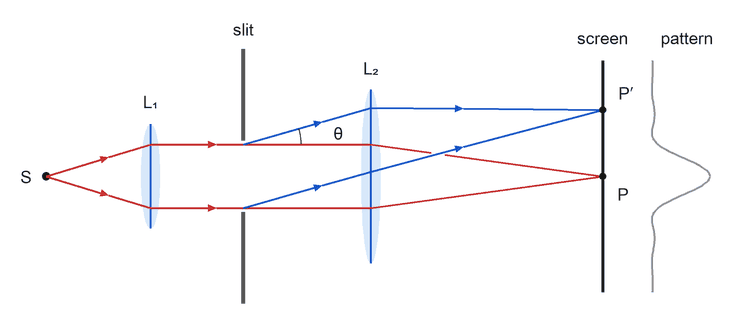
Step 5 — Explain the central maximum. All points of the slit lie on one wavefront, so their wavelets start in phase. Straight ahead () they all travel equal paths to P and reinforce, giving the bright central maximum.
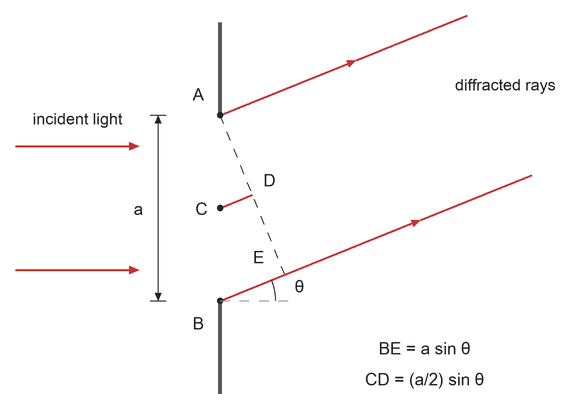
Step 6 — Explain the minima. In a direction the edge waves differ in path by . If this is , each point of the upper half of the slit can be paired with a point below it, with path difference , so the halves cancel. If it is , the four quarters cancel in pairs, and so on:
Step 7 — Explain the secondary maxima. If the edge path difference is , the slit splits into three strips; two cancel and one is left, giving a weak maximum. In general (approximately):
Only one strip out of 3, 5, 7, … is left over, so the secondary maxima are weak (about 4.7 %, 1.6 % and 0.8 % of the central intensity).
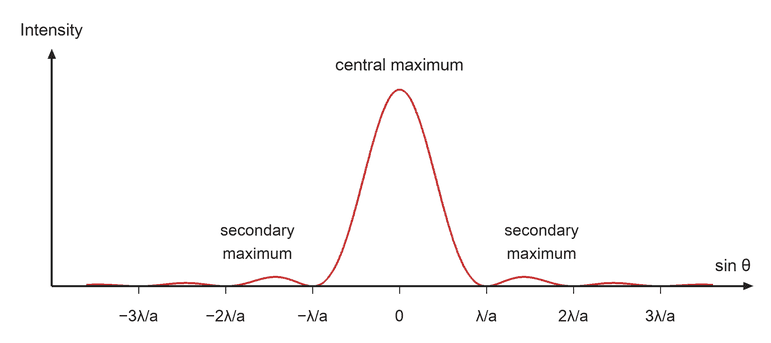
Therefore, diffraction is the bending of light into the geometrical shadow, secondary wavelets are Huygens' wavelets from each point of a wavefront, and the diffraction pattern is the resulting uneven light distribution; at a single slit the wavelets reinforce straight ahead (central maximum), cancel where (minima) and partly survive near (weak secondary maxima).