
Question 465 marksHard
Compare interference and diffraction. Explain the formation of central maximum, secondary maxima and minima in a Fraunhofer single-slit diffraction experiment. Derive the equations.
Confirming your payment
Sign up now and get 250 free tokens.
Diffraction of Light · Question 46 of 51
Compare interference and diffraction. Explain the formation of central maximum, secondary maxima and minima in a Fraunhofer single-slit diffraction experiment. Derive the equations.
Solution:
Concept: Interference and diffraction both come from the superposition of waves; in a single slit the superposing waves are the secondary wavelets from different points of the one wavefront in the slit.
Step 1 — Compare interference and diffraction. The table sets out the main differences.
| Interference | Diffraction (single slit) |
|---|---|
| Superposition of waves from two separate coherent sources | Superposition of secondary wavelets from different parts of the same wavefront |
| Bright fringes are all of (nearly) the same intensity | The central maximum is by far the brightest; the secondary maxima fade quickly |
| Fringes are usually of equal width | The central maximum is twice as wide as each secondary maximum |
| A large number of fringes is seen | Only a few bands are seen |
Step 2 — Describe the set-up. A plane wavefront from a point source at the focus of a lens falls normally on a slit AB of width (centre C). A second lens focuses the parallel diffracted light on a screen in its focal plane.
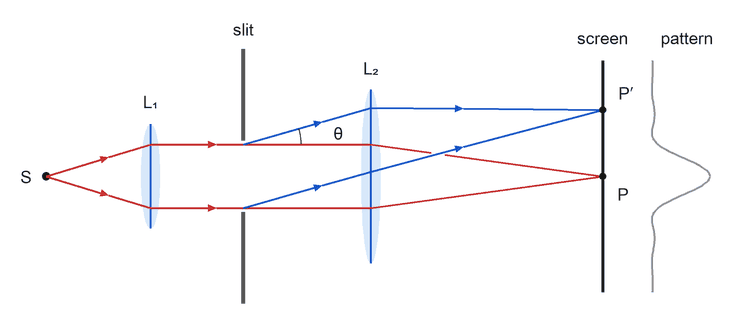
Step 3 — Derive the central maximum. The wavelets from all points of AB start in phase. For the path difference between any two of them is zero, so they reinforce at P: this is the central maximum, at
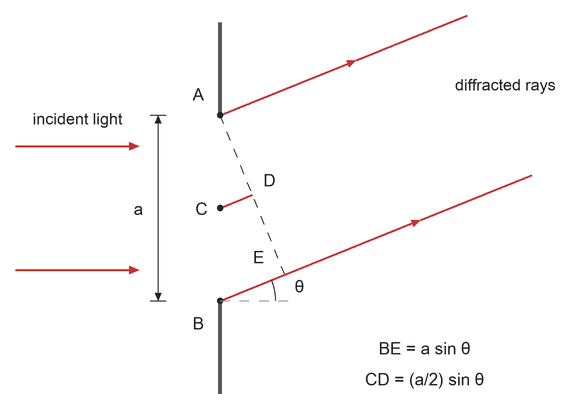
Step 4 — Derive the first minimum. For a direction , draw AE perpendicular to the diffracted rays. Beyond AE all the rays travel equal optical paths to P (the lens adds no path difference), so the ray from B travels the extra distance BE and the ray from C the extra distance CD. The edge path difference is . Pair each point of the upper half AC with the point below it in CB; each pair differs in path by . The halves cancel when this is :
Step 5 — Derive the other minima. Dividing the slit into 4, 6, …, equal parts, neighbouring parts cancel in pairs when the path difference across each part is :
Step 6 — Derive the secondary maxima. Divide the slit into 3 equal strips with path difference across each strip. Two neighbouring strips cancel and the third remains, giving the first secondary maximum; 5, 7, … strips give the next ones:
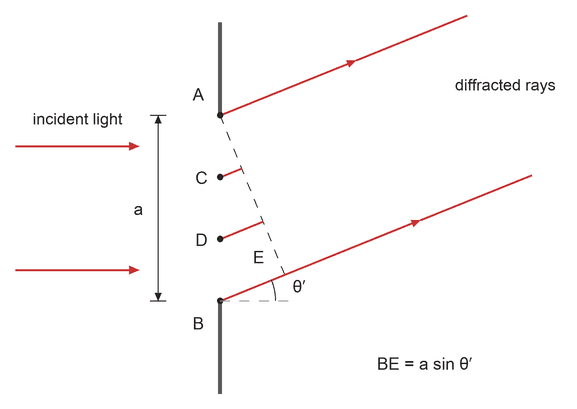
Only one strip in 3, 5, 7, … contributes, so the secondary maxima are much weaker than the central one and get weaker still with .
Watch out: The rule is the simple ISC rule for the secondary maxima. It places each one midway between two minima; the exact maxima lie slightly nearer the centre (the first at instead of ).
Step 7 — Write the small-angle results. For small angles :
The last result is the angular width of the central maximum.
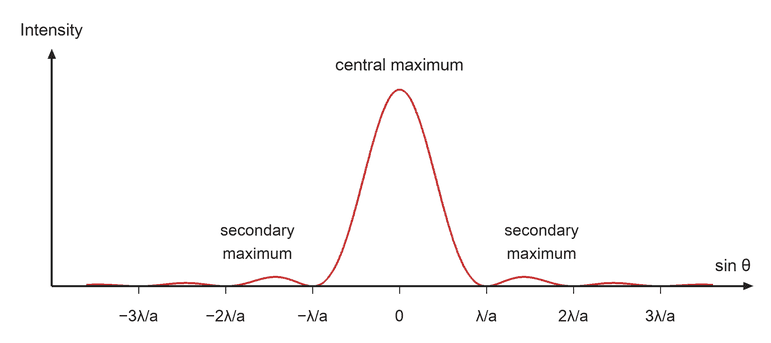
Therefore, the central maximum is at , the minima are at , the secondary maxima are approximately at , and the central maximum has angular width ; unlike interference fringes, the diffraction bands are unequal in width and fall off rapidly in intensity.