
Question 473 marksEasy
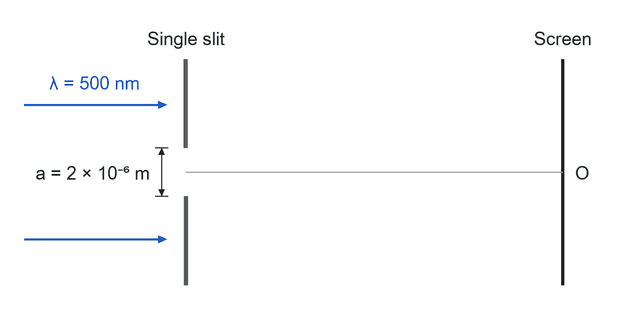
Calculate the half angular width of the central bright maximum in the Fraunhofer diffraction pattern of a slit of width when the slit is illuminated by a monochromatic light of wavelength .
Confirming your payment
Sign up now and get 250 free tokens.
Diffraction of Light · Question 47 of 51
Calculate the half angular width of the central bright maximum in the Fraunhofer diffraction pattern of a slit of width when the slit is illuminated by a monochromatic light of wavelength .
Solution:
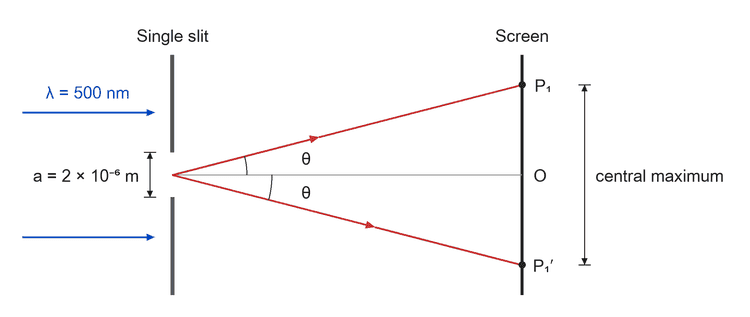
Concept: When a plane wavefront falls normally on a single slit of width , the light spreads out (diffracts) beyond the slit. On a distant screen (or in the focal plane of a lens) there is a bright central maximum, with dark minima on either side at angles given by , where and is the wavelength. The central maximum stretches from the first minimum on one side () to the first minimum on the other, so its angular width is , with . The half angular width is itself, the angle from the centre of the pattern to the first minimum.
Given: Slit width and wavelength .
Step 1 — Write the wavelength in metres. One nanometre is :
Step 2 — Find for the first minimum. The first minimum has , so we divide by :
Step 3 — Find the half angular width. We take the inverse sine:
Note: The book prints , which is the exact angle cut short (truncated) to two decimal places. Correctly rounded, the angle is .
Therefore, the half angular width of the central maximum is about 14.48°.