
Opening your dashboard
Class 12 Physics Chapter 21 Diffraction of Light: Practice Questions
93 questions on Chapter 21, each worked through on its own page with the AI tutor. Class 12 Physics, ICSE 2026-27.
93 questions
1–4 marks · Mixed difficulty
- 11 mark
Question 1
Which of the following observations is an example of the diffraction of light?
- 21 mark
Question 2
(Hypothetical data.) In which of these cases will diffraction be most marked, that is, will the wave spread out through the largest angle after passing the opening?
- 33 marks
Question 3
(Hypothetical data.) In a ripple tank, straight water waves of wavelength travel towards a barrier. The barrier has (a) a gap wide, and then (b) a gap wide, as shown.
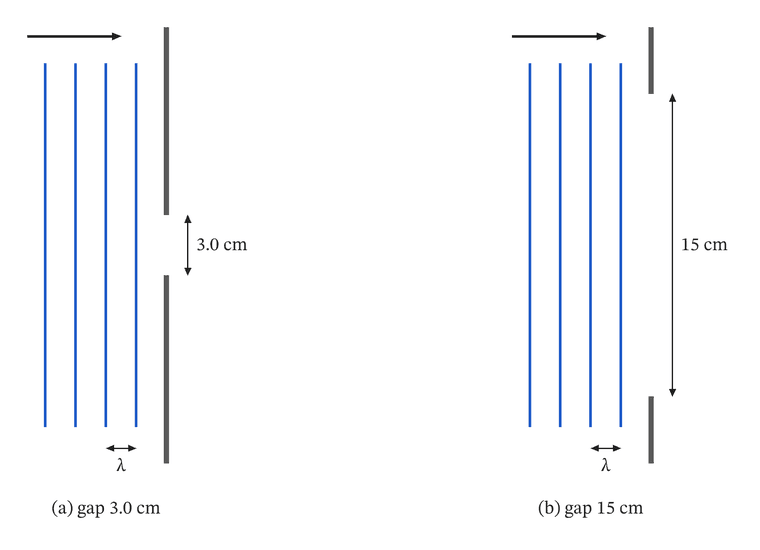
Take the edges of the waves that spread out beyond a gap of width to lie along the directions of the first minima, .
(i) Find for each gap.
(ii) For each gap, state whether the waves beyond it spread out widely or travel on mostly as a straight-sided beam.
(iii) The wavelength is now increased to . Find for the gap.
- 41 mark
Question 4
A plane wavefront of light reaches an opening many hundreds of wavelengths wide. According to Huygens' principle, the new wavefront just beyond the opening is plane over most of its width and curved only near the edges. This is because
- 52 marks
Question 5
A laser beam falls on the straight edge E of a razor blade, and a screen is placed beyond it, as shown.

Some light is found inside the geometrical shadow on the screen, and it becomes fainter and fainter farther into the shadow.
(i) Use Huygens' principle to explain why light reaches the geometrical shadow.
(ii) Why does the light fade farther into the shadow?
- 63 marks
Question 6
(Hypothetical data.) Diffraction is classed as Fresnel diffraction or Fraunhofer diffraction. Classify each arrangement below, giving a reason.
(i) A small torch bulb from a coin throws a shadow of the coin on a wall behind it.
(ii) Light from a sodium lamp is made parallel by a convex lens, passes through a narrow slit, and is focused by a second convex lens onto a screen in its focal plane.
(iii) A red laser beam of wavelength passes through a slit wide and falls on a screen only behind the slit.
(iv) Light from a distant star passes through the circular objective of a telescope and is brought to a focus in its focal plane.
- 71 mark
Question 7
A student sees clear diffraction fringes at the edge of the shadow of a razor blade when it is lit by a laser pointer. When the laser is replaced by a frosted filament bulb at the same distance, no fringes can be seen. The main reason is that
- 84 marks
Question 8
(Hypothetical data.) A student tries to see the diffraction pattern of a slit wide on a wall beyond it. The student lights the slit with a sodium lamp () whose glowing part is wide and stands behind the slit, with no lens and no source slit, as shown.
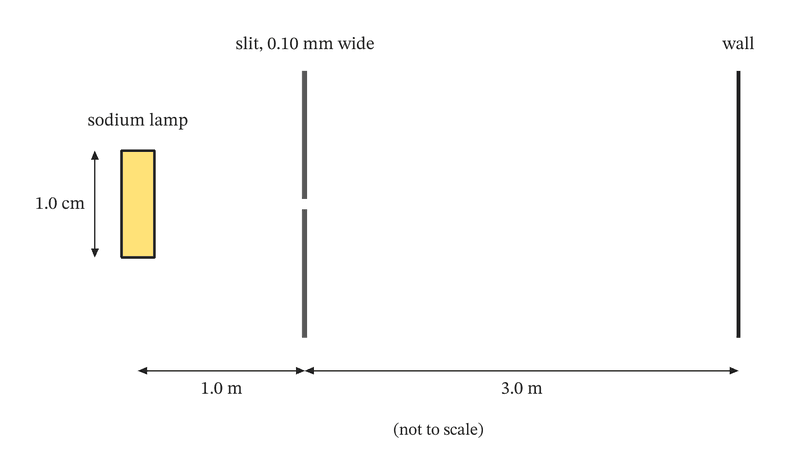
Every point of the lamp produces its own single-slit pattern on the wall, centred on the straight line from that point through the slit.
(i) Find the width of the central maximum that one point of the lamp would give on the wall, taking it as .
(ii) How far apart on the wall are the centres of the patterns produced by the two edges of the lamp? Explain why no clear dark bands are seen.
(iii) A source slit is placed just in front of the lamp. How narrow must it be for the centres of the patterns from its two edges to be no more than a quarter of the width found in (i) apart?
- 91 mark
Question 9
Plane light of wavelength falls normally on a slit AB of width , with mid-point C, as shown.

In the direction of the first minimum, , so the waves from the two edges A and B differ in path by exactly and arrive in step. The screen is nevertheless dark in this direction because
- 101 mark
Question 10
(Hypothetical data.) A slit wide is lit normally by light of wavelength . In the direction of its second secondary maximum (ISC rule), the slit can be divided into five equal strips, and the waves from neighbouring strips cancel in pairs. In this direction, the path difference between the waves from the top and bottom edges of the slit is
- 113 marks
Question 11
(Hypothetical data.) In a Fraunhofer single-slit experiment with light of wavelength , a student measures the directions of the first three minima on one side of the centre as , and .
(i) Show that the sines of these angles are in the ratio , as the condition for the minima predicts.
(ii) Find the width of the slit.
(iii) Predict the direction of the fourth minimum, and explain why it is not simply .
- 123 marks
Question 12
(Hypothetical data.) In a Fraunhofer single-slit experiment, the lens has a focal length of , and the screen is in its focal plane. The first minima are on either side of the centre of the pattern, as shown.

(i) Find the half-width and the angular width of the central maximum.
(ii) is replaced by a lens of focal length , and the screen is moved to its new focal plane; nothing else is changed. Find the new distance of each first minimum from the centre, and the new width of the central maximum on the screen.
(iii) Explain why the angular width of the central maximum does not change, although the pattern on the screen becomes larger.
- 131 mark
Question 13
(Hypothetical data.) A narrow slit is placed on the prism table of a spectrometer and lit normally by parallel sodium light () from the collimator. The telescope, focused for parallel light, shows the Fraunhofer pattern. With the cross-wire on the first dark band to the left of the central maximum, the reading is ; on the first dark band to the right, it is . The width of the slit is about
- 143 marks
Question 14
(Hypothetical data.) Light of wavelength falls normally on a slit wide. A small detector, far from the slit, is set in turn at angles of , , and from the central direction.
(i) For each setting, find the path difference and the phase difference between the waves reaching the detector from the two edges of the slit.
(ii) State whether each setting is at a minimum or, by the ISC rule, at a secondary maximum, and give its order.
- 151 mark
Question 15
In the Fraunhofer arrangement shown, the source S is at the focus of and the screen is in the focal plane of .

The slit is now moved sideways in its own plane (at right angles to its length), staying inside the parallel beam. Nothing else is moved. The diffraction pattern on the screen
- 163 marks
Question 16
(Hypothetical data.) A narrow vertical slit wide is cut in a piece of black card, as shown.
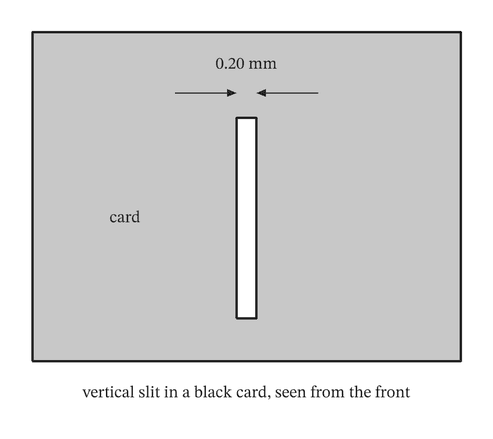
The slit is held just in front of the eye, and through it a student looks at a small, distant lamp covered by a yellow filter that passes light of wavelength close to .
(i) Explain why this is a Fraunhofer arrangement, even though no lenses are added.
(ii) Find the angular width of the central maximum that the student sees, in radians and in degrees.
(iii) Is the lamp seen stretched into a horizontal band or a vertical band? Give a reason.
- 171 mark
Question 17
(Hypothetical data.) A data sheet for a laser-and-slit kit says: “Angular half-width of the central maximum: , at .” In the chapter's convention, the half-width is the angle (in radians) from the centre of the central maximum to the first minimum on one side. The slit width is about
- 181 mark
Question 18
(Hypothetical data.) In a single-slit Fraunhofer pattern on a distant screen, the central maximum is wide, measured from the first minimum on one side to the first minimum on the other. Taking all angles as small, the width of the second secondary maximum (from the second minimum to the third minimum on the same side) is
- 191 mark
Question 19
The graph shows how the intensity varies with in a single-slit Fraunhofer pattern. P, Q, R and S are points on the curve.
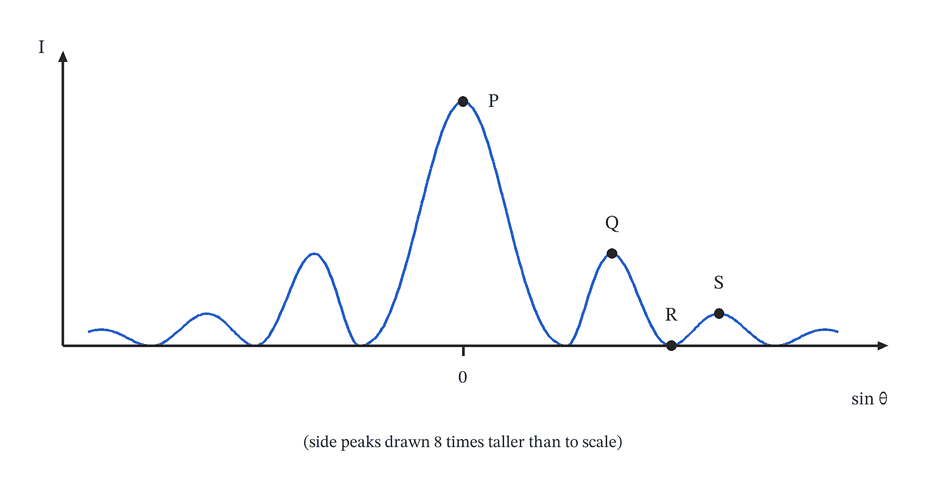
At which point do the waves from the two edges of the slit differ in path by ?
- 203 marks
Question 20
(Hypothetical data.) Light of wavelength falls normally on a slit wide, and the pattern is received on a flat screen away. Take the width of the central maximum as the distance between the first minima on either side.
(i) Find this width using the small-angle formula .
(ii) Find the angle of the first minimum exactly from , and hence the true width .
(iii) By what percentage of the true width does the small-angle formula fall short? What does this show about the formula?
- 213 marks
Question 21
(Hypothetical data.) A single-slit Fraunhofer pattern is formed on a screen from the slit with light of wavelength . The first and second secondary maxima on one side are found and from the centre of the pattern. Take their positions from the ISC rule, , and treat all angles as small.
(i) Find the value of .
(ii) Find the width of the slit.
(iii) Find the width of the central maximum (between the first minima on either side).
- 222 marks
Question 22
(Hypothetical data.) A parallel laser beam of wavelength falls normally on a slit wide. A camera focused for distant objects, with a lens of focal length , is placed just behind the slit, so the Fraunhofer pattern forms on its sensor. Taking the central maximum in the focal plane of a lens as wide (between the first minima), find its width on the sensor and the number of pixels it covers if the pixels are apart.
- 233 marks
Question 23
(Hypothetical data.) To measure the thickness of a fine wire, a student shines a red laser beam () on it and looks at the diffraction pattern on a screen away, as shown.

A thin wire gives the same diffraction pattern as a slit of the same width (apart from the very centre of the pattern), so the slit formulas may be used. The first minima on either side of the centre are apart.
(i) Find the thickness of the wire.
(ii) Find the half-width of the central maximum, and check that the small-angle approximation used is justified.
- 243 marks
Question 24
(Hypothetical data.) Light of wavelength falls normally on a small rectangular hole wide and tall in an opaque sheet, as shown.
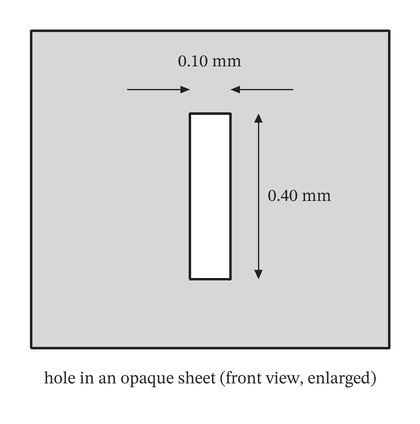
The diffraction pattern is seen on a screen away. Each pair of opposite edges of the hole diffracts the light like a slit of that width, spreading it at right angles to those edges.
(i) Find the size of the central bright patch in the horizontal direction and in the vertical direction, taking each as the distance between the first minima, .
(ii) Describe the shape of the central patch and compare its orientation with that of the hole.
- 251 mark
Question 25
(Hypothetical data.) A student shines a red laser of wavelength on an adjustable slit of width and looks at the diffraction pattern on a screen away. The student wants the width of the central bright band (between the first dark bands on either side of the centre) to be at least , so that its edges can be marked easily.
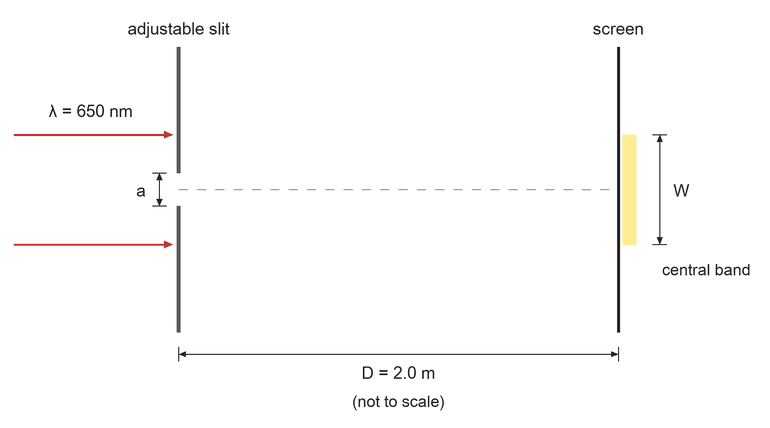
The widest slit the student can use is
- 263 marks
Question 26
(Hypothetical data.) In a single-slit experiment the screen is kept from the slit, and light of one wavelength is used throughout. The slit width is changed, and each time the full width of the central bright band is measured.
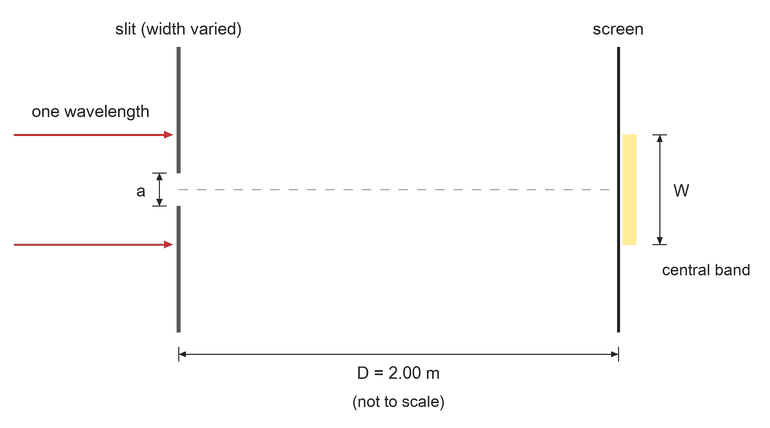
(mm) 0.10 0.16 0.25 0.40 (mm) 23.6 14.8 9.4 5.9 (a) Show that the product is nearly the same for every reading, and explain why theory predicts this.
(b) Find the wavelength of the light.
(c) Predict the width of the central band for a slit wide.
- 271 mark
Question 27
(Hypothetical data.) Light of wavelength falls normally on a very narrow slit of width , and the diffracted light is examined in every direction on the far side of the slit. In how many directions is the light cancelled (a dark band) on each side of the central maximum?
- 282 marks
Question 28
(Hypothetical data.) A slit of width is lit normally by light of wavelength . Take the condition for the secondary maxima of a single slit as , with for the first secondary maximum.
(a) Find the angle at which the first secondary maximum of this slit is formed.
(b) A second slit, lit by the same light, is to have its first minimum in exactly this direction. How wide must the second slit be?
- 294 marks
Question 29
(Hypothetical data.) A pinhole camera has its film behind a small hole of width . Light of wavelength from a distant point makes a blurred spot of width on the film. In a simple model, the hole is treated as a slit: the spot is about as wide as the hole's own shadow, , plus the width of the central diffraction band, , so that
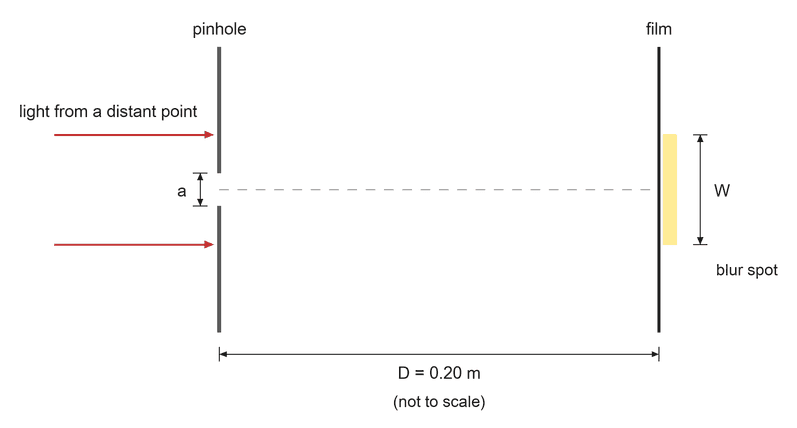
(a) Find for holes , and wide.
(b) Which of these three holes gives the sharpest picture? Explain why making the hole either much smaller or much larger makes the picture less sharp.
(c) Show that is least when , and find this best width and the smallest spot.
- 301 mark
Question 30
Light of wavelength falls normally on a slit that is first wide and is then narrowed to . As a result, the angle between the centre of the pattern and the first dark band (the half angular width of the central maximum)
- 313 marks
Question 31
(Hypothetical data.) To check a fine adjusting screw, a technician sets two razor blades edge to edge with a narrow gap of width between them and lights the gap normally with a helium–neon laser (). A lens of focal length just behind the gap forms the Fraunhofer pattern on a screen in its focal plane.

The width of the central bright band is . After the screw is turned, it is .
(a) Find the width of the gap before the screw was turned.
(b) Find the width of the gap after it was turned.
(c) By how much, and in which direction, did the gap change?
- 322 marks
Question 32
Using the idea of dividing a single slit into two equal halves, explain why making the slit narrower makes the central maximum of its Fraunhofer diffraction pattern wider.
- 331 mark
Question 33
(Hypothetical data.) A single slit lit by monochromatic light is narrowed from to . The light and the screen are not changed, and all the angles involved stay small. Which of these is the same for both slit widths?
- 343 marks
Question 34
(Hypothetical data.) Sunlight comes into a room through a gap wide between two curtains and makes a bright patch on the floor. Take the wavelength of sunlight as and the angular diameter of the Sun as .
(a) Find the angle of the first dark band for this gap.
(b) Compare with the angular radius of the Sun, and use this to explain why no diffraction bands are seen at the edge of the patch.
(c) About how narrow would the gap have to be for to equal the Sun's angular radius?
- 351 mark
Question 35
In a single-slit experiment the slit is replaced by one half as wide, and nothing else is changed at first. To bring the linear width of the central bright band on the screen back to its old value, the student should
- 363 marks
Question 36
(Hypothetical data.) A green laser () lights a slit wide, and the pattern falls on a screen away.

(a) Find the width of the central bright band.
(b) The slit is now widened to . Find the distances from the centre of the first three dark bands of the new pattern.
(c) How many dark bands of the new pattern lie inside the region that the old central band covered?
- 373 marks
Question 37
(Hypothetical data.) A student shines a laser of wavelength through a slit wide onto a screen away.
The student sees only a bright strip about wide with slightly fuzzy edges, and no dark bands.
(a) Find the Fresnel distance for this slit, and use it to explain what the student sees.
(b) For the screen at , find the slit width whose Fresnel distance is exactly . How should the student change the slit to see a clear diffraction pattern?
- 381 mark
Question 38
With laser light, a single slit shows a bright centre with only a few faint bands on each side, while a double slit with very narrow slits shows many bright fringes of nearly equal brightness. The main reason for this difference is that
- 393 marks
Question 39
(Hypothetical data.) Two students, P and Q, each shine light of wavelength on an aperture and look at the pattern on a screen away. One of them used a single slit and the other a double slit with very narrow slits. P sees a bright central band wide with much fainter bands wide on each side. Q sees many equally bright bands whose centres are apart.

(a) Which student used the single slit? Give two features of the patterns that show this.
(b) Find the width of the slit used by P.
(c) Find the separation of the slits used by Q.
- 401 mark
Question 40
For a single slit of width , the condition gives the first dark band. For a double slit with slit separation , the condition gives the first-order bright fringe. Which statement correctly explains why conditions of the same form give opposite results?
- 412 marks
Question 41
In a single-slit diffraction pattern the central bright band is twice as wide as each of the other bright bands. In a double-slit interference pattern with very narrow slits, all the bright fringes are equally wide. Explain the reason for this difference, using the positions of the dark bands in each pattern.
- 421 mark
Question 42
In a Young's double-slit experiment the two slits and are very narrow compared with their separation. The bright fringes have intensity , where is the intensity that one slit alone produces at the centre of the screen. Slit is now covered with an opaque card.
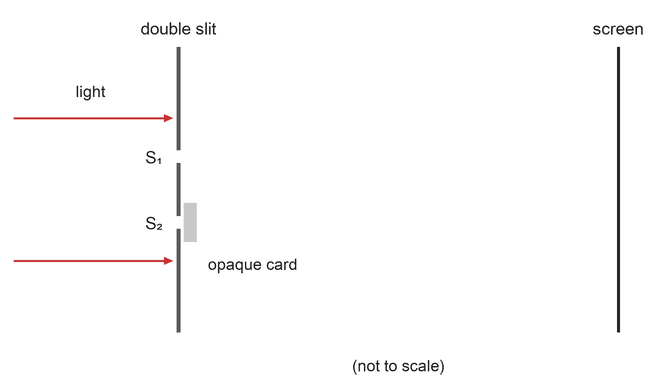
In the region where the fringes were, the screen now shows
- 432 marks
Question 43
(Hypothetical data.) A light meter is moved across two patterns made with the same laser. In a single-slit diffraction pattern it reads units at the centre of the central maximum. In a double-slit interference pattern made with very narrow slits it also reads units at the central bright fringe. The secondary maxima of a single slit have about and of the intensity of the central maximum.
(a) Predict the readings at the first and second secondary maxima of the single-slit pattern.
(b) Predict the readings at the first and second bright fringes on one side of the centre of the double-slit pattern.
(c) Which difference between interference and diffraction patterns do these readings show?
- 442 marks
Question 44
A single slit lit by one sodium lamp, through a narrow source slit, gives a clear diffraction pattern. But when two separate sodium lamps light the same patch of a screen, no interference fringes are seen. Explain this, using the way each pattern is formed.
- 451 mark
Question 45
(Hypothetical data.) Light of wavelength falls in turn on a single slit of width and on a double slit with very narrow slits whose separation is . The screen is away each time. The distance from the centre of the pattern to the first dark band is, for the single slit and the double slit respectively,
- 463 marks
Question 46
(Hypothetical data.) In a double-slit experiment each slit is wide and the slits are apart, centre to centre. Light of wavelength is used, and the screen is away. Each slit's own diffraction pattern acts as an envelope for the fringes: where the single-slit pattern is dark, no light from either slit arrives, so a bright fringe that would fall there is missing.
(a) Find the fringe width.
(b) Find the distance from the centre of the first dark band of the single-slit (diffraction) pattern.
(c) Which order of bright fringe is the first to be missing, and how many bright fringes are seen inside the central diffraction band?
- 471 mark
Question 47
(Hypothetical data.) With red light of wavelength , a single slit gives a central bright band wide, and a double slit gives fringes wide, both on the same screen. The red light is replaced by blue light of wavelength , and nothing else is changed. The new widths of the central band and of the fringes are
- 482 marks
Question 48
In a Young's double-slit experiment the slit separation is kept the same, but each slit is made twice as wide. The fringes are seen only inside the central diffraction band of each slit. State, with a reason, what happens to
(a) the fringe width,
(b) the number of bright fringes seen inside the central diffraction band, and
(c) the brightness of the fringes.
- 493 marks
Question 49
Sketch, one above the other and on the same horizontal scale of , the intensity patterns for (i) a single slit of width and (ii) a double slit with very narrow slits a distance apart, both lit by the same light of wavelength . Mark the dark bands of the single slit and the bright fringes of the double slit in terms of , and state two differences between the patterns that your sketch shows.
- 502 marks
Question 50
By studying the diffraction phenomenon can we draw any conclusions regarding the wave nature of light?
- 512 marks
Question 51
In Fraunhofer single-slit diffraction, what will happen to the diffraction pattern if the slit width is made equal to the wavelength of light used?
- 522 marks
Question 52
Fraunhofer diffraction at a single slit is studied using (i) monochromatic light and (ii) white light. Comment on the diffraction pattern observed.
- 532 marks
Question 53
Is it possible to get a diffraction pattern due to a wide slit?
- 541 mark
Question 54
What should be the order of the size of obstacle or aperture for diffraction of light?
- 552 marks
Question 55
Diffraction is common in sound waves but not common in light waves. Why?
- 562 marks
Question 56
In a single-slit diffraction experiment, the width of the slit is made double the original width. How does this affect the size and intensity of the central diffraction band?
- 572 marks
Question 57
When a tiny circular obstacle is placed in the path of light from a distant source, a bright spot is seen at the centre of the shadow of the obstacle. Explain.
- 583 marks
Question 58
A plane transmission grating having 8000 lines per cm is being used at normal incidence. Find the longest wavelength which can be observed in the first order.
- 593 marks
Question 59
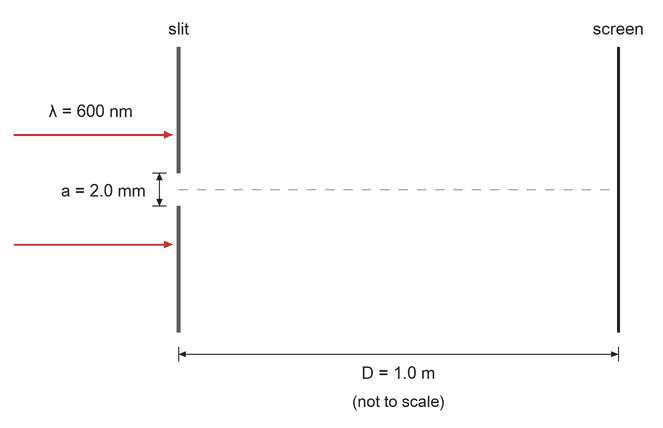
Light of wavelength 600 nm is incident on an aperture of size 2 mm. Calculate the distance upto which the ray of light can travel, such that its spread is less than the size of the aperture.
- 603 marks
Question 60
A slit 400 cm wide is irradiated with microwave of wavelength 2.0 cm. Find the angular spread of central maxima, assuming incidence normal to the plane of the slit.
- 613 marks
Question 61
In Fraunhofer diffraction, monochromatic light of wavelength 6000 Å is passed through a single slit of width 1 mm. Upto what distance can ray optics be applied to a good approximation?
- 623 marks
Question 62
On a slit of width cm monochromatic light of wavelength 6500 Å is allowed to fall normally. Find the angular positions of the first two minima on either side of the central maxima.
- 633 marks
Question 63
On a slit of width cm, monochromatic light of wavelength 6500 Å is allowed to fall normally. Find the angular positions of the first two minima on either side of the central maxima.
- 643 marks
Question 64
In Fraunhofer single-slit diffraction, light of wavelengths and are used. (i) If first diffraction minimum of is to coincide with the second minimum of , how are the two wavelengths related? (ii) Will any other minima coincide in the diffraction pattern?
- 653 marks
Question 65
In Fraunhofer diffraction, monochromatic light of wavelength 6000 Å is passed through a single slit of width 1 mm. Upto what distance can ray optics be applied to a good approximation?
- 661 mark
Question 66
For observing diffraction at a single slit, what type of wavefront should be incident on the slit?
- 672 marks
Question 67
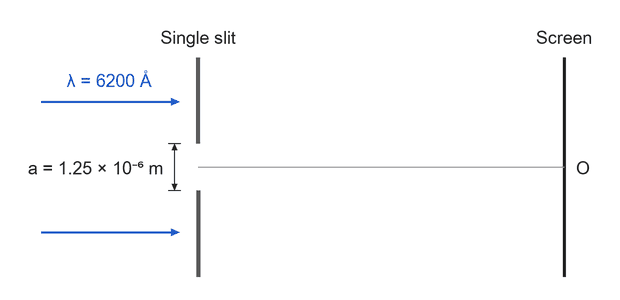
Fraunhofer diffraction from a single slit width is observed with a light of wavelength . Calculate the angular width of central maximum.
- 682 marks
Question 68
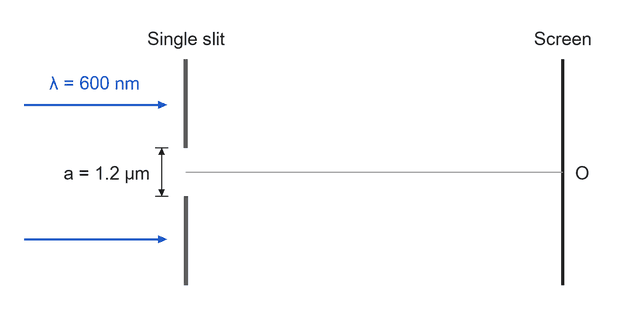
Light of wavelength falls normally on a slit of width producing Fraunhofer diffraction pattern on a screen. Calculate the angular position of the first minimum and the angular width of the central maximum.
- 692 marks
Question 69
In a single-slit diffraction pattern, how does the angular width of the central maxima change when
(i) the slit width is increased and
(ii) light of a smaller wavelength is used?
- 701 mark
Question 70
For observing Fraunhofer diffraction from a single slit, what type of wavefront should be incident on the slit?
- 712 marks
Question 71
A parallel beam of monochromatic light of wavelength is incident normally on a rectangular slit. The angular width of the central bright fringe of Fraunhofer diffraction is found to be . Find the width of the slit in metre.
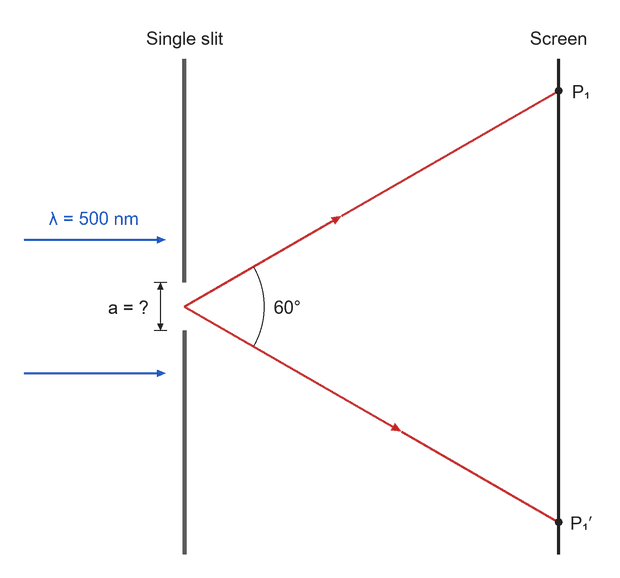
- 722 marks
Question 72
State one similarity and one difference between interference and diffraction of light.
- 732 marks
Question 73
What will be the effect on the width of the central bright fringe in the diffraction pattern of a single slit if
(i) monochromatic light of smaller wavelength is used and
(ii) slit is made narrower?
- 741 mark
Question 74
State one difference between the interference of light and diffraction of light.
- 752 marks
Question 75
In Fraunhofer diffraction, what kind of source of light is used and where is it situated?
- 761 mark
Question 76
What is meant by diffraction of light?
- 772 marks
Question 77
Draw a labelled graph showing the variation in intensity of light with distance in a Fraunhofer single-slit diffraction experiment.
- 781 mark
Question 78
A slit of width is illuminated by white light. For red light () the first minima is determined at . Then the value of will be
- 791 mark
Question 79
The bending of beam of light around corners of obstacles is called
- 801 mark
Question 80
The penetration of light into the region of geometrical shadow is called
- 811 mark
Question 81
Yellow light is used in single-slit diffraction experiment with slit width . If yellow light is replaced by X-rays, then the pattern will reveal
- 821 mark
Question 82
Red light is generally used to observe diffraction pattern from single slit. If blue light is used instead of red light, then diffraction pattern
- 831 mark
Question 83
Condition of diffraction is
- 841 mark
Question 84
The phenomenon of diffraction of light was discovered by
- 851 mark
Question 85
When a compact disc is illuminated by a source of white light, coloured lines are observed. This is due to
(A) dispersion
(B) diffraction
(C) refraction
(D) interference
- 861 mark
Question 86
The diffraction effect can be observed in
- 871 mark
Question 87
The angular width of the central maxima of diffraction pattern in a single slit (of width ‘’) experiment, with as the wavelength of light is
- 881 mark
Question 88
A parallel beam of monochromatic light of wavelength is incident normally on a single narrow slit of width . The light is focused by a convex lens on a screen placed on the focal plane. The first minimum will be formed for the angle of diffraction equal to
- 891 mark
Question 89
In single-slit diffraction pattern
- 901 mark
Question 90
The condition for obtaining secondary maxima in the diffraction pattern due to single slit is
- 911 mark
Question 91
If is the intensity of the principal maxima in the single-slit diffraction pattern, then what will be its intensity when the slit width is doubled?
- 921 mark
Question 92
The angular width of the central maximum in a single-slit diffraction pattern is . The width of the slit is . The slit is illuminated by monochromatic plane waves. If another slit of the same width is made near it, Young's fringes can be observed on a screen placed at a distance from the slits. If the observed fringe width is , what is the slit separation distance (i.e. distance between the centres of each slit)?
- 931 mark
Question 93
Consider the diffraction pattern obtained from the sunlight incident on a pinhole of diameter . If the diameter of the pinhole is slightly increased, it will affect the diffraction pattern such that