
(Hypothetical data.) A student tries to see the diffraction pattern of a slit wide on a wall beyond it. The student lights the slit with a sodium lamp () whose glowing part is wide and stands behind the slit, with no lens and no source slit, as shown.
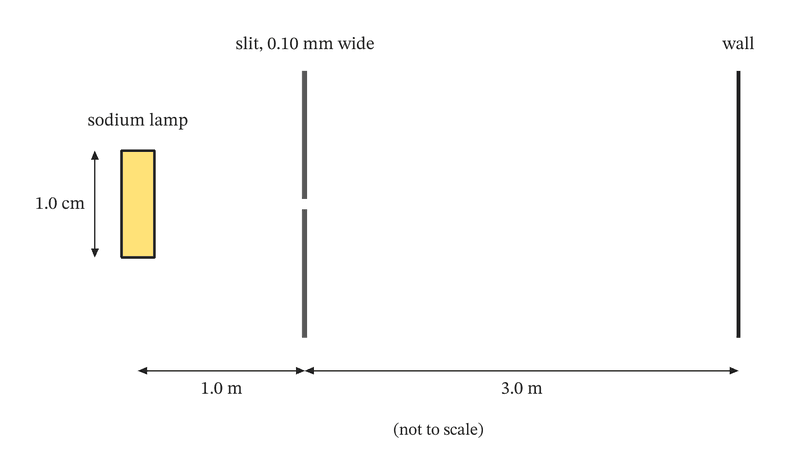
Every point of the lamp produces its own single-slit pattern on the wall, centred on the straight line from that point through the slit.
(i) Find the width of the central maximum that one point of the lamp would give on the wall, taking it as .
(ii) How far apart on the wall are the centres of the patterns produced by the two edges of the lamp? Explain why no clear dark bands are seen.
(iii) A source slit is placed just in front of the lamp. How narrow must it be for the centres of the patterns from its two edges to be no more than a quarter of the width found in (i) apart?