Solution:
Concept: In Fraunhofer diffraction at a single slit of width a, the minima (dark bands) lie in the directions θn given by
asinθn=nλ,n=±1,±2,±3,…
Here λ is the wavelength. The central maximum lies between the two first minima, sinθ1=±aλ.
Step 1 — Describe the image for a narrow slit. The screen shows a broad central bright band parallel to the slit. Above and below it there are alternate dark bands (minima) and fainter bright bands (secondary maxima), whose brightness falls off rapidly.
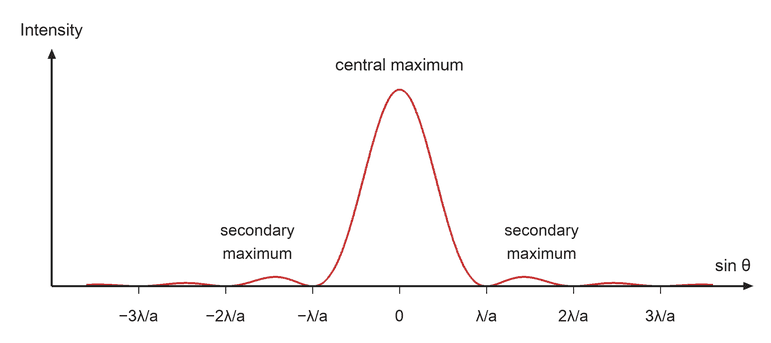
Step 2 — Describe the image for a very wide slit. If a≫λ, the first minimum is at a tiny angle, θ1≈aλ. The central maximum and all the secondary bands are then squeezed into this tiny angle round the straight-through direction, too close together to be seen separately, so there is no visible spreading of light.
Therefore, a narrow slit gives a broad central bright band with secondary minima and maxima on either side; a very wide slit gives just a sharp geometrical image of the slit, with no visible diffraction bands.
