
Opening your dashboard
Class 11 Physics Chapter 23: Waves: Wave Motion Solutions
52 textbook questions with step-by-step answers, free to read, for ISC 2026-27.
Get talked through Ch 23, not just shown the answer
Reading a finished solution is not the same as being able to do it. The AI tutor takes one question at a time and works it with you, in your own words, until you can.
- Ask it out loud, in your own words
- It gives you the next step, not the answer
- Stuck on part (ii)? Start there
52 questions with solutions
1–5 marks · Mixed difficulty
The first 33 solutions are on this page. This chapter is a long one, so the rest open on their own page to keep this one quick to load.
- 11 mark
Question 1
Transverse waves can propagate
Solve with AIAnswer
(A) both in a gas and a metal
(B) in a gas but not in a metal
- Correct
(C) not in a gas but in a metal
(D) neither in a gas nor in a metal
Answer: (C) not in a gas but in a metal
Concept: In a transverse mechanical wave the layers of the medium slide sideways past one another. The medium must therefore resist a change of shape, that is, it must have rigidity (a modulus of rigidity). Solids have rigidity; a gas has none.
Step 1 — Decide what a transverse wave needs. When a layer is pushed sideways, a transverse wave can travel only if the next layer is pulled along by a shearing (restoring) force. That force exists only in a medium with rigidity.
Step 2 — Apply this to a metal. A metal is a solid with a large modulus of rigidity, so a sideways displacement of one layer produces a restoring force on the next layer. Transverse waves can travel through it.
Step 3 — Apply this to a gas. The molecules of a gas do not resist a change of shape, so the modulus of rigidity of a gas is zero. A sideways push produces no restoring force, and a transverse wave cannot travel; a gas carries only longitudinal (compression) waves such as sound.
Step 4 — Check the other options. Each of the other options gets the gas or the metal wrong:
- (A) This includes the gas, but a gas has no rigidity, so it cannot carry transverse mechanical waves.
- (B) This is the wrong way round: the metal, being rigid, can carry transverse waves, while the gas cannot.
- (D) This leaves out the metal, but transverse (shear) waves do travel through solid metal; ultrasonic shear waves are used to test metal parts for cracks.
Watch out: Here "transverse waves" means mechanical waves. Light is a transverse electromagnetic wave and does pass through gases, but it is not a vibration of the gas.
Therefore, transverse waves can propagate not in a gas but in a metal, option (C).
- 21 mark
Question 2
A wave equation which gives the displacement along the -direction is given by , where and are in metres and is time in seconds. This represents a wave
Solve with AIAnswer
(A) travelling with a velocity of 60 m/s in the negative direction
(B) of wavelength metre
(C) of frequency hertz
- Correct
(D) of amplitude metre travelling along the negative direction
Answer: (D) of amplitude metre travelling along the negative direction
Concept: A wave travelling in the negative direction can be written as , where is the amplitude, the angular frequency and the propagation constant. From these, the wave speed is , the wavelength is and the frequency is .
Step 1 — Compare with the standard form. Matching the given equation with gives the three constants:
The plus sign between the and terms shows that the wave travels in the negative direction.
Step 2 — Find the speed. The wave speed is the ratio of to :
Step 3 — Find the wavelength and the frequency. We use and :
Step 4 — Check the other options. Only option (D) agrees with every value found above:
- (A) The direction is right, but 60 is , not the speed; the wave speed is .
- (B) A wavelength of m would need ; here , so m.
- (C) A frequency of Hz would need ; here the frequency is Hz, about 9.5 Hz.
Therefore, the equation represents a wave of amplitude m travelling along the negative direction, option (D).
- 31 mark
Question 3
If and , then what is the phase difference between the two waves?
Solve with AIAnswer
- Correct
(A)
(B)
(C)
(D)
Answer: (A)
Concept: Two vibrations can be compared in phase only when both are written with the same function. A cosine is a sine that is a quarter of a cycle ahead:
Step 1 — Write the second vibration as a sine. We use the identity above with :
Step 2 — Read off the two phase constants. The first vibration has phase constant and the second has .
Step 3 — Subtract them. The phase difference is the difference of the phase constants:
So leads by .
Step 4 — Check the other options. Each of the other values leaves something out:
- (B) This is the phase constant of alone; it forgets that the cosine is itself ahead of a sine.
- (C) This is the phase lead of a cosine over a sine, which ignores the already present in .
- (D) A phase difference of would mean at every instant, which is not the case.
Therefore, the phase difference between the two waves is , option (A).
- 41 mark
Question 4
Two waves are represented by the following equations
Ratio of intensities will be
Solve with AIAnswer
(A) 1
(B) 2
(C) 4
- Correct
(D) 16
Answer: (D) 16
Concept: The intensity of a progressive wave is given by the formula below.
Here is the frequency, the amplitude, the density of the medium and the wave speed. For waves in the same medium, is proportional to , not to alone.
Step 1 — Read the constants of the first wave. Comparing the first equation with gives:
Step 2 — Read the constants of the second wave. In the same way, the second equation gives:
Step 3 — Check that the medium is the same. The two speeds are equal: and both come to 100 in the same units. So we take both waves to travel in the same medium, with the same and .
Step 4 — Take the ratio of intensities. Since and are the same for both waves, they cancel:
Step 5 — Check the other options. Each of the other values drops part of the formula:
- (A) A ratio of 1 would need ; here and .
- (B) This is the ratio of the amplitudes, , not squared and without the frequency factor.
- (C) This is alone. It would be right only if the two frequencies were equal; here the second frequency is twice the first, which multiplies the ratio by a further 4.
Note: the book's printed answer is 4, which uses alone; by the chapter's own formula the doubled frequency also counts, so the correct ratio is 16.
Therefore, the ratio of intensities is 16, option (D).
- 51 mark
Question 5
The sound carried by air from a sitar to a listener is a wave of the following type
Solve with AIAnswer
(A) longitudinal stationary
(B) transverse progressive
(C) transverse stationary
- Correct
(D) longitudinal progressive
Answer: (D) longitudinal progressive
Concept: Air is a gas, so it can carry only longitudinal mechanical waves (compressions and rarefactions). A progressive wave travels outward from its source carrying energy; a stationary wave stays confined between fixed boundaries.
Step 1 — Decide the type of vibration. The air layers between the sitar and the listener vibrate back and forth along the direction in which the sound travels, forming compressions and rarefactions. Air has no rigidity, so it cannot carry a transverse mechanical wave. The wave in air is therefore longitudinal.
Step 2 — Decide whether it travels. The sound spreads outward from the sitar and carries energy to the listener's ear, which is some distance away. A wave that moves energy from one place to another in this way is a progressive wave.
Step 3 — Check the other options. Each of the other options describes some other wave:
- (A) Longitudinal stationary waves form in a closed air column, such as an organ pipe, where waves reflect back and forth; the sound reaching the listener moves outward instead.
- (B) Air cannot carry transverse mechanical waves, because its modulus of rigidity is zero.
- (C) A transverse stationary wave is set up on the sitar string itself, not in the air that carries the sound.
Therefore, the sound carried by air from the sitar to the listener is a longitudinal progressive wave, option (D).
- 61 mark
Question 6
The distance between two points differing in phase by on a wave, velocity 360 m/s and frequency 500 Hz is
Solve with AIAnswer
(A) 24 cm
- Correct
(B) 12 cm
(C) 6 cm
(D) 1 cm
Answer: (B) 12 cm
Concept: Along a wave, a path difference of one wavelength gives a phase difference of (that is, ). So the path difference for a phase difference is
Step 1 — Find the wavelength. The wavelength is the speed divided by the frequency:
Step 2 — Find what fraction of a cycle is. A phase difference of is one-sixth of :
Step 3 — Find the distance. The distance is one-sixth of a wavelength:
This is 12 cm.
Step 4 — Check the other options. Each of the other distances belongs to a different phase difference:
- (A) 24 cm is , the distance for a phase difference of .
- (C) 6 cm is , the distance for a phase difference of .
- (D) 1 cm is only of a wavelength, which corresponds to a phase difference of .
Therefore, the two points are 12 cm apart, option (B).
- 71 mark
Question 7
Which of the following does not represent a travelling wave?
(A)
(B)
(C)
(D)
Solve with AIWritten solution
Solution:
Concept: A travelling wave keeps its shape while moving, so its displacement depends on and only through the single combination (moving towards ) or (moving towards ). In addition, the displacement must stay finite for all values of and .
Step 1 — Test option (A). The function depends only on , so the shape moves towards with speed . With a finite function it represents a travelling wave.
Step 2 — Test option (B). The function depends only on and always lies between and . It is a harmonic wave travelling towards .
Step 3 — Test option (C). The function depends on , but it is not finite everywhere. At the point where the logarithm becomes infinitely large (negative), and for it is not defined at all. So it cannot describe the displacement of a real medium, and it does not represent a travelling wave.
Step 4 — Test option (D). The quantity cannot be written as a function of alone. For example, the two events and have the same value of , namely 1, but different values of :
So the shape does not simply move along unchanged, and does not represent a travelling wave either (unless is a constant, which is no wave at all).
Note: the printed key gives only (C); option (D) also fails the test above, so both (C) and (D) are correct answers.
Therefore, options (C) and (D) do not represent travelling waves: (C) is not finite everywhere, and (D) is not a function of or .
- 81 mark
Question 8
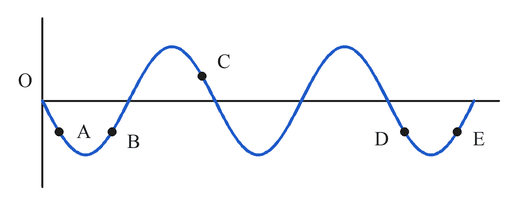
The given diagram shows the propagation of a wave. Which points are in phase?
 Solve with AI
Answer
(A) ,
(B) ,
(C) ,
- Correct
(D) ,
Answer: (D) ,
Concept: Two points of a wave are in phase when they have the same displacement and are moving in the same direction at every instant. This happens when they are separated by a whole number of wavelengths. Since the particle velocity is times the slope of the curve (with a sign fixed by the direction of travel), points at the same displacement on parts of the curve with the same slope (both rising or both falling) move the same way.
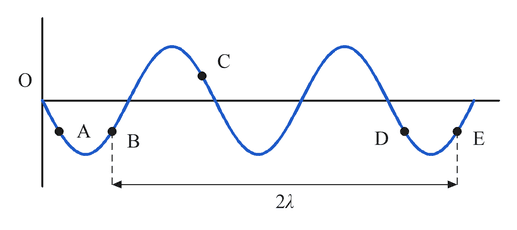
Step 1 — Read the positions of the points. From the diagram: and lie below the axis on falling parts of the curve; and lie below the axis on rising parts at the same depth; lies above the axis on a falling part.
Step 2 — Find the pair in phase. Points and have the same displacement and lie on rising parts of the curve, so they move in the same direction. The figure shows that they are exactly two wavelengths apart.
Step 3 — Check the other options. Each of the other pairs differs in displacement or in direction of motion:
- (A) and have the same displacement, but is on a falling part and on a rising part, so they move in opposite directions; they are less than half a wavelength apart.
- (B) is below the axis while is above it, so their displacements are different.
- (C) and have the same displacement, but is on a rising part and on a falling part, so they move in opposite directions.
Note: Points and are also two wavelengths apart and are in phase, but that pair is not among the options.
Therefore, the points in phase are and , option (D).
- 91 mark
Question 9
In a sinusoidal wave, the time required for a particular point to move from maximum displacement to zero displacement is 0.17 s. The frequency of the wave is
Solve with AIAnswer
- Correct
(A) 1.47 Hz
(B) 0.36 Hz
(C) 0.73 Hz
(D) 2.94 Hz
Answer: (A) 1.47 Hz
Concept: Each point of a sinusoidal wave vibrates in simple harmonic motion. In one period it goes from the mean position to one extreme, back to the mean, to the other extreme and back again, so moving from an extreme to the mean position takes one-quarter of a period. The frequency is .
Step 1 — Find the period. The time from maximum displacement to zero displacement is a quarter period:
Step 2 — Find the frequency. The frequency is the reciprocal of the period:
Step 3 — Check the other options. Each of the other frequencies gives a different quarter period:
- (B) A frequency of 0.36 Hz means a period of about 2.8 s, so a quarter period would be about 0.69 s, not 0.17 s.
- (C) A frequency of 0.73 Hz means a period of about 1.37 s, so a quarter period would be about 0.34 s, not 0.17 s.
- (D) This takes 0.17 s as half a period ( s); but going from an extreme to the mean position is only a quarter of a cycle.
Therefore, the frequency of the wave is about 1.47 Hz, option (A).
- 101 mark
Question 10
A transverse wave is represented by the equation
For what value of is the maximum particle velocity equal to two times the wave velocity?
Solve with AIAnswer
(A)
(B)
(C)
- Correct
(D)
Answer: (D)
Concept: The particle velocity is the rate of change of displacement of one particle with time, (with fixed). Its largest value is reached when the cosine factor equals 1.
Step 1 — Differentiate the displacement. Keeping fixed and differentiating with respect to gives the particle velocity:
Step 2 — Write the maximum particle velocity. The cosine has a largest value of 1, so:
Step 3 — Apply the condition. We set the maximum particle velocity equal to twice the wave velocity:
Step 4 — Check the other options. Putting each other wavelength into gives a different multiple of :
- (A) Putting in makes the maximum particle velocity equal to , not .
- (B) Putting in makes the maximum particle velocity .
- (C) Putting in makes the maximum particle velocity .
Therefore, the maximum particle velocity is twice the wave velocity when , option (D).
- 111 mark
Question 11
The frequency of a rod is 200 Hz. If the velocity of sound in air is 340 m s, the wavelength of the sound produced is
Solve with AIAnswer
(A) 1.7 cm
(B) 6.8 cm
- Correct
(C) 1.7 m
(D) 6.8 m
Answer: (C) 1.7 m
Concept: The sound produced has the same frequency as the vibrating rod. Its wavelength in air follows from .
Step 1 — Write the relation for the wavelength. We rearrange :
Step 2 — Substitute the values. We substitute and Hz:
Step 3 — Check the other options. Each of the other wavelengths would need a different frequency in air:
- (A) 1.7 cm has the right digits but is 100 times too small; it would need a frequency of 20 000 Hz.
- (B) 6.8 cm would need a frequency of 5000 Hz.
- (D) 6.8 m would need a frequency of 50 Hz.
Therefore, the wavelength of the sound is 1.7 m, option (C).
- 121 mark
Question 12
The wavelength of a wave in a medium is 0.5 m. The phase difference between the oscillations at two points in the medium due to this wave is . What is the minimum distance between these points?
Solve with AIAnswer
- Correct
(A) 0.05 m
(B) 0.1 m
(C) 0.25 m
(D) 0.15 m
Answer: (A) 0.05 m
Concept: A phase difference between two points of a wave corresponds to a path difference
The same phase difference also occurs at distances larger by whole wavelengths, so this value is the minimum distance.
Step 1 — Substitute the values. We substitute m and :
Step 2 — Check the other options. Each of the other distances belongs to a different phase difference:
- (B) 0.1 m is ; it comes from dividing the phase difference by instead of , and it corresponds to a phase difference of .
- (C) 0.25 m is half a wavelength, which corresponds to a phase difference of .
- (D) 0.15 m is , which corresponds to a phase difference of .
Therefore, the minimum distance between the two points is 0.05 m, option (A).
- 131 mark
Question 13
The relation between phase difference and path difference is
Solve with AIAnswer
- Correct
(A)
(B)
(C)
(D)
Answer: (A)
Concept: Two points one wavelength apart differ in phase by . The phase difference grows in proportion to the path difference.
Step 1 — Set up the proportion. A path difference gives a phase difference , so a path difference gives:
Step 2 — Check the other options. Each of the other relations fails a simple test:
- (B) has the unit m, but a phase difference is a pure number (an angle in radians).
- (C) makes the phase difference smaller for points farther apart; for it gives instead of .
- (D) gives only 2 radians for , not .
Therefore, the relation is , option (A).
- 141 mark
Question 14
If the frequency of human heartbeat is 1.25 Hz, the number of heartbeats in 1 minute is
Solve with AIAnswer
(A) 80
(B) 65
(C) 90
- Correct
(D) 75
(E) 120
Answer: (D) 75
Concept: A frequency of 1 Hz means one complete beat every second. The number of beats in a time is the frequency multiplied by in seconds.
Step 1 — Multiply the frequency by the time. One minute is 60 s:
Step 2 — Check the other options. Each of the other counts would need a different frequency:
- (A) 80 beats per minute would need a frequency of about 1.33 Hz.
- (B) 65 beats per minute would need a frequency of about 1.08 Hz.
- (C) 90 beats per minute would need a frequency of 1.5 Hz.
- (E) 120 beats per minute would need a frequency of 2 Hz.
Therefore, the heart beats 75 times in 1 minute, option (D).
- 151 mark
Question 15
Which of the following equations represents a wave travelling along -axis?
Solve with AIAnswer
(A)
- Correct
(B)
(C)
(D)
Answer: (B)
Concept: A wave travelling along an axis has a displacement that depends on position and time through one combination such as , where is the coordinate along which the wave moves. A product of a function of position and a function of time, such as , is a stationary wave, which does not travel.
Step 1 — Look for the coordinate in the phase. In option (B) the phase is , so the disturbance moves along the -axis (towards , with speed ).
Step 2 — Read the displacement. In option (B) the displacement is called , so the particles move along the -axis while the wave moves along the -axis; this is a transverse wave travelling along .
Step 3 — Check the other options. Each of the other equations fails one of the two tests:
- (A) The phase is , so this wave travels along the -axis, not the -axis.
- (C) The displacement is a product of and ; this is a stationary wave, with fixed nodes where , so it does not travel.
- (D) This is also a product, , so it is a stationary wave too.
Therefore, the wave travelling along the -axis is , option (B).
- 161 mark
Question 16
Name the properties which a material medium should have in order that a wave propagates through it.
Solve with AIWritten solution
Solution:
Concept: A mechanical wave travels because each particle of the medium, once disturbed, pulls or pushes its neighbour and passes the disturbance on.
Step 1 — State the first property. The medium must have elasticity. When a particle is displaced, elasticity produces a restoring force that pulls it back and also acts on the next particle, passing the disturbance along.
Step 2 — State the second property. The medium must have inertia (mass). Because of inertia a displaced particle overshoots its mean position and keeps vibrating, and it can store and hand on kinetic energy.
Step 3 — Add the condition on friction. The frictional resistance in the medium should be small; otherwise the vibrations die out quickly and the wave does not travel far.
Therefore, the medium must have elasticity and inertia (with little frictional resistance).
- 171 mark
Question 17
When a wave passes through a medium, what type of motion do the particles execute?
Solve with AIWritten solution
Solution:
Concept: In a harmonic (sinusoidal) wave, the displacement of each particle is ; at a fixed position this is the equation of simple harmonic motion.
Step 1 — Describe the motion of one particle. As the wave passes, each particle vibrates to and fro about its own mean (equilibrium) position; it does not travel along with the wave.
Step 2 — Name the motion. For a harmonic wave the displacement of each particle varies sinusoidally with time, with the same amplitude and frequency for every particle, so each particle performs simple harmonic motion. (In a wave that is not harmonic, the particles still vibrate about their mean positions, but not in pure SHM.)
Therefore, the particles execute simple harmonic motion about their mean positions.
- 181 mark
Question 18
Is it possible to produce transverse wave in air?
Solve with AIWritten solution
Solution:
Concept: A transverse mechanical wave needs a medium that resists a change of shape (one with a modulus of rigidity), so that a sideways shift of one layer drags the next layer along.
Step 1 — Look at the rigidity of air. Layers of air slide past one another freely, so air does not resist a change of shape. Its modulus of rigidity is zero.
Step 2 — Draw the conclusion. With no restoring force against a sideways shift, a transverse mechanical wave cannot travel through air; air carries only longitudinal waves such as sound.
Watch out: Light and radio waves are transverse and travel through air, but they are electromagnetic waves, not vibrations of the air itself.
Therefore, no; a transverse mechanical wave cannot be produced in air, because the modulus of rigidity of air is zero.
- 191 mark
Question 19
What type of wave motion is observed by a person standing near the sea-coast?
Solve with AIWritten solution
Solution:
Concept: Waves on the surface of water are neither purely transverse nor purely longitudinal. Each water particle moves up and down (across the direction of travel) and, at the same time, back and forth (along it).
Step 1 — Describe the motion of the water. As a sea wave passes, a floating object rises and falls and also moves a little forward and back. Combining the two motions, each water particle moves round a closed path.
Step 2 — Name the path. In deep water the path is nearly a circle; in the shallow water near the coast the paths are flattened into ellipses. The motion becomes smaller with depth.
Note: the book's hint says that the surface particles move transversely and those a little below move longitudinally; in fact every particle has both motions together, which is why its path is an ellipse.
Therefore, the person sees surface water waves (elliptical waves): the water particles move in elliptical paths, combining transverse and longitudinal motion.
- 201 mark
Question 20
When a wave propagates through a medium, what is the direction of vibrations of the particles, if the wave is (i) transverse and (ii) longitudinal?
Solve with AIWritten solution
Solution:
Concept: Waves are classified by comparing the direction in which the particles vibrate with the direction in which the wave travels, as the figure shows.
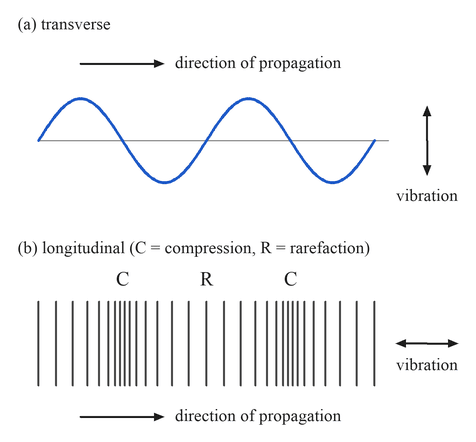
Step 1 — Transverse wave. In a transverse wave, such as a wave on a string, the particles vibrate at right angles to the direction in which the wave travels.
Step 2 — Longitudinal wave. In a longitudinal wave, such as sound in air, the particles vibrate back and forth along the direction in which the wave travels, forming compressions and rarefactions.
Therefore, (i) in a transverse wave the particles vibrate perpendicular to the direction of propagation, and (ii) in a longitudinal wave they vibrate parallel to it.
- 211 mark
Question 21
"Longitudinal waves are called pressure waves." Why?
Solve with AIWritten solution
Solution:
Concept: In a longitudinal wave the particles vibrate along the direction of travel, so neighbouring layers move closer together in some places and farther apart in others.
Step 1 — Describe what the wave does to the medium. Where layers crowd together (a compression) the volume of a small region decreases, so its density and pressure rise above normal. Where layers spread apart (a rarefaction) the density and pressure fall below normal.
Step 2 — Link this to the name. A longitudinal wave therefore travels as a pattern of high- and low-pressure regions moving through the medium; a pressure gauge or the ear detects it through these pressure changes.
Therefore, longitudinal waves are called pressure waves because they travel as alternate regions of increased and decreased pressure (compressions and rarefactions) in the medium.
- 221 mark
Question 22
Compared to air, sound heard is more in carbon dioxide, why?
Solve with AIWritten solution
Solution:
Concept: The intensity of a sound wave of frequency and amplitude is . For the same frequency and amplitude, the intensity is proportional to , the density of the gas times the speed of sound in it.
Step 1 — Compare the densities. Carbon dioxide is denser than air: at 0 °C its density is about , while that of air is about .
Step 2 — Compare the products . Sound travels more slowly in carbon dioxide (about at 0 °C, against in air), but the larger density wins:
Step 3 — Draw the conclusion. For the same amplitude and frequency, a sound wave in carbon dioxide carries about 1.2 times as much energy per second per unit area as in air, so it is heard louder.
Therefore, for the same amplitude and frequency the intensity () is larger in carbon dioxide, which is denser than air, so the sound is heard louder.
- 231 mark
Question 23
What is the nature of wave produced in a lake, due to an explosion inside the lake?
Solve with AIWritten solution
Solution:
Concept: Inside a liquid only longitudinal (compression) waves can travel, because a liquid, like a gas, has no rigidity to resist a sideways shift of its layers.
Step 1 — Describe the disturbance. The explosion suddenly compresses the water around it. This compression is passed from layer to layer, followed by a rarefaction, as a pressure (sound) wave.
Step 2 — Name the wave. The water layers vibrate along the direction in which the disturbance travels, so the wave inside the lake is longitudinal. (Where the disturbance reaches the surface it also sets up ordinary surface water waves.)
Therefore, the wave produced inside the lake by the explosion is a longitudinal wave.
- 241 mark
Question 24
What is the distance between a compression and the nearest rarefaction in a longitudinal wave?
Solve with AIWritten solution
Solution:
Concept: In a longitudinal wave, one compression and one rarefaction together make up one wavelength . So the distance between two successive compressions is .
Step 1 — Locate the nearest rarefaction. A rarefaction lies midway between two successive compressions, as the figure shows.
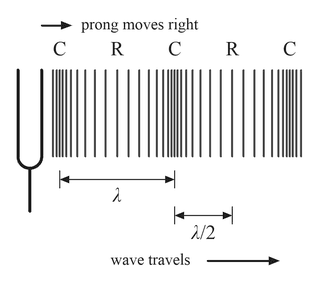
Step 2 — Find the distance. Half of the distance between two compressions is half a wavelength.
Therefore, the distance between a compression and the nearest rarefaction is , where is the wavelength.
- 251 mark
Question 25
Give two properties which are common to the different types of mechanical waves.
Solve with AIWritten solution
Solution:
Concept: All mechanical waves, transverse or longitudinal, are disturbances passed from particle to particle of a material medium.
Step 1 — State the first common property. A material medium is necessary for their propagation; mechanical waves cannot travel through a vacuum.
Step 2 — State the second common property. When the wave passes, the particles of the medium only vibrate about their mean positions; they do not flow along with the wave. Only energy (and the disturbance) is carried forward.
Therefore, (i) a medium is necessary for the propagation of mechanical waves, and (ii) the particles of the medium only vibrate about their mean positions and do not move along with the wave.
- 262 marks
Question 26
Give an example of a wave in one dimension.
Solve with AIWritten solution
Solution:
Concept: A wave is one-dimensional when the energy it carries travels along a single line.
Step 1 — Describe the example. Tie one end of a long string to a peg on a wall and hold the other end in the hand. Give the free end a sudden jerk up and down.
Step 2 — Explain why it is one-dimensional. A pulse runs along the string towards the wall. The disturbance and its energy travel only along the length of the string, one direction in space.
Therefore, the wave pulse produced on a string, tied at one end to a peg on a wall, when its free end is jerked up and down is an example of a wave in one dimension.
- 272 marks
Question 27
"Sound is an example of a wave in three dimensions." Why?
Solve with AIWritten solution
Solution:
Concept: The dimension of a wave is the number of directions in space along which its energy spreads out from the source.
Step 1 — Describe how sound spreads. A small sound source in air, such as a bell, pushes on the air on all sides. The compressions and rarefactions move outward in every direction, so the wavefronts are expanding spheres.
Step 2 — Link this to three dimensions. Because the energy of the sound travels outward along all three dimensions of space (it can be heard above, below and on every side of the source), sound is a three-dimensional wave.
Therefore, sound is a wave in three dimensions because, when sound is produced by a source in air, its energy propagates in all three dimensions.
- 282 marks
Question 28
What is a wave? What are elastic waves?
Solve with AIWritten solution
Solution:
Concept: A wave transfers energy from one place to another without transferring matter.
Step 1 — Define a wave. A wave is a disturbance produced in a medium by the repeated periodic vibrations of the particles of the medium about their equilibrium positions. The vibration is handed over from one particle to the next, so the wave transfers energy (and information) from one point to another, while the medium itself does not flow. (Electromagnetic waves, such as light, also carry energy, but they are vibrations of electric and magnetic fields and need no medium.)
Step 2 — Define elastic waves. Some waves, such as sound waves and waves on a stretched string, need a material medium for their propagation, and the medium must have elasticity and inertia. Such waves, which travel by means of the elastic restoring forces between neighbouring particles of the medium, are called elastic waves (or mechanical waves).
Note: Waves on the surface of water are also mechanical waves, because they need the water to travel. Their main restoring force, however, is gravity (with surface tension for very short ripples), not the elasticity of the water.
Therefore, a wave is a disturbance passed on by the repeated periodic vibrations of the particles of a medium, carrying energy without carrying matter; elastic (mechanical) waves are waves, such as sound and waves on a stretched string, that need a material medium with elasticity and inertia and travel by the elastic forces between its particles.
- 292 marks
Question 29
What is the difference between a sound wave and a T.V. wave?
Solve with AIWritten solution
Solution:
Concept: Waves are either mechanical (needing a material medium) or electromagnetic (needing no medium).
Step 1 — Describe a sound wave. Sound is a mechanical wave. In air it is longitudinal: the air layers vibrate along the direction of travel. It needs a material medium and cannot travel through a vacuum. Its speed in air is about at 20 °C (about at 0 °C).
Step 2 — Describe a T.V. wave. A T.V. signal is carried by electromagnetic (radio) waves. These are transverse vibrations of electric and magnetic fields, not of particles. They need no medium and travel through a vacuum at .
Therefore, a sound wave is a longitudinal mechanical wave that needs a medium, whereas a T.V. wave is an electromagnetic (transverse) wave that needs no medium and travels at the speed of light.
- 302 marks
Question 30
What is meant by (i) rarefaction and (ii) condensation?
Solve with AIWritten solution
Solution:
Concept: In a longitudinal wave the particles vibrate along the direction of travel, so in some regions the layers of the medium crowd together and in others they spread apart. The lower part of the figure shows both kinds of region.
Step 1 — Explain rarefaction. A rarefaction is a region of a longitudinal wave where the layers of the medium are farther apart than normal, so the density and pressure there are lower than in the undisturbed medium.
Step 2 — Explain condensation. A condensation (compression) is a region where the layers are pushed closer together than normal, so the density and pressure there are higher than in the undisturbed medium.
Therefore, (i) a rarefaction is a region of low pressure and density in a longitudinal wave, and (ii) a condensation (compression) is a region of high pressure and density.
- 312 marks
Question 31
What are the characteristics of wave motion?
Solve with AIWritten solution
Solution:
Concept: Wave motion is a disturbance handed on from particle to particle of a medium, so it has features that set it apart from the motion of a single body.
Step 1 — Medium and vibration. A mechanical wave needs a medium that has elasticity and inertia. The disturbance travels outward, but the particles of the medium do not travel; they only vibrate about their mean positions.
Step 2 — Phase of the particles. Each particle starts to vibrate a little later than the one before it, so each particle lags behind its predecessor by a definite phase angle.
Step 3 — Two different speeds. The velocity of the wave is constant in a given uniform medium, but the velocity of a particle changes from instant to instant and from point to point; the two are different.
Step 4 — Electromagnetic waves. Electromagnetic waves, such as light, need no material medium for their propagation.
Step 5 — Behaviour at boundaries and in combination. When waves pass from one medium to another they are partly reflected and partly refracted. Waves also show interference and diffraction.
Therefore, in wave motion the disturbance and energy travel while the particles only vibrate about their mean positions, each lagging in phase behind the previous one; the wave speed is constant in a medium while the particle velocity varies, and waves can be reflected, refracted, and show interference and diffraction.
- 322 marks
Question 32
Is it possible to produce longitudinal wave and transverse wave in the same medium? Explain with an example.
Solve with AIWritten solution
Solution:
Concept: A medium can carry longitudinal waves if it resists compression, and transverse waves if it resists a change of shape or has a surface restoring force (gravity, surface tension, tension).
Step 1 — Give the example of water. In a wave on the surface of water, the water particles move up and down and also back and forth at the same time. So both transverse and longitudinal motion occur together in water, and each particle moves round an elliptical path.
Step 2 — Give a second example, a solid. A solid resists both compression and change of shape, so it can carry separate longitudinal and transverse waves; an earthquake sends both kinds through the rocks of the earth's crust.
Therefore, yes; both kinds of wave can be produced in the same medium, for example in a wave on the surface of water, where the particles vibrate both up and down and back and forth, describing elliptical paths.
- 332 marks
Question 33
Define wavelength, frequency and speed of a wave. How are they related?
Solve with AIWritten solution
Solution:
Concept: These three quantities describe how often and how far the pattern of a wave repeats and how fast it moves.

Step 1 — Define wavelength. The wavelength is the distance travelled by a wave during one complete vibration of the particles of the medium. It equals the distance between two nearest points in the same state of vibration, such as two successive crests (shown in the figure) or two successive compressions.
Step 2 — Define frequency. The frequency is the number of vibrations made by a particle of the medium in one second. Its S.I. unit is the hertz (Hz), and it is the reciprocal of the period .
Step 3 — Define speed. The speed (velocity) of a wave is the distance travelled by the wave in one second.
Step 4 — Relate them. During one period the wave advances by one wavelength , so:
Since , this becomes:
Therefore, the speed of a wave equals its frequency multiplied by its wavelength, .
- 342 marks
Question 34
Distinguish between a longitudinal wave and a transverse wave.
- 352 marks
Question 35
Using suitable diagram, explain how sound wave propagates through air from a vibrating tuning fork.
- 362 marks
Question 36
Draw diagrams to show the instantaneous positions of the vibrating particles of a medium at time , , and when a transverse wave propagates through it.
- 372 marks
Question 37
What are crests and troughs in a transverse wave?
- 382 marks
Question 38
Is it possible to represent a longitudinal wave using crests and troughs?
- 392 marks
Question 39
Draw the displacement–time graph of a longitudinal wave. On the diagram, mark the region of compression and region of rarefaction.
- 402 marks
Question 40
Draw the pressure–distance graph of a longitudinal wave. Compare it with the displacement graph. What can you conclude from the graph?
- 412 marks
Question 41
For a wave propagating in the positive -direction, the instantaneous displacement of the particle is
What is the significance of the negative sign? If positive sign is used, what does it represent?
- 422 marks
Question 42
What is meant by propagation constant?
- 432 marks
Question 43
If denotes phase difference, then explain the meaning of the following two equations,
(i) and (ii) .
- 442 marks
Question 44
Write down the wave equation in four different forms.
- 452 marks
Question 45
What is meant by the intensity of a wave?
- 463 marks
Question 46
What is a wave? What is (i) a longitudinal and (ii) a transverse wave? Give examples.
- 473 marks
Question 47
Define displacement, amplitude, time period, frequency and wavelength of a wave. Derive the relation velocity = frequency wavelength.
- 483 marks
Question 48
Explain the graphical representation of (i) transverse wave and (ii) longitudinal wave with suitable diagrams. Derive the equation of a progressive harmonic wave.
- 493 marks
Question 49
What is propagation constant? Show that a phase change of corresponds to a path difference of . What is meant by the statement "a wave has double periodicity"?
- 505 marks
Question 50
(a) What are the characteristics of wave motion?
(b) Explain the difference between longitudinal wave and transverse wave.
(c) Draw diagram to show the formation of a transverse wave. Show the position of the vibrating particles at time , , , and on a graph.
- 515 marks
Question 51
(a) What is a harmonic wave? Write down the general expression for a harmonic wave.
(b) Show that the phase of a wave changes (i) with time and (ii) with distance.
(c) Explain the characteristics of a progressive wave.
- 525 marks
Question 52
(a) Obtain the relation connecting particle velocity and wave velocity.
(b) What is wavefunction? What is its significance?
(c) When a longitudinal wave passes through a medium (liquid or gas), write down the expression for the pressure amplitude of the wave.
What Class 11 Physics Ch 23 covers
The sections of the chapter, in the order the book takes them. Every question above comes from one of these.
- 01Waves and Types of Waves
- 02Transverse and Longitudinal Waves
- 03Wavelength, Frequency and Wave Velocity
- 04Graphical Representation of a Harmonic Wave
- 05Equation of a Progressive Wave
More ways to study this chapter
The same chapter asked three other ways. Practise it, revise it, and see what the board has set on Ch 23 before.
Class 11 Physics Ch 23 questions students ask
How many questions are there in Class 11 Physics Ch 23?
52 questions. Every one is solved step by step on this page.
Are these Class 11 Physics solutions free?
Yes. Every question and its full working is free to read, with no account needed.
Can I download the Class 11 Physics Ch 23 solutions as a PDF?
There is no PDF to download. Every solution is on this page instead, which means it is searchable, always the current syllabus, and readable on a phone. Use your browser's print option if you want it on paper.