
Opening your dashboard
Class 11 Physics Chapter 23 Waves: Wave Motion: Practice Questions
84 questions on Chapter 23, each worked through on its own page with the AI tutor. Class 11 Physics, ICSE 2026-27.
84 questions
1–4 marks · Mixed difficulty
- 11 mark
Question 1
In which of the following is energy carried from one place to another by a wave, with no flow of the medium as a whole?
- 22 marks
Question 2
A long rope is tied to a hook on a wall and held taut by a student at the other end. A small ribbon is tied to the rope halfway along. The student gives the free end a single quick up-and-down jerk, and a pulse travels along the rope towards the wall, as shown in the figure.
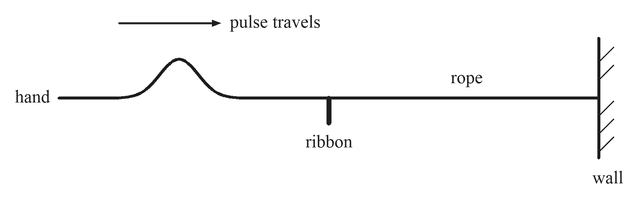
(a) Describe how the ribbon moves as the pulse passes it.
(b) What does the pulse carry from the student's hand to the wall? Give one observation that supports your answer.
- 31 mark
Question 3
An electron microscope can show details far smaller than an ordinary light microscope can. The waves that form its image are
- 43 marks
Question 4
During a thunderstorm, an observer sees a lightning flash and hears its thunder later. (Hypothetical data.) Take the speed of sound in air as and the speed of light as .
(a) How far away was the lightning?
(b) How long did the light of the flash take to reach the observer, and why can this time be ignored in (a)?
(c) Say whether thunder and the light of the flash are mechanical or electromagnetic waves.
- 51 mark
Question 5
Mission control on the Earth asks a question by radio to an astronaut on the Moon, away, and the astronaut answers at once. Take the speed of radio waves as . The shortest time between the end of the question and the start of the reply heard on the Earth is about
- 63 marks
Question 6
Classify each wave below as mechanical or electromagnetic, and say whether it could travel across the vacuum of space.
(a) Ultrasound used to scan an unborn baby
(b) Microwaves heating food in an oven
(c) Seismic waves shaking the ground after an earthquake
(d) Wi-Fi signals passing from a router to a laptop
(e) The wave that carries a voice along the taut thread of a toy “string telephone” made of two paper cups
- 71 mark
Question 7
After a large earthquake, seismograph stations on the side of the Earth directly opposite the earthquake record the longitudinal P waves, but no transverse S waves reach them along the direct path through the Earth's centre. This is evidence that
- 81 mark
Question 8
Deep-water waves pass a small ball floating far out at sea. Watched over several waves, the ball moves
- 93 marks
Question 9
A long rope passes through a narrow vertical slit cut in a wooden board and is tied to a post beyond it, as shown in the figure. The slit is only a little wider than the rope. A student sends waves along the rope from the free end in three different ways:
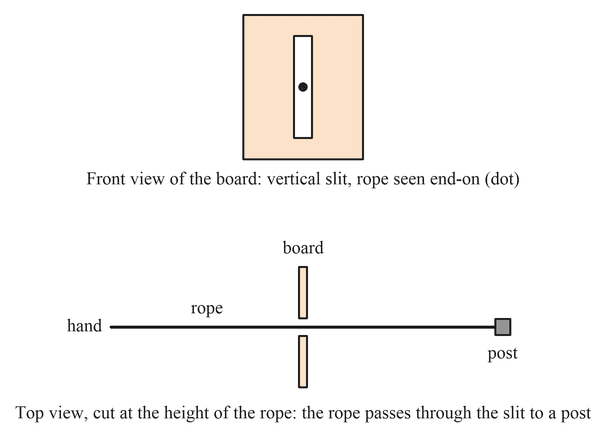
(a) by moving the end up and down (vertically);
(b) by moving the end from side to side (horizontally);
(c) by pushing and pulling the end along the length of the rope.
For each, state whether the wave gets through the slit to the part of the rope beyond the board, and explain why.
- 103 marks
Question 10
The figure shows the positions of the layers of air in a long tube at one instant, as a sound wave travels through it from left to right. (The crowding of the layers is greatly exaggerated.) The letters K, L, M and N mark four places along the tube, and the distance from K to N is . (Hypothetical data.)
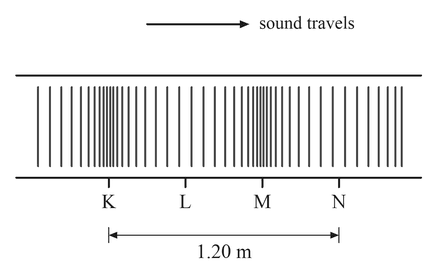
(a) Which of the marked places are at the centres of compressions, and which are at the centres of rarefactions?
(b) Find the wavelength of the sound.
(c) The sound travels at in the tube. Find its frequency.
- 111 mark
Question 11
A transverse wave travels along a stretched horizontal string. When a small piece of the string is pulled sideways out of line, the force that pulls it back towards its undisturbed position comes from
- 123 marks
Question 12
A seismograph station records the longitudinal P waves from an earthquake before the transverse S waves arrive. In the rock between the earthquake and the station, P waves travel at and S waves at . (Hypothetical data.)
(a) Describe how the rock particles move as each kind of wave passes.
(b) Find the distance of the station from the earthquake.
(c) How long after the earthquake did the P waves reach the station?
- 131 mark
Question 13
Sound of frequency passes from air, where its speed is , into water, where its speed is . In the water, the frequency and the wavelength of the sound are
- 143 marks
Question 14
A hospital scanner sends ultrasound of frequency into the body. In soft tissue it travels at . (Hypothetical data.)
(a) Find the wavelength of the ultrasound in soft tissue.
(b) A short pulse is reflected from a boundary below the skin. How long after the pulse is sent does its echo return to the scanner?
(c) Details much smaller than about one wavelength cannot be made out in the image. Explain why scanners use frequencies of a few megahertz rather than, say, .
- 153 marks
Question 15
In a ripple tank, a straight dipper vibrates and sends straight ripples across the water. The dipper makes 50 complete vibrations in . The figure shows the crests at one instant; the distance from the first crest to the seventh crest is . (Hypothetical data.)
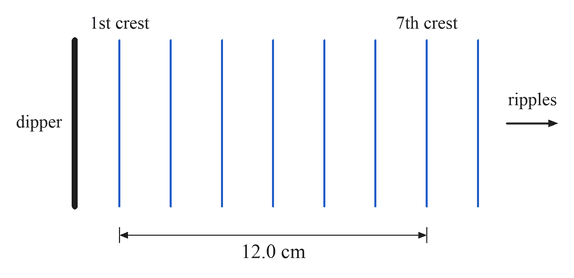
Find (a) the frequency and the time period of the ripples, (b) their wavelength, and (c) their speed.
- 161 mark
Question 16
A student puts one ear to one end of a long straight steel rail, and a friend away strikes the other end once with a hammer. The student hears two sounds, one through the steel and one through the air, apart. The speed of sound in air is . (Hypothetical data.) The speed of sound in the steel is
- 172 marks
Question 17
A violin plays the note A at and then the A one octave lower, at . Sound travels at in the air of the hall.
(a) Find the wavelength of each note in the air.
(b) Does the higher note reach a listener at the back of the hall sooner than the lower note? Explain.
- 184 marks
Question 18
A long heavy rope lies straight on a smooth floor. A student moves one end from side to side along the floor, making 3 complete oscillations every , and the crests on the rope are apart. (Hypothetical data.)
(a) Find the frequency and the time period of the wave.
(b) Find the speed of the wave.
(c) How long does a crest take to travel along the rope?
(d) The student now moves the end twice as often, while the rope and its tension stay the same. What happens to the wavelength? Explain.
- 193 marks
Question 19
A vibrator drives one end of a long stretched elastic cord at different frequencies, and a student measures the wavelength of the waves on the cord each time. The tension is not changed. (Hypothetical data.)
Frequency (Hz) 4.0 6.0 8.0 12.0 Wavelength (m) 1.20 0.80 0.60 0.40 (a) Use the table to show that the waves travel at the same speed at every frequency, and find that speed.
(b) Predict the wavelength when the frequency is .
(c) What decides the speed of the waves on the cord: the vibrator or the cord? Use the table to explain.
- 201 mark
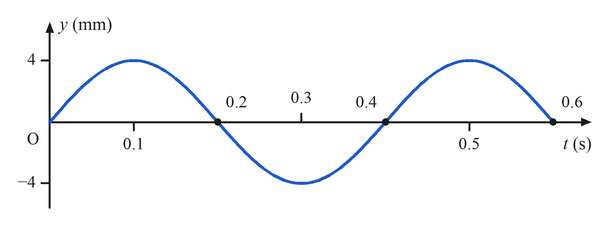
Question 20
The graph shows how the displacement of one particle of a medium changes with time as a wave passes through the medium. The frequency of the wave is
- 214 marks
Question 21
A harmonic wave travels in the direction along a long string. Graph (a) shows the displacement of the string against position at the instant . Graph (b) shows the displacement of one particle of the string against time. (Hypothetical data.)
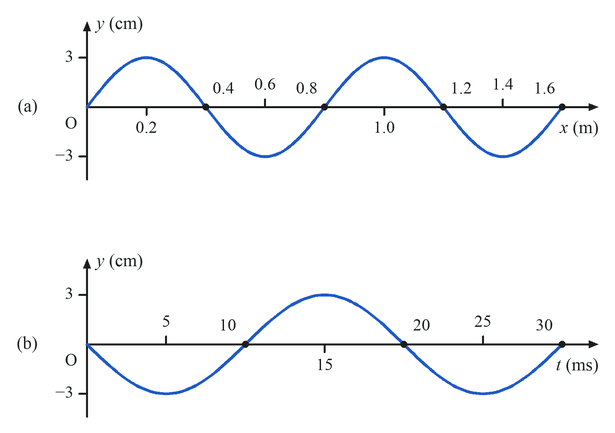
(a) Which graph gives the wavelength and which gives the time period? Explain why.
(b) Write down the amplitude, the wavelength and the time period.
(c) Find the frequency and the speed of the wave.
(d) How far does the wave travel in ?
- 223 marks
Question 22
The two graphs show the shape of a wave on a rope at and later. In this time the wave has moved less than half a wavelength. (Hypothetical data.)
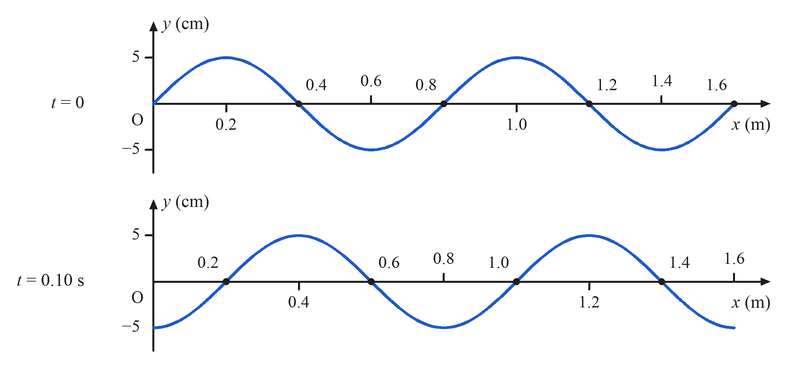
(a) In which direction is the wave travelling?
(b) Find the speed of the wave.
(c) Find its frequency and time period.
- 231 mark
Question 23
A sound wave travels through air in the direction. The graph shows, at one instant, the displacement of the air layers from their normal positions, plotted against their normal positions . A positive means a layer is displaced in the direction. At which marked point is the air at the centre of a compression?

- 243 marks
Question 24
The figure shows the shape, at , of a harmonic wave travelling in the direction along a string at . (Hypothetical data.)
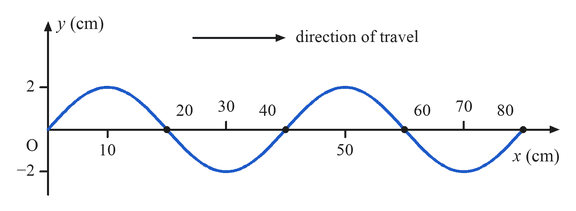
(a) Find the time period of the wave.
(b) Does the particle of the string at move up or down just after ? Explain.
(c) Draw the displacement–time graph of the particle at for one period, marking the scales on both axes.
- 253 marks
Question 25
A harmonic wave travels along a string from a particle P to a particle Q, which is farther along the string. The distance PQ is less than one wavelength. The graphs show the displacements of P and Q against time. (Hypothetical data.)

(a) Find the frequency of the wave.
(b) By how much time does the motion of Q lag behind that of P?
(c) Find the speed and the wavelength of the wave.
- 261 mark
Question 26
The end O of a long stretched string is moved up and down so that its displacement is , with in millimetres and in seconds. The wave produced travels along the string in the direction at , with O at . (Hypothetical data.) Once the wave has reached it, the displacement (in mm) of the particle at is
- 273 marks
Question 27
A wave travelling along a long rope is described by , where and are in metres and is in seconds. (Hypothetical data.)
(a) Find the earliest time after at which the particle at has its greatest positive displacement.
(b) At , find the position of the crest that is nearest to the origin on the positive side of the -axis.
(c) Where is this same crest at ?
- 281 mark
Question 28
A harmonic wave travelling in the direction is written as . At , the particle at has a displacement of and is moving towards its mean position. The initial phase is
- 293 marks
Question 29
At the shape of a long stretched rope is , with and in metres. This wave travels along the rope in the direction at without changing shape. (Hypothetical data.)
(a) Write the equation of the wave.
(b) Find the wavelength and the frequency of the wave.
(c) Find the displacement of the particle at at .
- 302 marks
Question 30
Riya writes the equation of a wave on a string as , while Kabir writes ; in both, is in cm, is in metres and is in seconds.
(a) Show that the two equations describe waves of the same speed travelling in the same direction.
(b) Do they describe the same wave? Compare the displacements they give for the particle at at .
- 312 marks
Question 31
A single pulse travels along a long rope. Its shape is described by
Here and are in metres and is in seconds. (Hypothetical data.)
(a) In which direction does the pulse travel, and at what speed?
(b) Where is the peak of the pulse at , and how high is it there?
- 324 marks
Question 32
A vibrator at the origin O drives a harmonic wave along a long string in the direction at . The particle at O is filmed, and its displacement is plotted against time below. (Hypothetical data.)
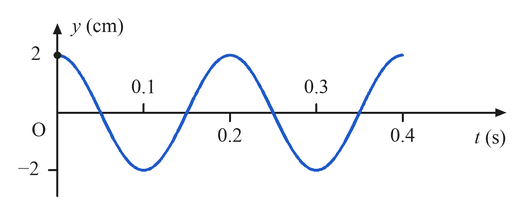
(a) Using the plot, write the equation of the wave in the form , with numerical values of , , and .
(b) Find the displacement of the particle at at .
- 331 mark
Question 33
A wave on a string is , with and in metres and in seconds. Its phase is . At one instant, the phase of the particles is plotted against their position . The plot is
- 343 marks
Question 34
(a) For a wave , show that a point of constant phase, such as a crest, moves along the -axis with speed .
(b) A wave on a long stretched rope is , with and in metres and in seconds. (Hypothetical data.) How far does a crest of this wave travel in ?
- 353 marks
Question 35
A harmonic wave of frequency and amplitude travels along a long stretched rope. At one instant a particle P of the rope is above its mean position. (Hypothetical data.)
(a) Find the speed of P at that instant.
(b) Find the magnitude and direction of the acceleration of P at that instant.
- 361 mark
Question 36
A transverse wave travels in the direction along a stretched string at . At one instant the slope of the string at a point P is . (Hypothetical data.) At that instant, the particle of the string at P is
- 371 mark
Question 37
The same vibrator drives two long stretched strings X and Y, so that waves of the same frequency and the same amplitude travel along both. The waves travel twice as fast along Y as along X. The greatest speed of a particle of string Y is
- 383 marks
Question 38
A loudspeaker sends a sound wave through air, in which sound travels at . The air layers vibrate with a displacement amplitude of . (Hypothetical data.)
(a) What total distance does one layer of air travel during one period of the wave?
(b) How far does the wave advance in the same time?
(c) How many times as far as the layer travels does the wave advance in one period?
- 391 mark
Question 39
A harmonic wave passes through a medium. For one particle of the medium, the ratio of its average speed over one complete period to its greatest speed is
- 403 marks
Question 40
A triangular pulse ABC travels along a long stretched string in the direction at without changing shape. At one instant it is as shown: the back edge AB rises over a horizontal distance of , and the front edge BC falls back to the level of the string over . (Hypothetical data.)
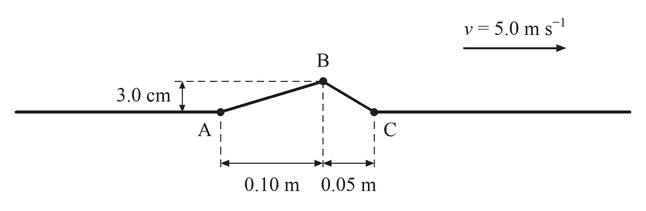
(a) Find the velocity (magnitude and direction) of a particle of the string on the back edge AB.
(b) Find the velocity of a particle on the front edge BC.
(c) What is the velocity of a particle of the string outside the pulse?
- 414 marks
Question 41
A wave on a stretched string is , with and in metres and in seconds. (Hypothetical data.)
(a) Write the expression for the velocity of the particle at position at time .
(b) At , find and at , , , and .
(c) Sketch and against at , and use your sketch to state the phase difference between the particle velocity and the displacement.
- 422 marks
Question 42
A tiny bead of mass is glued to a long stretched string; it is light enough not to change the wave. A transverse harmonic wave of amplitude and frequency travels along the string. (Hypothetical data.)
(a) Find the greatest speed of the bead and its greatest kinetic energy.
(b) Where is the bead when its kinetic energy is greatest, and where is it when its kinetic energy is zero?
- 431 mark
Question 43
A sound wave of intensity travels through air. Its amplitude is increased by and, at the same time, its frequency is reduced by ; the medium is unchanged. The new intensity is about
- 443 marks
Question 44
Two sound waves of the same frequency, , have the same intensity, . One travels through air (density , speed of sound ) and the other through water (density , speed of sound ). (Hypothetical data.)
(a) Without finding either amplitude, find the ratio of the displacement amplitude in air to that in water.
(b) Find the displacement amplitude in air and in water.
(c) Explain why the water layers vibrate with a much smaller amplitude while carrying the same intensity.
- 451 mark
Question 45
A small source sends sound out equally in all directions through still air, and the air absorbs a negligible amount of it. At from the source the displacement amplitude of the air layers is . At from the source the amplitude is
- 463 marks
Question 46
A public-address loudspeaker at a sports ground sends out of sound power equally in all directions. Treat it as a point source, and ignore absorption and reflection of the sound. (Hypothetical data.)
(a) At what distance from the loudspeaker is the intensity ?
(b) A listener stands at this distance. Taking the opening of the listener's ear canal to have an area of , find the sound energy that enters one ear in one minute.
- 471 mark
Question 47
Which one of the following statements about the intensity of a wave is correct?
- 482 marks
Question 48
In an office where people are talking, the sound intensity near a desk is . Sound travels at in the air of the room. (Hypothetical data.)
(a) Find the energy density of the sound, that is, the sound energy in each cubic metre of air.
(b) If this energy density were the same throughout the room, of volume , how much sound energy would the room hold?
- 493 marks
Question 49
During a hearing test, two pure tones, of frequencies and , reach a listener through the same air with the same intensity. (Hypothetical data.)
(a) Find the ratio of the displacement amplitude of the tone to that of the tone.
(b) Compare the greatest speeds of the air layers in the two tones.
(c) Compare the energy densities of the two tones.
- 501 mark
Question 50
In a sound wave in air, the greatest speed of the vibrating air layers is . The density of air is and sound travels at . (Hypothetical data.) The intensity of the wave is about
- 513 marks
Question 51
How far does sound travel in air when a tuning fork of frequency 480 Hz completes 50 vibrations. Velocity of sound is 348 m s.
- 523 marks
Question 52
A broadcasting station radiates at a frequency of 555 kHz. What is the wavelength? Given velocity of wave is m s.
- 533 marks
Question 53
A plane progressive wave is given by, , where is in second, is in m. Find the amplitude and phase difference between two points separated by a distance 0.01 m.
- 543 marks
Question 54
A progressive wave of frequency 550 Hz is travelling with a velocity of 360 m s. How far apart are the two points out of phase?
- 553 marks
Question 55
A broadcasting station radiates at a frequency of 710 kHz. What is the wavelength? Velocity of light m/s.
- 563 marks
Question 56
How far does the sound travel in air when a tuning fork of frequency 500 Hz completes 25 vibrations? Velocity of sound in air is 332 m s.
- 573 marks
Question 57
What is the wavelength of a wave frequency 262 Hz in water, if the wave velocity is 1480 m s in water?
- 583 marks
Question 58
The intensity of a wave emitted from a small source at a distance 10 m is W m. What is the intensity at a distance 100 m?
- 591 mark
Question 59
A wave is represented by the equation , where is in metres and in seconds. The velocity of the wave is
- 601 mark
Question 60
A simple harmonic progressive wave is represented by the equation where and are in cm and is in seconds. At any instant the phase difference between two particles separated by in the -direction is
- 611 mark
Question 61
The equation of a transverse wave travelling on a rope is given by where and are in cm and in seconds. The maximum transverse speed of a particle in the rope is about
- 621 mark
Question 62
The rope shown in the given figure, at an instant is carrying a wave travelling towards right, created by a source vibrating at a frequency . Consider the following statements

I. The speed of the wave is
II. The medium of will be in the same phase as after s
III. The phase difference between and is
Which of these statements are correct?
- 631 mark
Question 63
The equation of a sound wave is
The wavelength of this wave is
- 641 mark
Question 64
The equation of the propagating wave is , where is displacement. Which of the following statements is not true?
- 651 mark
Question 65
The following phenomenon cannot be observed for sound waves
- 661 mark
Question 66
Which of the following is not true for this progressive wave where and are in cm and in s?
- 671 mark
Question 67
The phase difference between two waves represented by
where is expressed in metres and is expressed in seconds, is approximately
- 681 mark
Question 68
Which one of the following statements is true?
- 691 mark
Question 69
Given that , where and are measured in metres. Which of the following statements is true?
- 701 mark
Question 70
Two waves are given by and . The phase difference between the two waves is
- 711 mark
Question 71
If , , , . For given progressive wave equation, phase difference between two vibrating particles having path difference would be
- 721 mark
Question 72
The wave described by where and are in meters and in seconds, is a wave travelling along the
- 731 mark
Question 73
The equation of a plane progressive wave is given by . The frequency of this wave would be
- 741 mark
Question 74
The displacement of a wave travelling in the -direction is given by
where is expressed in metres and in seconds. The speed of the wave motion in , is
- 751 mark
Question 75
The equation of a travelling wave is where is in microns, in seconds and in metres. The ratio of maximum particles velocity to velocity of wave propagation is
- 761 mark
Question 76
A wave is represented by the equation . It is a travelling wave propagating along the direction with velocity
- 771 mark
Question 77
A progressive wave travelling along the positive -direction is represented by . Its snapshot at is given in the figure. For this wave, the phase is

- 781 mark
Question 78
For a transverse wave travelling along a straight line, the distance between two peaks (crests) is , while the distance between one crest and one trough is . The possible wavelengths (in m) of the waves are
- 791 mark
Question 79
A sound wave of frequency travels with the speed of along the positive -axis. Each point of the wave moves to and fro through a total distance of . What will be the mathematical expression of this travelling wave?
- 801 mark
Question 80
A longitudinal wave is represented by cm. The maximum particle velocity will be four times the wave velocity if the determined value of wavelength is equal to
- 811 mark
Question 81
A travelling wave is described by the equation . The velocity of the wave is: [All the quantities are in S.I. unit]
- 821 mark
Question 82
Read the assertion and reason carefully to mark the correct option out of the options given below:
Assertion: Like sound, light cannot propagate in vacuum.
Reason: Sound is a square wave. It propagates in a medium by a virtue of damping oscillation.
- 831 mark
Question 83
Read the assertion and reason carefully to mark the correct option out of the options given below:
Assertion: Speed of wave
Reason: Wavelength is the distance between two nearest particles in phase.
- 841 mark
Question 84
The distance between two consecutive points with phase difference of in a wave of frequency is . The velocity with which the wave is traveling is ______ km/s.