
Question 352 marksEasy
Using suitable diagram, explain how sound wave propagates through air from a vibrating tuning fork.
Confirming your payment
Sign up now and get 250 free tokens.
Waves: Wave Motion · Question 35 of 52
Using suitable diagram, explain how sound wave propagates through air from a vibrating tuning fork.
Solution:
Concept: Sound in air is a longitudinal wave: the air layers vibrate back and forth along the direction of travel, forming compressions (high pressure) and rarefactions (low pressure).
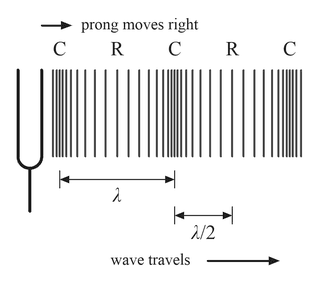
Step 1 — Prong moving outward. When a prong of the fork moves outward (to the right in the figure), it pushes the layer of air next to it and squeezes it. This creates a region of higher pressure and density, a compression C.
Step 2 — The compression moves on. Because air is elastic, the compressed layer pushes on the next layer and then relaxes, the next layer pushes on the one after it, and so on. The compression thus travels away from the fork.
Step 3 — Prong moving back. When the prong moves back (to the left), the air next to it gets more room, and a region of lower pressure and density, a rarefaction R, is formed. The neighbouring layer, being at a higher pressure, moves into it, and the rarefaction also travels outward.
Step 4 — The result. As the fork keeps vibrating, alternate compressions and rarefactions move out through the air, as shown in the figure. The air layers only vibrate about their mean positions along the direction of travel; one compression and the next rarefaction together make one wavelength .
Therefore, a vibrating tuning fork sends out alternate compressions and rarefactions that travel through the air as a longitudinal wave, while each layer of air only vibrates back and forth about its mean position.