Solution:
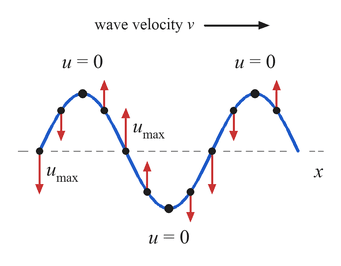
Concept: The particle velocity u=∂t∂y describes how fast one particle moves about its mean position, while the wave velocity v describes how fast the pattern travels. The slope ∂x∂y of the displacement–distance graph links the two.
Step 1 — Write the wave (part a). A wave travelling along +x with amplitude A, period T and wavelength λ is
y=Asin2π(Tt−λx)
Step 2 — Find the particle velocity (part a). Differentiating with respect to t, keeping x fixed:
u=∂t∂y
u=T2πAcos2π(Tt−λx)
Step 3 — Find the slope of the displacement graph (part a). Differentiating with respect to x, keeping t fixed:
∂x∂y=−λ2πAcos2π(Tt−λx)
Step 4 — Divide the two results (part a). The cosine factors cancel:
∂y/∂xu=−Tλ
Since Tλ=v:
u=−v∂x∂y
So the particle velocity equals minus the wave velocity times the slope of the displacement–distance graph at that point. Where the slope is zero (crests and troughs) the particles are momentarily at rest; where the slope is steepest (at the mean position) they move fastest, with umax=ωA. The figure shows this for a wave moving to the right. The particle velocity also differs in phase from the displacement by 2π.
Step 5 — Define the wavefunction (part b). The displacement of a one-dimensional progressive wave satisfies the wave equation
∂t2∂2y=v2∂x2∂2y
Writing the disturbance as ψ, the equation ∂t2∂2ψ=v2∂x2∂2ψ holds, and ψ(x,t) is called the wavefunction.
Step 6 — State its significance (part b). The wavefunction is the quantity that actually varies as the wave passes, and any function satisfying the equation describes a possible wave moving with speed v. For a wave on a string or on the surface of water, ψ is the displacement; for an electromagnetic wave, it is the electric field E or the magnetic field B; for a sound wave, it represents the pressure variations.
Step 7 — Find the excess pressure (part c). In a longitudinal wave the excess pressure is proportional to how much the medium is squeezed. With E the elasticity (bulk modulus) of the medium:
p=−E∂x∂y
Using the slope from Step 3:
p=λ2πEAcos2π(Tt−λx)
Step 8 — Write the pressure amplitude (part c). The largest value of the excess pressure is the pressure amplitude:
p0=λ2πEA
Since E=ρv2 and λv=n, it can also be written p0=2πρvnA. For a gas, E=γP for sound (adiabatic changes). The figure shows that the pressure is greatest or least where the displacement is zero.

Therefore, (a) the particle velocity is u=−v∂x∂y; (b) the wavefunction ψ is the disturbance (displacement, field or pressure change) that satisfies the wave equation and describes the wave; and (c) the pressure amplitude of a longitudinal wave is p0=λ2πEA, where E is the elasticity of the medium.
