
Question 515 marksMedium
(a) What is a harmonic wave? Write down the general expression for a harmonic wave.
(b) Show that the phase of a wave changes (i) with time and (ii) with distance.
(c) Explain the characteristics of a progressive wave.
Confirming your payment
Sign up now and get 250 free tokens.
Waves: Wave Motion · Question 51 of 52
(a) What is a harmonic wave? Write down the general expression for a harmonic wave.
(b) Show that the phase of a wave changes (i) with time and (ii) with distance.
(c) Explain the characteristics of a progressive wave.
Solution:
Concept: In a harmonic wave every particle of the medium performs simple harmonic motion, so the wave can be written with a sine or cosine function of .
Step 1 — Define a harmonic wave (part a). When a wave propagates through a medium and the particles of the medium vibrate simple harmonically, the wave is called a harmonic wave. It is represented by a sine or a cosine function. If it advances through the medium undamped and unobstructed, it is a plane progressive harmonic wave.
Step 2 — Write the general expression (part a). We take a wave of amplitude , angular frequency and propagation constant , travelling in the direction with initial phase ; its displacement is:
The same wave can be written equivalently as:
For a wave travelling in the direction, is replaced by .
Step 3 — Show that the phase changes with time (part b, i). The phase of the particle at is
Keeping fixed and letting the time change by :
The phase of a particle grows steadily with time; when , , so the particle returns to the same state of vibration after every period.
Step 4 — Show that the phase changes with distance (part b, ii). Keeping fixed and comparing two particles a distance apart:
The phase falls off steadily with distance (each particle lags behind the one before); when , the phase difference is . The figure shows the pattern repeating every wavelength.
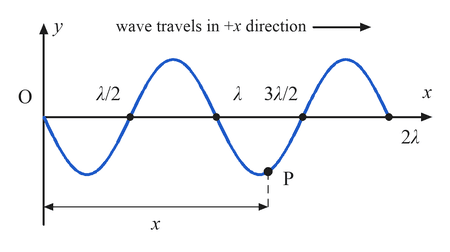
Step 5 — State the characteristics of a progressive wave (part c). The main characteristics are:
Therefore, a harmonic wave is one in which every particle performs SHM, given by ; its phase changes by with time and by with distance; and a progressive wave carries energy forward undamped while the particles vibrate with the same amplitude and frequency but different phases.