Solution:
Concept: A wave is a disturbance handed on from particle to particle of a medium; the particles vibrate while the disturbance and its energy travel.
Step 1 — State the characteristics of wave motion (part a). The main characteristics are:
- A material medium with elasticity and inertia is necessary for the propagation of mechanical waves; electromagnetic waves need no medium.
- The disturbance travels outward, but the particles of the medium do not travel; they vibrate about their mean positions.
- Each particle starts vibrating a little later than its predecessor, so it lags behind it by a definite phase angle.
- The velocity of the wave is constant in a given uniform medium, but the velocity of a particle varies from point to point and from instant to instant.
- When waves pass from one medium to another they are partly reflected and partly refracted; mechanical waves also show interference and diffraction.
- Transverse waves, such as electromagnetic waves, can be polarised; longitudinal waves such as sound cannot.
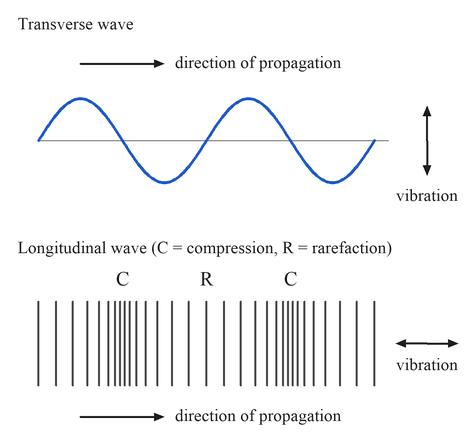
Step 2 — Explain the difference between the two kinds of wave (part b). In a longitudinal wave the particles vibrate parallel to the direction of propagation, and the wave travels as compressions and rarefactions; one compression and one rarefaction make one wavelength. In a transverse wave the particles vibrate perpendicular to the direction of propagation, and the wave travels as crests and troughs; one crest and one trough make one wavelength. A longitudinal wave cannot be polarised, but a transverse wave can. Sound in air is longitudinal; a wave on a string and light are transverse.
Step 3 — Set up the formation of a transverse wave (part c). Take five particles 1 to 5 at equal distances along a straight line, so spaced that the disturbance takes a time 4T to pass from one particle to the next. Particle 1 is made to vibrate at right angles to the line, starting downwards.
Step 4 — Follow the particles through one period. At t=0 all particles are on the line and particle 1 just starts moving down. At 4T particle 1 is at its lowest position and particle 2 just starts. At 42T particle 1 is back at its mean position, particle 2 is lowest and particle 3 starts. At 43T particle 1 is highest, particle 2 at the mean position, particle 3 lowest and particle 4 starts. At 44T=T particle 1 is back at its starting position, particle 2 is highest, particle 3 at the mean position, particle 4 lowest and particle 5 just starts. One complete wave (a crest and a trough) has then formed between particles 1 and 5.

Note: the stem prints "t=34T" twice; the last time is taken as 44T, one full period T, which completes the cycle.
Therefore, the figure shows the formation of a transverse wave: after each quarter period the disturbance reaches one more particle, and after one period T a complete wavelength, one crest and one trough, has formed between particles 1 and 5.
